
Key Takeaways
- Log each drink with its time. The calculator adds them up and estimates how much caffeine may still be around right now and at your bedtime, using a simple half-life model.
- Half-life is how long it takes for half of a dose to fade. ISSN reports an average of 4 to 6 hours, and a range of 1.5 to 10 hours between adults[2]. The default here is 5 hours, and you can change it.
- The targets are yours. Set an evening level and a daily total that suit your routine. The 400 mg line is only a figure FDA cites for most adults, shown as a reference[1].
- For a workout, ISSN reports benefits at 3 to 6 mg per kg taken about 60 minutes before[2]. The planner shows what that dose would add at bedtime.
- Drink values are typical figures and real cups vary a lot. Supplement labels can be off by a wide margin, so type in the label value when you have one[7][8].
What This Calculator Does
Most caffeine counters stop at a daily total, and a total does not say much about the evening. Two people can both log 300 mg, and one had it all before 10 am while the other had a cup at 5 pm.
This tool keeps the time for every drink, so you can see the shape of your day, not only the sum.
It is a logging and planning aid. Pick a drink, enter the servings and the time, and it draws an estimated curve for the day, with markers for now and for your bedtime. Caffeine is not only in coffee.
Tea, soft drinks, energy drinks, chocolate, bars, gum and dietary supplements all count[1], and the body handles caffeine from tea or coffee the same way as caffeine added to a product[1].
Your drinks are saved in your browser for the day, and your settings stay until you reset them. There is no account.
How the Timeline Works
Each drink gets its own curve: a quick rise, then a slow fade. The curves are added together.
| Part of the model | What it uses | Basis |
|---|---|---|
| Fade speed | Half-life: Faster 3 h, Typical 5 h, Slower 8 h, or your own 2 to 10 h | ISSN: average 4 to 6 h, range 1.5 to 10 h[2]. The three presets sit inside that range. |
| Rise after a drink | Absorption half-life of 12 minutes, which peaks about 50 to 66 minutes after a drink for those presets | ISSN: peak levels 30 to 120 minutes after a dose, with near-complete absorption[2]. The 12 minutes is my modelling choice to land in that window. |
| Several drinks | Each drink is modelled on its own, and the amounts are added | A simplifying assumption of this model: drinks do not affect each other |
| Bedtime | The clock time you enter. Times before 4:00 count as after midnight | Calculator rule |
The model, and where each assumption comes from.
In maths, the share of a dose still around t minutes after a drink is ka ÷ (ka − ke) × (e^(−ke·t) − e^(−ka·t)). Here ke is ln 2 divided by your half-life, and ka is ln 2 divided by 12 minutes.
Five hours after a drink, with a 5 hour half-life, about 52% of the dose is still counted. That is just above half, because the first hour is spent rising.
Worked example: coffee at 8:00 and 2:00 pm, 5 hour half-life, 22:30 bedtime
Each cup is 96 mg, so the day totals 192 mg. By 10:30 pm the model counts about 44 mg as still around. The 2:00 pm cup alone accounts for about 31 mg of that, which is most of it, because the morning cup has faded much further.
With an evening target of 50 mg, the estimate is at or under it from about 9:37 pm. The calculator can also work the other way.
It can find the latest time a planned drink still fits under your target, counting any drink taken within about an hour of bedtime at its peak.
Treat the curve as a way to compare plans, such as moving a cup from 4 pm to noon, and not as a reading of what is in you.
Caffeine Before a Workout
The ISSN position stand says caffeine has consistently improved exercise performance at 3 to 6 mg per kg of body mass. The lowest effective dose is unclear and may be as low as 2 mg per kg.
Very high doses, such as 9 mg per kg, are linked to a high rate of side effects and do not seem to be needed for the benefit[2].
The most common timing is about 60 minutes before exercise, and caffeine chewing gum may need a shorter wait than capsules[2].
Worked example: 80 kg, workout at 6:00 pm, same two coffees
2 mg per kg is 160 mg, and the ISSN range of 3 to 6 mg per kg is 240 to 480 mg. To follow the timing, take it around 5:00 pm.
On top of the two coffees, the low end would leave about 161 mg around at 10:30 pm and the high end about 277 mg, compared with 44 mg without it.
That is the part a workout-time dose adds to your evening, and the planner shows it for your own numbers.
The ISSN also notes that people respond differently, and that the benefit has to be weighed against side effects, so finding out how you respond matters more than the exact number[2].
The review reports mixed findings on whether regular users benefit less than occasional users, so this calculator does not shrink or grow the range for habit[2].
How Much Is in Your Cup
These are the values the calculator uses. They are typical figures, and a real cup can be well above or below them.
| Source | Serving | Caffeine | Source |
|---|---|---|---|
| Espresso, single shot | 1 fl oz (30 mL) | 63 mg | [3] |
| Brewed coffee | 8 fl oz (237 mL) | 96 mg | [3] |
| Instant coffee | 8 fl oz (237 mL) | 62 mg | [3] |
| Decaf brewed coffee | 8 fl oz (237 mL) | 2 mg | [1] |
| Black tea, brewed | 8 fl oz (237 mL) | 48 mg | [3] |
| Green tea, brewed | 8 fl oz (237 mL) | 29 mg | [3] |
| Coca-Cola Original | 12 fl oz can | 34 mg | [5] |
| Diet Coke | 12 fl oz can | 46 mg | [5] |
| Red Bull Energy Drink | 8.4 fl oz can | 80 mg | [6] |
| Energy shot | 2 fl oz (60 mL) | 200 mg | [3] |
| Dark chocolate, 60 to 69% cacao | 1 oz (28 g) | 24 mg | [4] |
Caffeine per serving. Source numbers match the sources list.
For a sense of the spread, FDA lists typical amounts per 12 oz: caffeinated soft drinks 23 to 83 mg, green tea 37 mg, black tea 71 mg, regular brewed coffee 113 to 247 mg and energy drinks 41 to 246 mg[1]. Decaf is not caffeine-free.
An 8 oz cup usually has 2 to 15 mg[1]. Researchers have reported roughly 8 to 9 fold differences in caffeine between coffees bought from similar shops[2], so for a coffee shop drink, a published value for that product beats any average.
Restaurants and other food outlets are not required to tell you how much caffeine is in what they serve, and FDA encourages you to ask[1]. The table only lists drinks tied to a published source.
For anything else, such as cold brew, matcha or chai, use Label value or Save your own drink.
Pre-Workouts, Pills and Labels
Independent testing of 15 popular pre-workout supplements in Australia found between 91 and 387 mg of caffeine per serving. Only 6 of the 15 listed the caffeine amount on the label.
Among those, the measured caffeine ranged from 59% to 176% of what the packaging claimed, and nearly every product varied by 40 mg or more within or between batches[7].
A 2013 US study of popular capsule, powder and tablet supplements sold on military bases found the same problem.
Of 20 products that listed caffeine, only 9 had a label within 10% of the measured amount, and 6 products that named caffeine without an amount held 210 to 310 mg per serving[8].
Both studies tested a small number of products, and the US one tested a single sample of each, so they show a risk, not the state of every product today.
The practical takeaway is simple. Use Label value or Save your own drink, enter the mg from the pack, and treat it as a best guess. If a product lists caffeine without an amount, assume it could be high, because the six such products in that study were.
Why Your Numbers Will Differ
Two people logging the same drinks at the same times can end up with different real curves. ISSN puts the range of half-life between adults at 1.5 to 10 hours and links the spread to several factors, including variation in the CYP1A2 gene and heavy regular caffeine use[2].
FDA also notes wide variation in how fast people eliminate caffeine[1].
That is why the speed setting is yours to change. A shorter half-life pulls the curve down sooner, and a longer one keeps it up into the evening.
If you move it from 5 hours to 8 hours for the two-coffee example above, the bedtime estimate goes from about 44 mg to about 75 mg. Try your own day with each setting to see how much the answer depends on it.
What This Calculator Cannot Tell You
- It is an estimate from a simple model. It is not a measurement of what is in your body, and it is not a test.
- The mg for drinks are typical values. Your actual intake can be quite different, especially for coffee and supplements.
- It does not know your own half-life. The presets sit inside the range ISSN reports[2].
- Food, drink size changes, sipping slowly and your routine are not modelled beyond the time you enter.
- The targets are your own numbers. The 400 mg line is a reference FDA cites for most adults, not a rule for you[1].
- This is an informational and journaling tool for personal awareness, and it is not medical advice.
Frequently Asked Questions
Sources & References
- Spilling the Beans: How Much Caffeine Is Too Much? (content current as of 08/28/2024). U.S. Food and Drug Administration. FDA Consumer Update (2024)
- International society of sports nutrition position stand: caffeine and exercise performance. Guest NS, VanDusseldorp TA, Nelson MT, et al.. Journal of the International Society of Sports Nutrition 18:1 (2021)
- Caffeine content for coffee, tea, soda and more (updated February 6, 2025). Mayo Clinic Staff. Mayo Clinic (2025)
- Caffeine content of selected foods, abridged list (USDA National Nutrient Database for Standard Reference, Legacy). USDA National Agricultural Library. USDA NAL (2018)
- What is caffeine? (FAQ: Coca-Cola 34 mg and Diet Coke 46 mg per 12 oz). The Coca-Cola Company. Coca-Cola US
- How much caffeine is in a can of Red Bull Energy Drink?. Red Bull GmbH. Red Bull US
- Caffeine content of pre-workout supplements commonly used by Australian consumers. Desbrow B, Hall S, O'Connor H, Slater G, Barnes K, Grant G. Drug Testing and Analysis 11(3):523-529 (2019)
- Caffeine Content of Dietary Supplements Consumed on Military Bases. Cohen PA, Attipoe S, Travis J, Stevens M, Deuster PA. JAMA Internal Medicine 173(7):592-594 (2013)

Certified Personal Trainer & Sports Nutritionist
NASM-certified fitness and nutrition coach with over 10 years of hands-on experience helping people build strength, lose fat, and live healthier lives. Specializing in gym-based workouts with a strong focus on lifting technique, biomechanics, and practical exercise science. Through FitLifeRegime, sharing the tools, tips, and insights that have worked for hundreds of clients — helping you start your own fitness journey with confidence and clarity.
Learn more about Manish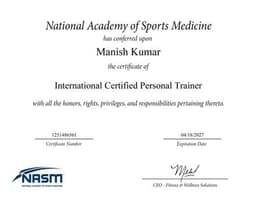
NASM Certified
Certified Personal Trainer & Sports Nutritionist from the National Academy of Sports Medicine
Disclaimer: This calculator is for informational and personal journaling purposes only. It logs measurements and compares them to published reference values. It is not health, medical, or nutrition advice.