
Key Takeaways
- Calories from steps depend on how long the steps took and how much energy each minute used. The tool works out the time from steps per minute and the energy from your weight and walking speed, using treadmill measurements from the CADENCE-Adults studies[2][3]. For 10,000 steps at 70 kg and 3.0 mph, the answer is about 325 kcal counting only the energy above resting, or 430 kcal counting all the energy while walking.
- Speed changes the answer a lot, because the same steps take less time but use more energy each minute at a faster pace. For 10,000 steps at 70 kg, the extra-only figure is about 240 kcal at 2.0 mph and 495 kcal at 4.0 mph. A single calories-per-step number hides that.
- Weight matters in proportion. At 3.0 mph, 10,000 steps is about 325 kcal at 70 kg and 415 kcal at 90 kg on the extra-only count.
- Treat the result as an average for a group, not a measurement of you. The 2024 Compendium says its values do not reflect precise individual energy expenditure[1]. The calculator rounds calories to the nearest 5 for that reason.
How It Works
Steps become minutes, and minutes become calories.
minutes = steps ÷ steps per minute
calories per minute = MET × 3.5 × weight in kg ÷ 200
calories = minutes × calories per minute
A MET is a multiple of resting energy use, and the 2024 Compendium defines 1 MET as 3.5 mL of oxygen per kg per minute[1], and says that is approximately 1.0 kcal per kg per hour.
The tool uses 5 kcal per litre of oxygen, which makes one MET 1.05 kcal per kg per hour, or 0.0175 per minute. That is where the ÷ 200 comes from.
The true figure runs from about 4.7 kcal per litre when you burn mostly fat to about 5.05 when you burn mostly carbohydrate[5], so expect a few percent of slack from this alone.
The METs and the steps per minute come from the same walkers. In CADENCE-Adults, healthy adults walked on a treadmill for five minutes at each speed from 0.5 mph upward.
An indirect calorimeter measured their oxygen use, which the researchers divided by 3.5 to get METs, and their steps were counted by hand[2]. The tool uses the averages for 1.5 to 4.0 mph.
One group was aged 21 to 40[2], the other 61 to 85[3]. This is the same data behind the Calories to Steps Calculator, so the two tools agree with each other.
Worked example: 10,000 steps, 70 kg, 3.0 mph, ages 21 to 40
At 3.0 mph the measured average was 4.0 METs and 113.6 steps per minute. 10,000 ÷ 113.6 = 88.0 minutes. All walking energy: 4.0 × 3.5 × 70 ÷ 200 = 4.90 kcal per minute, and 88.0 × 4.90 = 430 kcal.
Extra energy only: (4.0 − 1) × 3.5 × 70 ÷ 200 = 3.68 kcal per minute, and 88.0 × 3.68 = 325 kcal. In calories per step that is 0.043 counting everything and 0.032 counting the extra only.
Which count should I use? The all-walking figure is the total energy spent during the walk. The extra-only figure is what the walk added on top of the energy you would have used sitting still, and it is always the smaller number.
The METs in the Compendium and in these studies are total energy cost divided by 3.5, so they include the resting share and the all-walking number follows them directly.
The extra-only figure rests on one assumption: that you burn exactly 3.5 mL per kg per minute sitting still.
In a study that measured resting rate in 252 people, using 3.5 gave METs about 0.5 lower on average than using each person's own measured resting rate, and the errors were largest for people who were less fit, overweight or older[4]. So treat the extra-only count as approximate.
What 10,000 Steps Is Worth
Extra-energy calories for 10,000 steps, by speed and weight, ages 21 to 40.
| Speed | Steps/min | METs | 60 kg | 70 kg | 90 kg |
|---|---|---|---|---|---|
| 1.5 mph | 83.8 | 2.6 | 200 | 235 | 300 |
| 2.0 mph | 96.1 | 2.9 | 210 | 240 | 310 |
| 2.5 mph | 105.8 | 3.4 | 240 | 280 | 355 |
| 3.0 mph | 113.6 | 4.0 | 275 | 325 | 415 |
| 3.5 mph | 121.5 | 5.0 | 345 | 405 | 520 |
| 4.0 mph | 129.0 | 6.2 | 425 | 495 | 635 |
Calories for 10,000 steps counting only the energy above resting, using the measured steps per minute and METs at each treadmill speed. Rounded to the nearest 5.
Steps per minute at a given speed were within about 7 of each other in the two age groups, but the oxygen cost differs a little at the faster speeds. At 4.0 mph the average was 6.2 METs for the younger group and 5.5 for the older group.
Only 17 of the older walkers took the 4.0 mph bout, because testing stopped for anyone who chose to run, reached a heart rate limit or rated the effort too hard. That row rests on fewer people[3].
For all-walking calories, multiply the extra-only figure by MET ÷ (MET − 1), or let the calculator do it. The Calories to Steps Calculator shows the full table with the Compendium values beside the measured ones.
Limits of This Calculator
What the numbers cannot tell you.
Steps alone do not give a speed
You choose the pace, so the answer is only as good as that choice. The table above shows how far apart the speeds are. If your watch records cadence, enter it for a better time estimate.
Treadmill averages
Every value comes from level treadmill walking. The tool does not adjust for hills, wind, soft ground, carrying a load or the way you personally walk, and I did not find a source to adjust for them with.
Only the speeds that were measured
The speeds run from 1.5 to 4.0 mph. Jogging and running are not included, because the studies measured walking and I did not find a verified steps-per-minute table for running to use alongside them.
The younger group was 76 healthy adults with an average BMI of 24.8[2]. The older group was 98 community-dwelling adults with an average age of 72.6, 49% of them women[3].
This tool has no measured data for ages 41 to 60 or for people outside these two groups, so for them the numbers are an approximation.
No height field. Height is often used to guess step length. Here the calories come from walking time, which comes from steps per minute, so step length would only change the distance. I could only find height-to-step-length formulas on non-peer-reviewed sites, so the tool does not use one.
What this tool does not do
Frequently Asked Questions
Sources & References
- 2024 Adult Compendium of Physical Activities: A third update of the energy costs of human activities. Herrmann SD, Willis EA, Ainsworth BE, Barreira TV, Hastert M, Kracht CL, Schuna JM, Cai Z, Quan M, Tudor-Locke C, Whitt-Glover MC, Jacobs DR. Journal of Sport and Health Science 13(1):6-12 (2024)
- Walking cadence (steps/min) and intensity in 21-40 year olds: CADENCE-adults. Tudor-Locke C, Aguiar EJ, Han H, Ducharme SW, Schuna JM, Barreira TV, Moore CC, Busa MA, Lim J, Sirard JR, Chipkin SR, Staudenmayer J. International Journal of Behavioral Nutrition and Physical Activity 16:8 (2019)
- Walking cadence (steps/min) and intensity in 61-85-year-old adults: the CADENCE-Adults study. Tudor-Locke C, Mora-Gonzalez J, Ducharme SW, Aguiar EJ, Schuna JM, Barreira TV, Moore CC, Chase CJ, Gould ZR, Amalbert-Birriel MA, Chipkin SR, Staudenmayer J. International Journal of Behavioral Nutrition and Physical Activity 18:129 (2021)
- Errors in MET estimates of physical activities using 3.5 ml/kg/min as the baseline oxygen consumption. Kozey S, Lyden K, Staudenmayer J, Freedson P. Journal of Physical Activity and Health 7(4):508-516 (2010)
- The Physiology of Exercise, 3rd edition, chapter 6: Measuring Human Energy Expenditure, Work and Power. Lanphere R. University of Kentucky Libraries (open textbook) (2025)

Certified Personal Trainer & Sports Nutritionist
NASM-certified fitness and nutrition coach with over 10 years of hands-on experience helping people build strength, lose fat, and live healthier lives. Specializing in gym-based workouts with a strong focus on lifting technique, biomechanics, and practical exercise science. Through FitLifeRegime, sharing the tools, tips, and insights that have worked for hundreds of clients — helping you start your own fitness journey with confidence and clarity.
Learn more about Manish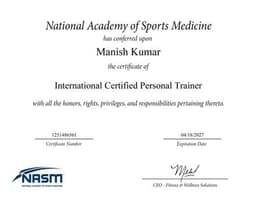
NASM Certified
Certified Personal Trainer & Sports Nutritionist from the National Academy of Sports Medicine
Disclaimer: This calculator is for informational and personal journaling purposes only. It logs measurements and compares them to published reference values. It is not health, medical, or nutrition advice.