
Key Takeaways
- On an angled leg press you push only part of the weight you load. On the ideal model that part is the moving mass times sin(rail angle)[1][2], which is 70.7% at 45°.
- The sled counts on this model, so the calculator adds it to the plates and applies the sine once. The one measurement cited here says part of the sled's weight is carried by the frame[3], so its real share is not known.
- The ideal number ignores friction. In that measurement, 454.55 kg of plates read 342.1 kg on a load cell[3]. Treat the result as a guide, not a reading of your machine.
How the Weight on a Leg Press Is Worked Out
Moving mass times the sine of the rail angle.
A mass on a slope has its weight split in two. One part presses into the slope, and the other acts along it, with a size of w sin θ = mg sin θ[1]. On a leg press, θ is the angle between the sled's rails and the floor.
Friction acts along the slope against the motion[2]. If there were none, pushing the sled up at a steady speed would take a force equal to that sloped part of the weight. Divide the force by g and you get an effective load in kg or lb, which is the number this page reports.
Effective load = (plates + sled) × sin(rail angle)
Worked example: 4 × 45 lb plates per side, 100 lb sled, 45° rails
Eight 45 lb plates weigh 360.0 lb. With a 100.0 lb sled the moving mass is 460.0 lb, and at 45° the effective load is 325.3 lb. The sled figure is made up to show the arithmetic, not a real machine.
sin(45°) = 0.7071
Moving mass = 360.0 lb plates + 100.0 lb sled = 460.0 lb
Effective load = 460.0 × 0.7071 = 325.3 lb
Speeding the sled up takes extra force on top of this, and the calculator leaves that out.
Rail Angle and Effective Weight
Steeper rails put more of the load on you.
| Rail angle | sin(angle) | Effective per 100 |
|---|---|---|
| 30° | 0.500 | 50.0 |
| 35° | 0.574 | 57.4 |
| 40° | 0.643 | 64.3 |
| 45° | 0.707 | 70.7 |
| 50° | 0.766 | 76.6 |
| 55° | 0.819 | 81.9 |
| 60° | 0.866 | 86.6 |
| 90° (vertical) | 1.000 | 100.0 |
Effective load for every 100 units of moving mass, by rail angle (ideal model)
Machines differ, so the angle is an input. Hammer Strength describes its linear leg press as a 45 degree design[4], and Life Fitness gives no rail angle for its linear press[6]. If you cannot find yours on the machine or in its manual, ask the maker.
Use the angle of the rails to the floor. A back pad adjustment, like the one Hammer Strength describes as widening the hip angle[5], changes how you sit and leaves the rails where they are.
Counting Plates: Per Side, Total, lb and kg
Check which one the number means before you add it up.
Plates go on both sides of the sled. Six plates can mean six on each side or six in all, so the calculator asks which. Four 45 lb plates per side is eight plates and 360.0 lb.
A 45 lb plate is 20.41 kg, not 20 kg, because 1 lb is exactly 0.45359237 kg[9]. Mixing the two types shifts the total, so enter the weight stamped on the plate.
The kg sizes offered (25, 20, 15, 10, 5, 2.5 and 1.25) are competition disc sizes[7][8]. The lb sizes (45, 35, 25, 10, 5 and 2.5) are common gym sizes, not from a rulebook, and your gym's plates may differ.
The Sled Weight
The empty sled has weight of its own.
Some makers publish an empty-sled figure. The table shows the two that could be checked, with each maker's own wording.
| Machine | Maker's wording | Figure | Rail angle |
|---|---|---|---|
| Hammer Strength Plate Loaded Linear Leg Press[4][5] | Starting resistance | 118 lb (53 kg) | The maker describes a 45 degree linear design. Its Australian page adds 'per arm' to the figure |
| Life Fitness Plate Loaded Linear Leg Press[6] | Starting resistance | 103 lb (47 kg) | Rail angle not listed on the maker's page |
Empty-sled figures published by two makers
Neither page says what "starting resistance" means, so it may not be the sled's mass. The Australian Hammer Strength page adds "per arm" to its figure[5].
The calculator treats the number you type as a mass. It also shows a second total that reads the figure as a force at the foot plate, so you can see how much the choice matters.
The Clemons abstract warns that knowing the sled weight is not very helpful, because part of it is supported by the frame[3]. No other machine's figure was checked for this page, so look at your machine's label or manual.
How Close Is the Ideal Number to a Real Machine?
The only measurement cited here is one abstract on one machine.
It is a 2010 conference abstract by Clemons. A load cell was fixed to the frame of an LE408 BM leg press, in the same plane as the sled, and the loaded sled was lowered until the cell held its full weight[3].
With no plates, the lifter had to overcome 49.6 kg. With 454.55 kg of plates, the resistance was 342.1 kg. The abstract's regression is mass lifted = 0.64 × plate mass + 50.26 kg[3].
The measured load was above the plate mass up to 140.9 kg of plates, and below it beyond that[3]. The author puts the first part down to the sled and, presumably, the second to more weight going to the frame.
A slope of 0.64 equals sin(39.8°), but the abstract does not state the machine's angle, so that match is arithmetic and not a finding.
What this does and does not show
It shows that one machine read about a quarter below its plate mass at 454.55 kg. It cannot show how yours compares, and no other leg press measurement or full paper behind the abstract was found. The calculator does not use this regression.
Related Tools
For questions this page does not answer.
- Your leg press max from a hard set: Leg Press 1RM calculator.
- Plates on a barbell, per side: Barbell Plate calculator.
- A one rep max from any lift: One Rep Max calculator.
- Pounds to kilograms and back: Weight Converter.
Limits
What these numbers cannot tell you.
- The result is an ideal figure. It leaves out friction in the rails and bearings. Hammer Strength calls the guide rods on its linear press "frictionless"[4], but gives no friction figure, so how close that is cannot be checked.
- A press that moves straight up on vertical guides fits the model at 90°. A lever, pivot or cable between the foot plate and the plates does not, and the calculator cannot correct for it.
- Plates stored on a storage horn do not count, so enter only the plates on the sled. Hammer Strength lists four storage horns on its linear press[4].
- The page does not convert to a squat or rate your weight as good or average, because no source was found that measures either.
- The cap of 20 plates per side, the 1 to 90 degree angle range and the notice below 15° are the calculator's own settings. They are not rules from a source.
Frequently Asked Questions
Sources & References
- 5.4 Inclined Planes (the weight component parallel to a slope is w sin θ = mg sin θ). OpenStax. Physics, OpenStax (open textbook)
- 6.2 Friction (friction acts along the slope against the motion; at constant speed the net force is zero). OpenStax. University Physics Volume 1, OpenStax (open textbook)
- Relationship between plate mass and actual leg press loads (abstract). Clemons J. Journal of Strength and Conditioning Research 24(S1):1, NSCA National Conference abstract. One LE408 BM leg press, load cell in the slide plane (2010)
- Plate Loaded Linear Leg Press (HSLLP): 45-degree angle, starting resistance 118 lb (53 kg), four storage horns, "frictionless" guide rods. Hammer Strength, Life Fitness. Maker product page (US)
- Hammer Strength Plate Loaded Linear Leg Press (HS-LLP): the same figure listed as 118 lbs (53 kg) per arm; a back pad adjustment that widens the hip angle. Hammer Strength, Life Fitness. Maker product page (Australia)
- Plate Loaded Linear Leg Press (SPLLLP): starting resistance 103 lbs (47 kg), rail angle not listed. Life Fitness. Maker product page (US)
- Technical and Competition Rules and Regulations (TCRR) 2026 (competition discs 25 kg to 0.5 kg). International Weightlifting Federation. IWF rulebook, PDF (the IWF site may show a security check before the file opens) (2026)
- Technical Rules, effective 1 March 2026 (version 3) (competition discs, including 1.25 kg). International Powerlifting Federation. IPF rulebook, PDF (2026)
- NIST Guide to the SI, Footnotes (exact conversion factor for the avoirdupois pound, 4.535 923 7 E-01 kg). National Institute of Standards and Technology. NIST Special Publication 811, online edition

Certified Personal Trainer & Sports Nutritionist
NASM-certified fitness and nutrition coach with over 10 years of hands-on experience helping people build strength, lose fat, and live healthier lives. Specializing in gym-based workouts with a strong focus on lifting technique, biomechanics, and practical exercise science. Through FitLifeRegime, sharing the tools, tips, and insights that have worked for hundreds of clients — helping you start your own fitness journey with confidence and clarity.
Learn more about Manish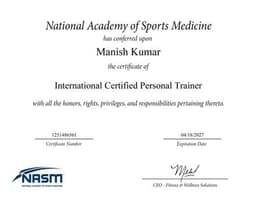
NASM Certified
Certified Personal Trainer & Sports Nutritionist from the National Academy of Sports Medicine
Disclaimer: This calculator is for informational and personal journaling purposes only. It logs measurements and compares them to published reference values. It is not health, medical, or nutrition advice.