
Key Takeaways
- Torso length here is sitting height minus an average head height, or standing height minus inseam when you enter leg length.
- Cormic Index (sitting height ÷ standing height) averages about 0.52 for men and 0.53 for women in this tool.[2][3]
- Classifications (long, proportionate, short) describe shape, not fitness. Use them for gear fit and curiosity, not as a score.
- Height-only mode applies average Cormic Index for your sex. Sitting height or inseam gives a tighter number when you have them.
What Is Torso Length?
In this calculator, torso length is your trunk without the head: either sitting height minus a population average head height, or standing height minus leg length when you measure inseam. Both paths should land close if your measurements are consistent.
Trunk length shows up in ergonomics (chairs, desks, packs), bike fit, and sport biomechanics. It does not tell you how strong or fast you are; it helps explain leverage and equipment choices.[3]
The Cormic Index
Cormic Index is sitting height divided by standing height. Higher values mean more of your height sits in the trunk and head; lower values mean longer legs relative to torso. This page uses ~0.52 (male) and ~0.53 (female) for height-only estimates (see Norgan 1994 and NHANES anthropometry in sources).[2][3]
| Classification | Cormic Index |
|---|---|
| Long torso | > 0.54 |
| Slightly long | 0.53 up to 0.54 |
| Proportionate | 0.51 to below 0.53 |
| Slightly short | 0.50 to below 0.51 |
| Short torso | < 0.50 |
How Proportions Vary
Cormic Index shifts with sex, age, and population. Women in many datasets average slightly higher sitting height ratios than men. Ethnicity and region also move the averages, which is why a single global "normal" is only a rough guide.[1][4]
Where you land is mostly genetics and growth history, not something you train away. The useful part is comparing your numbers to your own past measurements and to gear sizing charts.
Measuring Your Torso
Sitting height
Sit on a flat surface with your back to a wall. Head level (Frankfort plane: eyes forward). Mark the wall at the top of your head, then measure from the seat to the mark. Thighs horizontal, feet flat.
Standing height
No shoes, heels and upper back to the wall. Mark the wall at the top of your head and measure floor to mark.
Leg length (inseam)
Crotch to floor with the tape vertical. Torso in leg-length mode is standing height minus inseam (same as the calculator).
Sport & Activity Context
Longer torsos often show up in swimming and rowing conversations (body position, stroke length). Shorter torsos with long legs get mentioned in running stride talk. Powerlifting forums debate torso length for squat and deadlift leverage. These are trends, not rules: training beats proportions for most goals.
| Activity | Torso tendency | Why it comes up |
|---|---|---|
| Swimming | Longer torso | Body line and drag |
| Rowing | Longer or proportionate | Stroke length |
| Running | Shorter torso | Stride length |
| Powerlifting | Longer torso | Squat and deadlift leverage |
| Cycling | Varies | Reach and frame size |
Ergonomic Relevance
Torso length drives backpack torso size, chair depth, and how high a desk feels. Longer trunks often need taller work surfaces and longer pack sizes; shorter trunks may fit compact bike frames more easily.
At a desk, aim for roughly 90° at the elbows with forearms level. Chair depth should leave a few inches behind your knees. For packs, the hip belt should sit on the hip bones; torso size on the label should match your measured trunk length range.
More proportion tools
Pair this with other measurement tools when you are mapping your frame:
- Grecian Ideal Calculator for wrist-based circumference targets.
- Height to Foot Size Calculator for height and shoe size estimates.
Frequently Asked Questions
Sources & References
- Leg length, body proportion, and health: A review with a note on beauty. Bogin B, Varela-Silva MI. Int J Environ Res Public Health (2010)
- The relationship of sitting height ratio to body mass index and fatness in the United States. Norgan NG. Ann Hum Biol (1994)
- National Health and Nutrition Examination Survey: Anthropometry procedures manual. CDC/NCHS. U.S. Department of Health and Human Services (2016)
- Sex differences in body composition. Bredella MA. Adv Exp Med Biol (2017)

Certified Personal Trainer & Sports Nutritionist
NASM-certified fitness and nutrition coach with over 10 years of hands-on experience helping people build strength, lose fat, and live healthier lives. Specializing in gym-based workouts with a strong focus on lifting technique, biomechanics, and practical exercise science. Through FitLifeRegime, sharing the tools, tips, and insights that have worked for hundreds of clients — helping you start your own fitness journey with confidence and clarity.
Learn more about Manish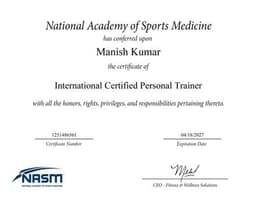
NASM Certified
Certified Personal Trainer & Sports Nutritionist from the National Academy of Sports Medicine
Disclaimer: This tool is for informational and personal journaling purposes only. Results are estimates based on published formulas and may vary based on individual factors such as genetics, training history, and measurement technique.