
Key Takeaways
- Your wrist sets target sizes for chest, waist, arms, and legs. That makes it easier to spot what is lagging.
- McCallum and Reeves are classic bodybuilding charts, not medical rules. This tool runs both and can average them for men.[1][4]
- Reeves' Symmetry Triad: neck, flexed bicep, and flexed calf should match. McCallum uses a smaller calf multiplier.[4]
- Use these numbers as training cues, not a diagnosis. Tape comparisons mean more when you are lean (often about 10–15% body fat for men and 18–24% for women).
What Is the Grecian Ideal?
The Grecian Ideal is about looking balanced from head to toe. Each body part scales to your frame instead of one muscle group stealing the show. Eugen Sandow pushed this in late-19th-century bodybuilding by studying classical statues and training for symmetry.[3][6]
Sandow measured museum sculptures and wrote down proportional training ideas that still influence physique culture today.[3]The wrist-based math most lifters use now comes from John McCallum's multiplier tables and Steve Reeves' symmetry rules.[1][4][5]
The McCallum Formula
McCallum's tables treat wrist size as your frame and multiply it for each circumference.[1] Hips use chest × 0.85 after chest is computed.
| Body Part | Formula | Multiplier |
|---|---|---|
| Chest | Wrist × 6.5 | 6.5 |
| Waist | Wrist × 4.5 | 4.5 |
| Hips | Chest × 0.85 | ≈ 5.53× wrist |
| Thigh | Wrist × 3.0 | 3.0 |
| Neck | Wrist × 2.5 | 2.5 |
| Bicep | Wrist × 2.5 | 2.5 |
| Calf | Wrist × 2.0 | 2.0 |
| Forearm | Wrist × 1.8 | 1.8 |
Example
The Steve Reeves Method
Reeves built a classically balanced look around the Symmetry Triad: neck, flexed bicep, and flexed calf at the same circumference.[4] In this calculator, Reeves waist uses about Neck × 2 (≈ Wrist × 5.0), thigh about half chest, and triad parts at Wrist × 2.5, as summarized in most Reeves proportion write-ups.[5]
Published lists of his measurements (for example ~18.25" neck, arms, and calves on a ~7.25" wrist) show the triad in real numbers. Exact figures vary by source.[4][5]
Often-cited Reeves measurements (inches)
Neck
18.25"
Bicep
18.25"
Calf
18.25"
Chest
52"
Waist
29"
Thigh
26"
Forearm
14.75"
Wrist
7.25"
The Symmetry Triad
When neck, flexed bicep, and flexed calf match, proportions look even from every angle.[4] McCallum matches neck and bicep at Wrist × 2.5 but sets calf to Wrist × 2.0. Reeves sets all three to Wrist × 2.5. Combined averages McCallum and Reeves per body part in this calculator.
Ideal Measurements by Wrist Size
McCallum formula (cm) for common wrist sizes.
| Wrist | Chest | Waist | Thigh | Bicep | Calf | Forearm |
|---|---|---|---|---|---|---|
| 15 cm | 97.5 | 67.5 | 45.0 | 37.5 | 30.0 | 27.0 |
| 16 cm | 104.0 | 72.0 | 48.0 | 40.0 | 32.0 | 28.8 |
| 17 cm | 110.5 | 76.5 | 51.0 | 42.5 | 34.0 | 30.6 |
| 18 cm | 117.0 | 81.0 | 54.0 | 45.0 | 36.0 | 32.4 |
| 19 cm | 123.5 | 85.5 | 57.0 | 47.5 | 38.0 | 34.2 |
| 20 cm | 130.0 | 90.0 | 60.0 | 50.0 | 40.0 | 36.0 |
How to Measure Each Body Part
Wrist
Tape just above the ulnar styloid on your dominant hand. Snug, not tight.
Chest
Fullest part at nipple line, arms relaxed, normal exhale.
Waist
Narrowest torso point, usually above the navel; tape level.
Hips
Widest glute circumference, feet together, tape horizontal.
Thigh
Largest mid-thigh girth, standing, leg relaxed.
Neck
Below the Adam's apple, tape level.
Bicep
Arm flexed 90°, tape at the peak.
Calf
Standing, largest calf girth.
Forearm
Arm extended, palm up; largest girth near the elbow.
Body Fat and Accuracy
These circumferences assume muscle is moving the tape, not extra fat. Most coaches compare at roughly 10–15% body fat for men and 18–24% for women. Above that range, waist and hip tapes swell and symmetry scores stop meaning much.
Female targets in this tool also anchor hips to waist using a WHR of about 0.70, in line with Singh's WHR work.[2] That does not mean WHR drives every female limb target. It only sets hips relative to waist here.
Training to Close the Gap
Use the results to find imbalances, the parts farthest below or above ideal. Do not obsess over hitting every number. Put extra work into lagging muscle groups, keep your big compound lifts for overall size, and shrink waist circumference mostly through nutrition and total fat loss, not spot training.
Reading Your Symmetry Score
Compare mode shows how close your tapes are to the ideals. Use it to pick what to train next. It is not a score on your worth as a lifter.
| Score Range | Rating | What it means |
|---|---|---|
| 90-100 | Grecian Ideal | Proportions line up tight. Classic balance on paper. |
| 80-89 | Excellent | Close overall. One or two areas might need extra work. |
| 70-79 | Very Good | Solid shape. Pick a lagging part and train it on purpose. |
| 55-69 | Good | Room to grow. Use the gaps list instead of guessing. |
| Below 55 | Developing | Clear imbalances. Build a balanced plan and track tapes monthly. |
Frequently Asked Questions
Sources & References
- Wrist Circumference Formula — Ideal Body Proportions. McCallum J (referenced in ExerciseDaily). ExerciseDaily.com
- Adaptive Significance of Female Physical Attractiveness: Role of Waist-to-Hip Ratio. Singh D. Journal of Personality and Social Psychology (1993)
- Eugene Sandow's 'Grecian Ideal' and the Birth of Modern Body-Building. Cleveland K. Philomathes, Austin Peay State University (2018)
- Steve Reeves — Bodybuilder and Actor. Encyclopedia Britannica
- Proportionality and Measurements. Gallagher M. IronCompany.com
- Sandow on Physical Training: A Study in the Perfect Type of the Human Form. Sandow E, Adam GM. J. S. Tait & Sons, New York (1894)

Certified Personal Trainer & Sports Nutritionist
NASM-certified fitness and nutrition coach with over 10 years of hands-on experience helping people build strength, lose fat, and live healthier lives. Specializing in gym-based workouts with a strong focus on lifting technique, biomechanics, and practical exercise science. Through FitLifeRegime, sharing the tools, tips, and insights that have worked for hundreds of clients — helping you start your own fitness journey with confidence and clarity.
Learn more about Manish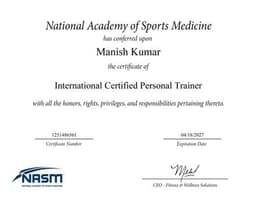
NASM Certified
Certified Personal Trainer & Sports Nutritionist from the National Academy of Sports Medicine
Disclaimer: This tool is for informational and personal journaling purposes only. Results are estimates based on published formulas and may vary based on individual factors such as genetics, training history, and measurement technique.