
Key Takeaways
- Calories = METs × 3.5 × body weight in kg × minutes ÷ 200. For a 70 kg person playing tennis singles (8.0 METs) for 60 minutes that is 588 kcal in total, or 514.5 kcal above what they would have used resting.
- There are 295 entries to choose from, copied from the 2024 Adult Compendium of Physical Activities[1][2]. Where the Compendium separates effort, such as a match versus hitting balls, it does so with separate entries, so choosing the right entry matters more than any other input.
- Enter the time you were playing, not the time you were at the venue. Breaks, warm-ups and waiting for your turn are not at the MET value.
- A MET value is one published figure per activity, and the 3.5 mL/kg/min behind it fits different people differently[3][4]. Read the result as a sensible estimate, not a measurement.
- Running, cycling, dancing and conditioning exercise are separate Compendium headings that are not on this page. Sports with no Compendium entry, such as pickleball and padel, have no value here.
How the Estimate Works
A MET is a multiple of your resting energy use. The Compendium gives each activity a MET value, and defines 1 MET two ways: as 3.5 mL of oxygen per kg per minute, and as 1 kcal per kg per hour[2].
This calculator uses the oxygen definition and converts oxygen to energy at about 5 kcal per litre, a standard approximation. That is where the ÷ 200 comes from.
| Figure | How it is worked out |
|---|---|
| Calories this session | METs × 3.5 × kg × minutes ÷ 200 |
| Above resting | (METs − 1) × 3.5 × kg × minutes ÷ 200 |
| Per week | calories this session × sessions per week |
| Per month | per week × 52 ÷ 12 |
Worked example. 70 kg, tennis singles at 8.0 METs, 60 minutes: 8.0 × 3.5 × 70 × 60 ÷ 200 = 588.0 kcal. Above resting, (8.0 − 1) × 3.5 × 70 × 60 ÷ 200 = 514.5 kcal.
The kcal definition of 1 MET would give about 5% less, since 1 kcal/kg/h is a little under 1.05. For the same example it is 560.0 kcal instead of 588.0. Neither convention is more correct, and different calculators pick different ones, so a small gap between tools is expected.
The first figure counts everything your body used in those 60 minutes, including the energy it would have burned sitting still. The second takes that resting share out, so it is closer to what the session added to your day.
Use the one that matches what you are tracking, and do not add them together.
Choosing the Right Entry
The Compendium does not give a sport one number. It gives a list of entries, and the wording of each one is what you match against. Here is tennis for the same 70 kg person and 60 minutes:
| Entry | METs | kcal |
|---|---|---|
| Tennis, doubles 15685 | 4.5 | 331 |
| Tennis, hitting balls, non-game play, moderate effort 15695 | 5.0 | 368 |
| Tennis, doubles (Taylor Code 430) 15680 | 6.0 | 441 |
| Tennis, general, moderate effort 15675 | 6.8 | 500 |
| Tennis, general, competitive 15676 | 8.0 | 588 |
| Tennis, singles (Taylor Code 420) 15690 | 8.0 | 588 |
- Match the effort. Hitting balls without playing a game is 5.0 METs, about 368 kcal an hour. Singles is 8.0 METs, about 588. Picking the wrong one is a difference of roughly 221 kcal for the hour.
- Two doubles entries exist. The list has Tennis, doubles at 6.0 and another Tennis, doubles at 4.5. The wording does not say why they differ, so the calculator does not choose for you. At this weight and time the gap is about 110 kcal.
- Read the whole entry. Some state how the time should be counted. Downhill skiing and snowboarding (6.3 METs, code 19160) is listed as "active time only", so count the time you spend on the move, not the whole day on the mountain.
- Equipment and travel change the value. Golf is 4.3 METs walking with your clubs and 3.5 with a power cart, which is 316 against 257 kcal for the same hour.
- Martial arts are grouped. One entry covers moderate-pace martial arts in general (judo, jujitsu, karate, kickboxing, taekwondo, tai-bo and Muay Thai) at 10.3 METs. Some have their own entries too, such as kickboxing at 7.3 and judo at 11.3, so search by name to see the options.
The picker lists popular choices first, and a search looks through all 295 entries by name or by code. You can filter by MET range and star the entries you use often.
Where the Values Come From
The 2024 update of the Compendium lists 1,114 activities under 22 major headings. Of those, 912 have measured energy costs and 202 are estimated[1]. It covers adults aged 19 to 59[1].
This page uses three headings: Sports (156 entries), Water Activities (87) and Winter Activities (52), which makes 295. Codes, METs and wording come from the published PDF, and every row is compared with the table on the Compendium website[2].
They matched, with one exception. For code 19144, biathlon training at 10.7 km/h (6.6 mph), the PDF repeats the line above it (12.8 METs at 5 mph), while the website lists 15.8. The page uses the website value.
The list does not mark which entries are measured and which are estimated, so that cannot be told for any single sport.
The Compendium has no recreational, competitive or vigorous levels. Where it distinguishes effort, it does so with separate entries.
Every entry now is a real Compendium row with its own code.
What Is Not on This Page
Four Compendium headings are left out of this page: Bicycling, Conditioning Exercise, Dancing and Running. Everyday activity is handled elsewhere too.
- Running. For jogging by speed and terrain, use the jogging calorie calculator.
- Bicycling and dancing. These are separate Compendium headings, and no calorie calculator on this site covers them yet.
- Conditioning exercise. Yoga and pilates, for example, sit under this heading, not under Sports. For step aerobics see the aerobic stepper calculator, and for tai chi the tai chi calculator.
- Everyday activity. Housework, walking around, standing and the like are on the NEAT calculator.
Skindiving and snorkeling are in the Water Activities list. For dives, the scuba diving calculator goes further.
Sports the Compendium does not list
The 2024 Compendium has no entry for pickleball, padel, kabaddi, kho kho or CrossFit. Karate, jujitsu and Muay Thai appear only inside the general martial arts entry above.
For a sport with no entry, the best you can do is pick the entry that matches your effort and the way you move, and treat the answer as rougher than the others.
How Accurate Is a MET Estimate?
A MET value is one figure for an activity, and your own energy cost can sit above or below it. The research on the 3.5 mL/kg/min convention shows why.
- A 2005 paper measured resting oxygen use in 769 adults and found it averaged 2.6 mL/kg/min, not 3.5[3]. A 2019 study of 52 endurance athletes and 53 active controls found that using the standard value underestimated activity energy significantly in the active controls and the male athletes, but not in the female athletes[4]. So the error can run either way depending on who you are.
- The values were compiled for adults aged 19 to 59[1]. The Compendium site lists a separate Older Adult Compendium for ages 60 and over[2], which this page does not use. Children and teenagers are not covered by either.
Frequently Asked Questions
Sources & References
- 2024 Adult Compendium of Physical Activities: A third update of the energy costs of human activities. Herrmann SD, Willis EA, Ainsworth BE, et al.. Journal of Sport and Health Science 13(1):6-12 (2024)
- Compendium of Physical Activities (definition of a MET, activity codes, the Adult and Older Adult Compendia, and the activity tables). Compendium of Physical Activities. pacompendium.com website (2024)
- Metabolic equivalent: one size does not fit all. Byrne NM, Hills AP, Hunter GR, Weinsier RL, Schutz Y. Journal of Applied Physiology 99(3):1112-1119 (2005)
- Comparison of Conventional and Individualized 1-MET Values for Expressing Maximum Aerobic Metabolic Rate and Habitual Activity Related Energy Expenditure. Heydenreich J, Schutz Y, Melzer K, Kayser B. Nutrients 11(2):458 (2019)

Certified Personal Trainer & Sports Nutritionist
NASM-certified fitness and nutrition coach with over 10 years of hands-on experience helping people build strength, lose fat, and live healthier lives. Specializing in gym-based workouts with a strong focus on lifting technique, biomechanics, and practical exercise science. Through FitLifeRegime, sharing the tools, tips, and insights that have worked for hundreds of clients — helping you start your own fitness journey with confidence and clarity.
Learn more about Manish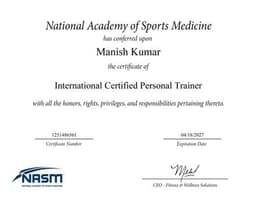
NASM Certified
Certified Personal Trainer & Sports Nutritionist from the National Academy of Sports Medicine
Disclaimer: This tool is for informational and personal journaling purposes only. Results are estimates based on published formulas and may vary based on individual factors such as genetics, training history, and measurement technique.