
Key Takeaways
- For a 70 kg adult practising for an hour, the Compendium works out to about 110 kcal seated, 243 kcal for general tai chi and 441 kcal for Yang style[1][2].
- The Compendium has only three tai chi entries for adults. This calculator uses those three and nothing else, so there are no made-up "beginner" or "Chen" levels[2].
- Ages 60 and over have their own table and a lower resting rate. The same hour of general tai chi comes to about 215 kcal for a 70 kg person[3].
- Lab studies of Yang style and the 24-form measured about 2.5 to 4.1 METs. The Compendium lists Yang style at 6.0, which is higher than any of those[4][5][6][8]. Treat 6.0 as the top of the range.
- Stance height changes the cost more than the style name does. In one set of studies, a lower stance burned more than a higher one in every form[4].
- Three one-hour sessions of general tai chi add up to 180 minutes a week. On the adult scale that is moderate effort, so it clears the 150 minute low end of WHO's adult guideline[1][9].
- Your watch's "active calories" leave out resting energy, so compare them with the Above resting figure. Apple's own tests of its tai chi, yoga and cooldown model show a wide spread, with an average error of 3% but a standard deviation of 20%[11].
How the Estimate Works
A MET is a multiple of your resting energy use. One MET is 3.5 mL of oxygen per kilogram per minute, which is roughly 1 kcal per kilogram per hour[1]. The calculator multiplies that by the MET value for your practice, your weight and your time:
kcal = MET × 3.5 × body weight (kg) × minutes ÷ 200
For ages 60 and over, the Older Adult Compendium measures METs against a resting rate of 2.7 mL/kg/min, so the 3.5 becomes 2.7[3]. That is why the 60+ MET values look higher than the adult ones but give fewer calories. The base they are measured against is lower.
| Practice | Ages 19 to 59 | Ages 60 and over |
|---|---|---|
| Seated tai chi or qi gong | 1.5 MET15672: Tai chi, qi gong, sitting, light effort | 2.8 MET0221160: Tai Chi, chair, general |
| General tai chi or qi gong | 3.3 MET15670: Tai chi, qi gong, general | 3.8 MET0221060: Tai Chi, general |
| Yang style tai chi chuan | 6 MET15674: Tai chi chuan, Yang style | No entry |
Values and codes are from the 2024 Adult Compendium[2] and the Older Adult Compendium[3]. Under-19s are not covered by either one.
Worked example: 70 kg, 60 minutes of general tai chi
Tai Chi Calories by Body Weight
A quick lookup if you do not want to type anything. These are general tai chi or qi gong values (3.3 METs for ages 19 to 59, 3.8 for 60 and over)[2][3], and they are total calories, resting burn included.
Ages 19 to 59
| Body weight | 30 min | 45 min | 60 min |
|---|---|---|---|
| 50 kg110 lb | 87 | 130 | 173 |
| 60 kg132 lb | 104 | 156 | 208 |
| 70 kg154 lb | 121 | 182 | 243 |
| 80 kg176 lb | 139 | 208 | 277 |
| 90 kg198 lb | 156 | 234 | 312 |
| 100 kg220 lb | 173 | 260 | 347 |
Ages 60 and over
| Body weight | 30 min | 45 min | 60 min |
|---|---|---|---|
| 50 kg110 lb | 77 | 115 | 154 |
| 60 kg132 lb | 92 | 139 | 185 |
| 70 kg154 lb | 108 | 162 | 215 |
| 80 kg176 lb | 123 | 185 | 246 |
| 90 kg198 lb | 139 | 208 | 277 |
| 100 kg220 lb | 154 | 231 | 308 |
The 60+ numbers are lower even though the MET value is higher, because the Older Adult Compendium measures METs against a lower resting rate[3].
What Lab Studies Measured
The Compendium is a table of group averages, so it helps to see what people actually burned when someone put a mask on them. These are the verified studies. The first rows come from a 2001 review of 31 earlier studies[4].
| Study | Who and what | Measured |
|---|---|---|
| Zhuo, 1984[5] | 11 men, average age 28, Yang style long form (108 form), 3 to 8 years of practice | 4.1 METs |
| Brown and Cao, in the review[4] | Yang style 108 form, two small groups of adults aged about 34 and 29 | 4.0 and 2.9 METs |
| Chen and Zhao, in the review[4] | Yang style, 10 middle-aged to older practitioners. Higher stance, then lower stance | 2.5 then 3.5 METs |
| Chen and Zhao, in the review[4] | Simplified 24-form, 10 middle-aged to older practitioners. Higher stance, then lower stance | 2.6 then 3.5 METs |
| Chen and Zhao, in the review[4] | Chen style, 10 middle-aged practitioners. Higher stance, then lower stance | 4.8 then 6.5 METs |
| Hui, Woo and Kwok, 2009[6] | 30 practitioners, modified 32-form Yang style at a regular pace, 10 minutes | 3.24 METs |
| Chao, 2002[7] | 47 practitioners, average age 61, Tai-Chi-Qui-Gong (54 motions) | About 3 METs, about 60 kcal per set |
| Lyu, 2020[8] | 60 healthy adults aged 20 to 60, tai chi beginners after 12 weeks of classes. 24-form, then a 3-minute Bafa Wubu form | 3.2 then 2.3 METs |
The Compendium's 3.3 for general tai chi sits in the middle of the Yang and 24-form results. Its 6.0 for Yang style does not. It is above every Yang measurement in the table, and it is closer to the Chen style numbers.
The study behind each Compendium tai chi entry is not identified, so the source of the 6.0 is unknown. It is used because it is the published reference. The studies above put Yang style practice between about 2.5 and 4.1 METs.
These are small studies with different protocols, ages and skill levels. They show a range, not a correction factor, so the calculator does not adjust the Compendium values.
Why Your Burn Will Differ
- Stance height. In the Chen and Zhao data, the lower stance cost more than the higher one in all three forms: 4.8 to 6.5 METs in Chen style, 2.5 to 3.5 in Yang style and 2.6 to 3.5 in the 24-form[4]. Sinking deeper into your stances is the biggest lever you control.
- Form and pace. A short, easy form costs less. The 3-minute Bafa Wubu form measured 2.3 METs against 3.2 for the 24-form in the same people[8].
- Skill. One study in the review found that the three tai chi masters in its group used significantly more oxygen than the other practitioners[4].
- Your body. The Compendium's authors say it is a starting point and does not give precise individual values. In one treadmill study they cite, women with obesity burned about 8 to 15% more than women without it at the same speeds[1].
Tai Chi Next to Walking and Yoga
For the same hour at 70 kg, the Adult Compendium gives 243 kcal for general tai chi, 279 kcal for moderate-pace walking (2.8 to 3.4 mph) and 169 kcal for general yoga[2]. The calculator shows the same comparison for your own weight and time.
A Hong Kong study measured it directly. Practitioners of a modified 32-form Yang style burned 3.24 METs, while the same people walking at a brisk, self-selected pace burned 4.7, about 46% more.
When they walked at a heart rate matched to tai chi, the cost was about the same at 3.5 METs[6].
The full report of that 12-week trial (374 middle-aged adults, five days a week, 45-minute sessions that included warm-up and cool-down stretching) found the tai chi group lost 0.50 kg of body weight and 0.47 kg of fat mass on average, and the walking group 0.76 kg and 0.59 kg.
Waist circumference ended 3.7 cm lower than the control group for tai chi and 4.1 cm lower for walking[10]. For fat loss, the calorie number here is a modest part of your day.
Tai chi's better-documented strengths are balance and fall prevention in older adults, and those are not calorie questions[4].
Related calculators: Yoga Calorie Calculator, Walking Calorie Calculator and MET Calculator.
Does Tai Chi Meet the Weekly Guideline?
WHO's 2020 guideline asks adults for 150 to 300 minutes of moderate-intensity activity a week, or 75 to 150 minutes of vigorous activity, or a mix[9]. On the Adult Compendium scale, 3.0 to 5.9 METs counts as moderate[1].
General tai chi at 3.3 METs falls in that band. Seated tai chi at 1.5 METs does not, because it sits below it[1].
So three 60-minute sessions of general tai chi give you 180 minutes, enough for the 150 minute low end. Two 45-minute sessions give you 90, which is part of the way there. The calculator shows this for your own routine.
Ages 60 and over need a caveat. The Older Adult Compendium says its intensity cut points are not validated for MET60+ values, so I do not label your practice light or moderate there[13].
For adults 65 and over, WHO also recommends balance-focused, moderate-or-greater activity on 3 or more days a week[9]. WHO asks every adult for muscle-strengthening activity on 2 or more days a week too, which this calculator does not assess[9].
Why Your Watch Shows a Different Number
Expect a mismatch. There are three reasons, and none of them means one number is broken.
- Different question. Apple counts active calories as energy burned above your resting rate, and its total adds resting energy back on[11]. Compare your watch's active figure with the Above resting card here, not with the main session total.
- Different method. This page takes a table value for a group average. Apple groups tai chi with yoga and cooldown in a heart rate predominant model, and its own validation (a sample of 43, with Apple's recommended practices followed) found a mean calorie error of 3% with a standard deviation of 20%[11]. An average error near zero with that spread means any one person's reading can sit well above or below the truth.
- Wrist devices in general. A systematic review of 158 publications found Apple Watch and Garmin the most accurate for heart rate, but no brand accurate for energy expenditure in lab settings[12].
Use either number to compare one week with the next, and do not eat back calories based on a single reading.
Limits of This Estimate
- The adult values are written for ages 19 to 59 and the older values for 60 and over. Neither covers under-19s. The Adult Compendium is meant for adults without health conditions that change energy use, such as heart failure, COPD or pregnancy[1]. If that is you, treat the figure as a rough guide only. The Older Adult Compendium likewise leaves out older adults with physical disabilities and chronic diseases[13].
- The result is total energy, including what you would burn resting anyway. The "Above resting" card subtracts one MET for the same time.
- The Compendium has one general entry for tai chi and qi gong together. It has no separate values for individual qi gong sets or for other tai chi styles.
- Monthly totals multiply the weekly figure by 52 ÷ 12, so they assume the same routine every week.
Frequently Asked Questions
Sources & References
- 2024 Adult Compendium of Physical Activities: A third update of the energy costs of human activities. Herrmann SD, Willis EA, Ainsworth BE, et al.. Journal of Sport and Health Science 13(1):6-12 (2024)
- 2024 Adult Compendium of Physical Activities (activity codes and MET values). Compendium of Physical Activities. pacompendium.com (2024)
- Older Adult Compendium (MET 60+ values, resting rate 2.7 mL/kg/min). Compendium of Physical Activities. pacompendium.com (2024)
- Tai chi: physiological characteristics and beneficial effects on health. Li JX, Hong Y, Chan KM. British Journal of Sports Medicine 35(3):148-156 (2001)
- Cardiorespiratory and metabolic responses during Tai Chi Chuan exercise. Zhuo D, Shephard RJ, Plyley MJ, Davis GM. Canadian Journal of Applied Sport Sciences 9(1) (1984)
- Evaluation of energy expenditure and cardiovascular health effects from Tai Chi and walking exercise. Hui SSC, Woo J, Kwok T. Hong Kong Medical Journal 15(1) Supplement 2 (2009)
- The cardiorespiratory response and energy expenditure of Tai-Chi-Qui-Gong. Chao YF, Chen SY, Lan C, Lai JS. American Journal of Chinese Medicine 30(4):451-461 (2002)
- Comparative study of physiologic characteristics between the newly compiled Bafa Wubu of tai chi and 24 form simplified tai chi. Lyu S, Zhang J, Nie J, et al.. BMC Sports Science, Medicine and Rehabilitation 12:43 (2020)
- World Health Organization 2020 guidelines on physical activity and sedentary behaviour. Bull FC, Al-Ansari SS, Biddle S, et al.. British Journal of Sports Medicine 54(24):1451-1462 (2020)
- Effects of Tai Chi and Walking Exercises on Weight Loss, Metabolic Syndrome Parameters, and Bone Mineral Density: A Cluster Randomized Controlled Trial. Hui SS, Xie YJ, Woo J, Kwok TC. Evidence-Based Complementary and Alternative Medicine 2015:976123 (2015)
- Using Apple Watch to measure heart rate, calorimetry, and activity. Apple Inc.. Apple white paper, November 2024 (2024)
- Reliability and Validity of Commercially Available Wearable Devices for Measuring Steps, Energy Expenditure, and Heart Rate: Systematic Review. Fuller D, Colwell E, Low J, et al.. JMIR mHealth and uHealth 8(9):e18694 (2020)
- Older Adult Compendium of Physical Activities: Energy costs of human activities in adults aged 60 and older. Willis EA, Herrmann SD, Hastert M, et al.. Journal of Sport and Health Science 13(1):13-17 (2024)

Certified Personal Trainer & Sports Nutritionist
NASM-certified fitness and nutrition coach with over 10 years of hands-on experience helping people build strength, lose fat, and live healthier lives. Specializing in gym-based workouts with a strong focus on lifting technique, biomechanics, and practical exercise science. Through FitLifeRegime, sharing the tools, tips, and insights that have worked for hundreds of clients — helping you start your own fitness journey with confidence and clarity.
Learn more about Manish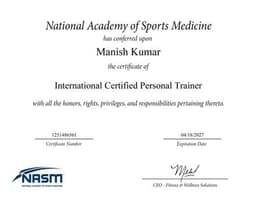
NASM Certified
Certified Personal Trainer & Sports Nutritionist from the National Academy of Sports Medicine
Disclaimer: This tool is for informational and personal journaling purposes only. Results are estimates based on published formulas and may vary based on individual factors such as genetics, training history, and measurement technique.