
The answer at a glance: 70 kg, mild stretching, 30 minutes
Calories this session
85kcal
48 kcal of it is above resting.
Intensity
2.3METs
Light, under 3.0 METs.
Per minute
2.8kcal
169 kcal for a full hour.
Per week
254kcal
Three 30-minute sessions.
Key Takeaways
- Calories = METs × 3.5 × body weight in kg × minutes ÷ 200. A 70 kg person doing mild stretching (2.3 METs) for 30 minutes uses about 85 kcal in total, of which 48 kcal is above what they would have used resting.
- The 2024 Adult Compendium of Physical Activities has one entry named stretching, and it is "Stretching, mild"[1][2]. There is no published value for hard or deep stretching, so this calculator does not invent one.
- Stretching is light-intensity activity, under 3.0 METs, and time spent on flexibility work alone does not count toward the weekly aerobic or muscle-strengthening targets[3].
- Printed calorie tables disagree about stretching. The CDC table implies about 2.6 METs and a Harvard Health table about 4.1, against 2.3 in the Compendium[6][7].
- A MET value is one published figure, not a measurement of you[4]. Read the result as a starting estimate.
How Calories Burned Stretching Are Worked Out
Each activity has a MET value, and calories are that value times your weight times your time.
A MET is a multiple of your resting energy use[3]. The Compendium gives each activity a MET value and defines 1 MET two ways: 3.5 mL of oxygen per kg per minute, and 1 kcal per kg per hour[2].
This calculator uses the oxygen definition and converts oxygen to energy at about 5 kcal per litre, a standard approximation. That is where the ÷ 200 comes from.
Calories this session
METs × 3.5 × kg × minutes ÷ 200
Above resting
(METs − 1) × 3.5 × kg × minutes ÷ 200
MET-minutes
METs × minutes
Minutes for a calorie goal
kcal × 200 ÷ (METs × 3.5 × kg)
Per week
calories this session × sessions per week
Total: 2.3 × 3.5 × 70 × 30 ÷ 200 = 84.5 kcal
Above resting: (2.3 − 1) × 3.5 × 70 × 30 ÷ 200 = 47.8 kcal
Total or above resting?
The first figure counts everything the body used in those 30 minutes, including the energy it would have burned sitting still. The second takes that resting share out, so it is closer to what the session added to the day.
Use one or the other when tracking, and do not add them together.
Two ways to define a MET
The kcal definition of 1 MET gives about 5% less, since 1 kcal/kg/h is a little under 1.05. For the same example it is 80.5 kcal instead of 84.5.
Neither convention is more correct, so a small gap between tools is expected.
Calories Burned Stretching by Time and Body Weight
For mild stretching, a 70 kg person uses about 85 kcal in 30 minutes and 169 kcal in an hour.
The table is for mild stretching at 2.3 METs. Each cell is the total for the session, rounded to a whole number, and it grows in a straight line with both weight and time. Darker cells mean more calories.
| Weight | 10 min | 15 min | 20 min | 30 min | 45 min | 60 min |
|---|---|---|---|---|---|---|
| 50 kg110 lb | 20 | 30 | 40 | 60 | 91 | 121 |
| 60 kg132 lb | 24 | 36 | 48 | 72 | 109 | 145 |
| 70 kg154 lb | 28 | 42 | 56 | 85 | 127 | 169 |
| 80 kg176 lb | 32 | 48 | 64 | 97 | 145 | 193 |
| 90 kg198 lb | 36 | 54 | 72 | 109 | 163 | 217 |
| 100 kg220 lb | 40 | 60 | 80 | 121 | 181 | 241 |
Per minute and per hour
2.8 kcal/min
At 70 kg that is 169 kcal for a full hour.
Per week
254 kcal
Three 30-minute sessions at 70 kg, or 143 kcal above resting.
To reach 100 kcal
36 min
At 70 kg. Counting only the part above resting, it takes 1 h 3 min.
The calculator has a second mode that does this in reverse. Enter a calorie target and it returns the minutes.
Does Stretching Burn Calories, and Does It Count as Exercise?
Yes, a little, and only about 57% of it is extra. Stretching alone does not count toward the weekly activity targets.
At 2.3 METs the body uses 2.3 times its resting rate, so about 57% of the energy in a stretching session is extra, and the rest would have been used anyway.
The Physical Activity Guidelines for Americans define light activity as waking, non-sedentary behavior under 3.0 METs, moderate as 3.0 to 5.9 and vigorous as 6.0 and above[3].
What the guidelines say about stretching
The Guidelines call flexibility activities an appropriate part of a physical activity program, even though their health benefits are unknown and it is unclear whether they reduce risk of injury[3].
They also state that time spent on flexibility activities by themselves does not count toward the aerobic or muscle-strengthening key guidelines[3]. The adult target is at least 150 to 300 minutes of moderate-intensity aerobic activity a week[3].
MET-minutes
The calculator reports MET-minutes, the unit the Guidelines use: METs × minutes. A 4 MET activity for 30 minutes is 120 MET-minutes, and so is an 8 MET activity for 15 minutes[3].
Mild stretching for 30 minutes is 69.
Stretching, Yoga and Pilates: Which Compendium Entry Fits?
Stretching has one entry of its own. Yoga, Pilates and stretch videos use the nearest rows, from 1.8 to 2.8 METs.
Six related rows from the same Conditioning Exercise heading are included so that yoga, Pilates and stretch videos have a published value too. All values are for 70 kg and 30 minutes. The accent bar is the stretching row.
- Pilates, traditional, mat1.8 METs
Pilates · code 02103 · 66 kcal in 30 minutes
- Stretching, mild2.3 METs
Stretching · code 02101 · 85 kcal in 30 minutes
- Yoga, Hatha2.3 METs
Yoga · code 02150 · 85 kcal in 30 minutes
- Yoga, general2.3 METs
Yoga · code 02175 · 85 kcal in 30 minutes
- Stretching or yoga video, light effort2.5 METs
Video workout · code 02140 · 92 kcal in 30 minutes
- Pilates, general2.8 METs
Pilates · code 02105 · 103 kcal in 30 minutes
- Therapeutic exercise ball2.8 METs
Exercise ball · code 02112 · 103 kcal in 30 minutes
The amber line is 3.0 METs, where light activity ends and moderate begins.
Rows from the 2024 Adult Compendium, heading 02, Conditioning Exercise. None of the seven is marked as an estimated value on the Compendium site.
Yoga
Pilates
Traditional mat Pilates is 1.8 METs and general Pilates is 2.8[2]. The wording does not say what separates them, but over 30 minutes at 70 kg the gap is about 37 kcal.
Stretch videos
The light-effort video entry covers workouts such as yoga, stretching and seated routines at 2.5 METs[2]. Harder video workouts have their own, higher entries that this page does not include.
Other activities
For tai chi, use the tai chi calorie calculator, and for sports the sports calorie calculator.
Why Calorie Tables for Stretching Disagree
One Harvard table implies 4.1 METs and the Compendium says 2.3. The same 30 minutes can print as 85 kcal or 144 kcal.
Search results for stretching calories give very different numbers. Putting two widely quoted tables on the MET scale shows why. Each printed figure is divided by body weight in kg and by hours, which is the 1 kcal/kg/h convention.
Neither table prints a MET value, so the implied METs are worked out here.
- CDC, Stretching2.6 METs
Printed: 90 kcal at 154 lb for 30 minutes
- Harvard Health, Stretching, Hatha Yoga4.1 METs
Printed: 144 kcal at 155 lb for 30 minutes
- Compendium, Stretching, mild (02101)2.3 METs
Published as METs, used by this calculator
- Compendium, Yoga, Hatha (02150)2.3 METs
Published as METs
The amber line is 3.0 METs, where light activity ends and moderate begins.
The Harvard figure is far above the Compendium
At 155 lb for 30 minutes this calculator gives 85 kcal for Hatha yoga, against 144 printed. Harvard Health lists ACE Fitness as its source[7], and the table does not say which MET value or method sits behind the number.
The CDC figure is closer
It is adapted from the 2005 Dietary Guidelines for Americans[6], which predates the 2024 Compendium. It lists stretching under moderate activity, although the figure implies a value under 3.0 METs.
Different conventions add a few percent
The ÷ 200 form and the kcal per kg per hour form differ by about 5%, as shown above. That alone does not explain gaps of this size.
Which one this page uses
This page uses the Compendium row because it is the one source here with a code, a stated wording and a published method[1]. The other two tables are shown for comparison only.
How Accurate Is a MET Estimate for Stretching?
A MET value is one figure for an activity. Your own energy cost can sit above or below it.
The 3.5 mL/kg/min behind 1 MET is a convention, not a measurement of any one person.
Resting use is often lower than 3.5
Body weight matters
That study covered 35 to 186 kg. The calculator shows a warning for weights outside this range, since the convention is less well tested there.
Age range
Effort
No source gives a range of error for stretching in particular. How hard and how deep a person stretches changes the cost, and the Compendium has no entry for that.
Not Covered
These are outside what this calculator can say, because no published value or method was found to support them.
Hard, deep, active or dynamic stretching
The Compendium has only a mild stretching entry. For dynamic routines, pick the closest entry yourself, or enter your own MET value and read the result as rougher.
Extra calories after the session
No afterburn figure is added.
Flexibility, injury risk and weight loss
The Guidelines call the health benefits of flexibility work unknown[3], so the page makes no claim about them.
Children, teenagers and adults over 59
The values are for adults aged 19 to 59[1].
Daily needs and other activities
For the energy cost of ordinary movement use the NEAT calculator. To plan stretching around training, see the warm-up calculator and the muscle recovery calculator.
Frequently Asked Questions
Sources & References
- 2024 Adult Compendium of Physical Activities: A third update of the energy costs of human activities. Herrmann SD, Willis EA, Ainsworth BE, et al.. Journal of Sport and Health Science 13(1):6-12 (2024)
- Compendium of Physical Activities (definition of a MET, activity codes, and the Conditioning Exercise table). Compendium of Physical Activities. pacompendium.com website (2024)
- Physical Activity Guidelines for Americans, 2nd edition (flexibility activities, MET-minutes and intensity classes). U.S. Department of Health and Human Services. Washington, DC: U.S. Department of Health and Human Services (2018)
- Metabolic equivalent: one size does not fit all. Byrne NM, Hills AP, Hunter GR, Weinsier RL, Schutz Y. Journal of Applied Physiology 99(3):1112-1119 (2005)
- A Systematic Review of the Energy Cost and Metabolic Intensity of Yoga. Larson-Meyer DE. Medicine and Science in Sports and Exercise 48(8):1558-1569 (2016)
- Physical Activity and Your Weight and Health (calories used in typical activities, adapted from the Dietary Guidelines for Americans 2005). Centers for Disease Control and Prevention. cdc.gov
- Calories burned in 30 minutes for people of three different weights. Harvard Health Publishing. health.harvard.edu (2021)

Certified Personal Trainer & Sports Nutritionist
NASM-certified fitness and nutrition coach with over 10 years of hands-on experience helping people build strength, lose fat, and live healthier lives. Specializing in gym-based workouts with a strong focus on lifting technique, biomechanics, and practical exercise science. Through FitLifeRegime, sharing the tools, tips, and insights that have worked for hundreds of clients — helping you start your own fitness journey with confidence and clarity.
Learn more about Manish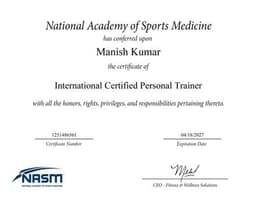
NASM Certified
Certified Personal Trainer & Sports Nutritionist from the National Academy of Sports Medicine
Disclaimer: This tool is for informational and personal journaling purposes only. Results are estimates based on published formulas and may vary based on individual factors such as genetics, training history, and measurement technique.