
Key Takeaways
- A front squat is about 78% of a back squat for gym lifters and about 89% for weightlifters. Three groups of trained lifters put the ratio between 0.74 and 0.83, and three groups of weightlifters between 0.87 and 0.91[1][2][3][4][5].
- Divide the front squat by 0.78 to get the back squat. A 225 lb front squat matches about 290 lb on the back squat at the gym-lifter average. The three gym-lifter ratios give 270 to 305 lb, and the weightlifter average gives 255 lb.
- Depth and bar position change the answer. One study tested the same 10 bodybuilders on two back squats. Their one-rep max was 238 kg in the parallel squat and 215 kg in the full-depth squat[3]. In another, with 19 lifters, a low bar added about 7% to a parallel back squat[6].
- The evidence is narrow. The 6 groups have 6 to 29 lifters each, with mean ages from 22.8 to 29.8 years[1][2][3][4][5]. No source cited here gives an adjustment for sex, age, body weight or experience, so the tool applies none.
How the Conversion Works
The ratio is the front squat max divided by the back squat max, with both squats to the same depth. A ratio of 0.78 means the front squat is 78% of the back squat[1][2][3].
Back squat = front squat ÷ ratio
Front squat = back squat × ratio
Choose gym lifter or weightlifter, and the tool uses that group's average ratio. It shows the answer at each of the 6 study ratios too, and rounds to the nearest 5 lb or 2.5 kg, which you can change under More options.
With the low-bar option on, the back squat is multiplied by 1.0692 when converting from the front squat, and divided by it when converting to the front squat. Your own ratio skips this step.
Worked example: a 225 lb front squat to the back squat
Back squat: 225 ÷ 0.78 = 287.9 lb
Nearest 5 lb: 290 lb
Worked example: a 315 lb back squat to the front squat
Front squat: 315 × 0.78 = 246.1 lb
Nearest 5 lb: 245 lb
Worked example: the same 225 lb front squat with a low-bar back squat
Back squat: 225 ÷ 0.78 × 1.0692 = 307.9 lb
Nearest 5 lb: 310 lb
Front Squat to Back Squat Chart
Find your front squat to see the back squat that matches it. Each value is rounded to the nearest 5 lb or 2.5 kg, and the weights on the left are common plate loadings, not targets.
Pounds
| Front squat (lb) | Gym lifters | Gym range | Weightlifters | Weightlifter range |
|---|---|---|---|---|
| 95 | 120 | 115 to 130 | 105 | 105 to 110 |
| 115 | 145 | 140 to 155 | 130 | 125 to 130 |
| 135 | 175 | 165 to 185 | 150 | 150 to 155 |
| 155 | 200 | 190 to 210 | 175 | 170 to 180 |
| 185 | 235 | 225 to 250 | 210 | 205 to 215 |
| 205 | 260 | 250 to 275 | 230 | 225 to 235 |
| 225 | 290 | 270 to 305 | 255 | 245 to 260 |
| 245 | 315 | 295 to 330 | 275 | 270 to 280 |
| 275 | 350 | 335 to 370 | 310 | 300 to 315 |
| 295 | 380 | 355 to 400 | 330 | 325 to 340 |
| 315 | 405 | 380 to 425 | 355 | 345 to 360 |
| 365 | 465 | 440 to 495 | 410 | 400 to 420 |
Back squat in lb for each front squat, with a high-bar back squat at the same depth. Rounded to the nearest 5 lb. The range runs across the studies of each group.
Kilograms
| Front squat (kg) | Gym lifters | Gym range | Weightlifters | Weightlifter range |
|---|---|---|---|---|
| 40 | 50 | 47.5 to 55 | 45 | 45 |
| 50 | 65 | 60 to 67.5 | 55 | 55 to 57.5 |
| 60 | 77.5 | 72.5 to 80 | 67.5 | 65 to 70 |
| 70 | 90 | 85 to 95 | 77.5 | 77.5 to 80 |
| 80 | 102.5 | 97.5 to 107.5 | 90 | 87.5 to 92.5 |
| 90 | 115 | 110 to 122.5 | 100 | 100 to 102.5 |
| 100 | 127.5 | 120 to 135 | 112.5 | 110 to 115 |
| 110 | 140 | 132.5 to 150 | 122.5 | 120 to 127.5 |
| 120 | 152.5 | 145 to 162.5 | 135 | 132.5 to 137.5 |
| 130 | 167.5 | 157.5 to 175 | 145 | 142.5 to 150 |
| 140 | 180 | 170 to 190 | 157.5 | 155 to 160 |
| 150 | 192.5 | 182.5 to 202.5 | 167.5 | 165 to 172.5 |
Back squat in kg for each front squat, with a high-bar back squat at the same depth. Rounded to the nearest 2.5 kg. The range runs across the studies of each group.
Back Squat to Front Squat Chart
Find your back squat to see the front squat that matches it. The back squat is a high bar at the same depth as the front squat. Each value is rounded to the nearest 5 lb or 2.5 kg.
Pounds
| Back squat (lb) | Gym lifters | Gym range | Weightlifters | Weightlifter range |
|---|---|---|---|---|
| 135 | 105 | 100 to 110 | 120 | 115 to 125 |
| 155 | 120 | 115 to 130 | 140 | 135 to 140 |
| 185 | 145 | 135 to 155 | 165 | 160 to 170 |
| 205 | 160 | 150 to 170 | 185 | 180 to 185 |
| 225 | 175 | 165 to 185 | 200 | 195 to 205 |
| 245 | 190 | 180 to 200 | 220 | 215 to 225 |
| 275 | 215 | 205 to 225 | 245 | 240 to 250 |
| 315 | 245 | 235 to 260 | 280 | 275 to 285 |
| 365 | 285 | 270 to 300 | 325 | 315 to 330 |
| 405 | 315 | 300 to 335 | 360 | 350 to 370 |
| 455 | 355 | 335 to 375 | 405 | 395 to 415 |
Front squat in lb for each high-bar back squat at the same depth. Rounded to the nearest 5 lb. The range runs across the studies of each group.
Kilograms
| Back squat (kg) | Gym lifters | Gym range | Weightlifters | Weightlifter range |
|---|---|---|---|---|
| 60 | 47.5 | 45 to 50 | 52.5 | 52.5 to 55 |
| 70 | 55 | 52.5 to 57.5 | 62.5 | 60 to 62.5 |
| 80 | 62.5 | 60 to 65 | 72.5 | 70 to 72.5 |
| 90 | 70 | 67.5 to 75 | 80 | 77.5 to 82.5 |
| 100 | 77.5 | 75 to 82.5 | 90 | 87.5 to 90 |
| 120 | 95 | 87.5 to 100 | 107.5 | 105 to 110 |
| 140 | 110 | 102.5 to 115 | 125 | 122.5 to 127.5 |
| 160 | 125 | 117.5 to 132.5 | 142.5 | 140 to 145 |
| 180 | 140 | 132.5 to 150 | 160 | 157.5 to 165 |
| 200 | 157.5 | 147.5 to 165 | 177.5 | 175 to 182.5 |
Front squat in kg for each high-bar back squat at the same depth. Rounded to the nearest 2.5 kg. The range runs across the studies of each group.
Front Squat to Back Squat Ratio
As a percentage, the front squat is 78% of the back squat at the gym-lifter average and 89% at the weightlifter average. The other way round, the back squat is 1.28 times the front squat for gym lifters and 1.12 times for weightlifters[1][2][3][4][5].
| Group | Lifters | Front ÷ back, average | Front ÷ back, range | Back ÷ front, average | Back ÷ front, range |
|---|---|---|---|---|---|
| Gym lifters[1][2][3]3 studies | 34 | 0.78 | 0.74 to 0.83 | 1.28 | 1.21 to 1.35 |
| Weightlifters[4][5]3 studies | 42 | 0.89 | 0.87 to 0.91 | 1.12 | 1.10 to 1.15 |
Each study counts once, whatever its size. The range is the lowest and highest of the study ratios in the group. Reading the ratio the other way round, back squat divided by front squat, flips each range.
Each study counts once, whatever its size. The lowest and highest study ratio in each group give its range.
Every weightlifter ratio is higher than every gym-lifter ratio. The studies differ in lifters, tests and depth, and none of them tests why, so the tool keeps the two groups apart.
What the Studies Measured
The ratios come from 6 groups in 5 papers in which the same lifters tested a front squat and a back squat. The table lists each one.
| Study | Lifters and mean age in years | Test and depth | Back squat bar | Front (kg) | Back (kg) | Ratio |
|---|---|---|---|---|---|---|
| Korak 2018[1]Gym lifters | 13 trained women, age 22.8 ± 3.1 | 1RM, thighs parallel | High bar | 60.7 | 78 | 0.78 |
| Davis 2020[2]Gym lifters | 11 trained adults (5 women, 6 men), age 23.7 ± 1.4 | 1RM, femur parallel | Not stated | 102.4 | 123.9 | 0.83 |
| Coratella 2021[3]Gym lifters | 10 male bodybuilders, age 29.8 ± 3.0 | 1RM, thighs parallel | Not named | 176 | 238 | 0.74 |
| Soriano 2024, women[4]Weightlifters | 7 women, Spanish weightlifting team, age 26.4 ± 3.9 | 1RM, not stated | High bar | 114.3 | 131.4 | 0.87 |
| Soriano 2024, men[4]Weightlifters | 6 men, Spanish weightlifting team, age 28.8 ± 4.5 | 1RM, not stated | High bar | 192.7 | 211.7 | 0.91 |
| Sandau 2025[5]Weightlifters | 29 elite men, German national team, age 24.6 ± 3.1 | 3RM, maximal depth | High bar | 203.7 | 228.1 | 0.89 |
| Coratella 2021, back squat to full depth[3]Different depths | 10 male bodybuilders, age 29.8 ± 3.0 | 1RM, front squat to parallel, back squat below parallel | Not named | 176 | 215 | 0.82 |
Means in kilograms as printed in each paper, worked out here as front squat divided by back squat. No paper prints the ratio. The last row uses the same 10 bodybuilders as Coratella 2021 above it, with the back squat taken below parallel. The two squats are at different depths, so the row is outside both ranges.
None of the papers prints the ratio. Each ratio here is the printed front squat mean divided by the printed back squat mean, so it is a ratio of group averages and not an average of each lifter's ratio.
The gym-lifter groups are 13 trained women with at least a year of lifting, 11 resistance-trained adults and 10 male competitive bodybuilders[1][2][3]. The first two groups tested both squats to parallel in a randomized order. The bodybuilders tested five squat variations in a random order.
The weightlifter groups are 7 women and 6 men of the Spanish national team, and 29 elite men of the German national team[4][5]. The Spanish lifters tested the two squats in different sessions with a high bar, and the paper states no depth. The German lifters squatted to maximal depth with a high bar.
The German study measured a three-rep max, not a one-rep max, and the copy read is an author manuscript, not the published version[5]. No source cited here compares the ratio at a 3RM with the ratio at a 1RM.
Depth and Bar Position
Coratella and colleagues tested the same 10 male bodybuilders on a front squat to parallel, a back squat to parallel and a back squat below parallel[3]. Their one-rep maxes were 176, 238 and 215 kg.
That gives a ratio of 0.74 against the parallel back squat and 0.82 against the deeper one. The tool keeps the parallel row in the gym-lifter group, since both squats are at the same depth, and shows the 0.82 row apart.
Use the same depth on both squats when you test yourself. A front squat to parallel set against a back squat below parallel does not match the ratios on this page.
González and colleagues tested 19 lifters, 9 men and 10 women, with at least a year of strength training[6]. Each squatted to parallel with a high bar and with a low bar, in two sessions a week apart.
The low-bar max averaged 105.0 kg and the high-bar max 98.2 kg, about 7% higher. The paper does not say how the order of the two sessions was set, and it did not test the front squat.
The low-bar option rests on that one small study, so the result carries a warning. It is not added to your own ratio, which already reflects the back squat you tested.
4 of the 6 study groups state a high bar. The other 2 do not name the bar[2][3].
Find Your Own Ratio
Choose Find my ratio, or choose My own ratio when converting, and enter your front squat max and your back squat max. Both should be maxes of the same kind, such as a one-rep max on each, with the two squats at an equal depth.
Ratio = front squat max ÷ back squat max
For example, a 200 lb front squat max and a 250 lb back squat max give a ratio of 0.80. The front squat is then 80% of the back squat.
The tool places your ratio against the 6 published ones, in words. It does not rank you against other lifters, because no source cited here gives percentiles for this ratio.
A ratio above 1 raises a warning that the two lifts may not be maxes of the same kind. The tool accepts ratios from 0.5 to 1.5, which only catches typing mistakes.
From a Set of Reps
This part is an extra. Under More options, enter the reps from a set taken to failure, and the tool estimates a one-rep max with seven published equations[7][8], then converts it at the ratio. It shows the average, the lowest and the highest of the seven.
LeSuer and colleagues tested the equations in 67 untrained students on the bench press, squat and deadlift. For the squat, the predicted weights differed significantly from the achieved 1RM in 6 of the 7 equations[7]. No source cited here tests them on the front squat, so treat the estimate as a rough guide.
Reps are limited to 10. Reynolds and colleagues tested the flat barbell bench press and the leg press, and advise no more than 10 reps in linear equations[9]. Their 5RM predicted the 1RM better than their 10RM or 20RM.
Example: 5 reps with a 185 lb front squat
Seven equations, front squat 1RM: 210 to 220 lb, average 215 lb
Back squat 1RM: average 275 lb at 0.78, or 250 to 300 lb across the equations and the three gym-lifter ratios
Not Covered
- Teenagers, older adults and beginners. The 6 groups are trained or elite adults with mean ages from 22.8 to 29.8 years.
- Corrections for sex, age, body weight, body fat, height, limb length or experience. No source cited here gives one, so the tool applies none. The groups that split by sex point both ways: women had the higher ratio among gym lifters (0.78 against 0.74) and the lower one among weightlifters (0.87 against 0.91). They come from different studies.
- Spread between lifters. The papers print group means and, mostly, standard deviations of the loads, but not of the ratio. The range on this page is the gap between group averages.
- The same reps on the other squat. No source cited here tests how many reps match across the two squats at one load, so the tool does not convert a set into a set.
- Other squat styles, such as the overhead squat. No source cited here gives a ratio for them.
- Safe weights. The result compares two loads. It does not say what weight is safe for you.
Frequently Asked Questions
Sources & References
- Muscle activation patterns of lower-body musculature among 3 traditional lower-body exercises in trained women. Korak JA, Paquette MR, Fuller DK, Caputo JL, Coons JM. J Strength Cond Res 2018;32(10):2770-2775. Full text read. 1RM of both squats in 13 trained women, parallel depth, high bar (2018)
- Muscle oxygen demands of the vastus lateralis in back and front squats. Davis PR, Yakel JP, Anderson DJF. Int J Exerc Sci 2020;13(6):734-743. Full text read. 1RM of both squats in 11 resistance-trained adults, parallel depth (2020)
- The activation of gluteal, thigh, and lower back muscles in different squat variations performed by competitive bodybuilders: implications for resistance training. Coratella G, Tornatore G, Caccavale F, Longo S, Esposito F, Cè E. Int J Environ Res Public Health 2021;18(2):772. Full text read. 1RM in 10 male bodybuilders, front squat and back squat to two depths (2021)
- Neuromuscular capabilities in top-level weightlifters and their association with weightlifting performance. Soriano MA, Flores FJ, Lama-Arenales J, Fernández-del-Olmo M, Comfort P. Appl Sci 2024;14(9):3762. Full text read. 1RM of both squats in 6 men and 7 women of the Spanish weightlifting team, high bar (2024)
- Prediction of snatch and clean and jerk performance from physical performance measures in elite male weightlifters. Sandau I, Kipp K. J Strength Cond Res 2025;39(1):33-40. Author manuscript read, not the published version. 3RM of both squats in 29 elite men, maximal depth, high bar (2025)
- Comparative analysis of performance in the high-bar vs. low-bar squat. González M, Navandar A, González-Ravé JM, Ojeda R, González-Mohíno F, Juárez Santos-García D. Appl Sci 2025;15(6):3143. Full text read. 1RM in the parallel squat with a high bar and a low bar in 19 lifters. The front squat was not tested (2025)
- The accuracy of prediction equations for estimating 1-RM performance in the bench press, squat, and deadlift. LeSuer DA, McCormick JH, Mayhew JL, Wasserstein RL, Arnold MD. J Strength Cond Res 1997;11(4):211-213. Only the abstract is available. The seven equations used for the optional one-rep-max estimates, tested in 67 untrained college students (1997)
- The effects of barbell resistance exercise on information processing speed and conflict-related ERP in older adults: a crossover randomized controlled trial. Lin TY, Hsieh SS, Chueh TY, Huang CJ, Hung TM. Sci Rep 2021;11:9137. Open access. Its Table 1 prints the seven equations from LeSuer et al., so the constants can be checked there (2021)
- Prediction of one repetition maximum strength from multiple repetition maximum testing and anthropometry. Reynolds JM, Gordon TJ, Robergs RA. J Strength Cond Res 2006;20(3):584-592. Only the abstract is available. 70 adults aged 18 to 69 (2006)

Certified Personal Trainer & Sports Nutritionist
NASM-certified fitness and nutrition coach with over 10 years of hands-on experience helping people build strength, lose fat, and live healthier lives. Specializing in gym-based workouts with a strong focus on lifting technique, biomechanics, and practical exercise science. Through FitLifeRegime, sharing the tools, tips, and insights that have worked for hundreds of clients — helping you start your own fitness journey with confidence and clarity.
Learn more about Manish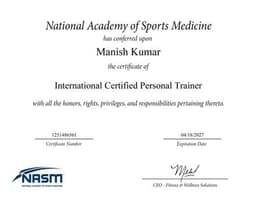
NASM Certified
Certified Personal Trainer & Sports Nutritionist from the National Academy of Sports Medicine
Disclaimer: This calculator converts between front squat and back squat weights using ratios from five small studies of trained and elite lifters. It does not say what weight is safe for you, and it does not replace advice from a coach, a physician or another qualified professional.