
Key Takeaways
- Speed is cadence times step length. Know any two and the third follows. It is plain arithmetic, not a model.
- Running faster is mostly a matter of longer steps. In a treadmill study of male recreational runners going from 3.15 to 4.12 m/s, stride frequency rose 4% while stride length rose 28%[3].
- At a fixed speed, 45 recreational runners absorbed less energy at the knee when they ran 5% or 10% above their preferred cadence, and less at the hip at +10%[1]. That is joint loading in a lab, not injury outcomes.
- Nobody has shown a best cadence for everyone. One lab study found an average optimum of about 85 strides (170 steps) per minute at 10.8 km/h[5], and body size did not predict preferred stride[3].
Speed, Cadence and Step Length
Each step covers some distance, and you take a certain number of steps a minute. Multiply the two and you get your speed: speed (m/s) = cadence (steps/min) × step length (m) ÷ 60.
Enter any two values and the calculator works out the third, plus your pace per kilometre and per mile.
Step or stride?
Example
To get your cadence, count every footstrike, left and right, for 30 seconds and double it. A watch will give it to you too. If you only counted one foot, double it again.
No watch for step length? Divide the distance by the steps you took to cover it.
What the Research Shows
| Source | What was done | Main finding |
|---|---|---|
| Heiderscheit 2011[1] | 45 healthy recreational runners on a treadmill at constant speed, step rate at preferred, ±5% and ±10% | Less energy absorbed at the knee at +5% and +10%, and at the hip at +10% only. Step length, vertical movement of the centre of mass, braking impulse and peak knee flexion fell as step rate rose. At −10%, every joint absorbed more energy. |
| Schubert 2014[2] | Systematic review of 10 studies that changed stride frequency or length at constant speed | Consistent evidence that a higher stride rate lowered vertical movement, ground reaction force, shock attenuation and energy absorbed at the hip, knee and ankle. Most studies were small, and most used male runners. |
| Figueiredo 2025[4] | Systematic review of 18 studies on cadence change in adult runners, combined as a narrative summary | A 5 to 10% increase gave consistent biomechanical changes, including lower vertical forces and loading rates, with no harm to metabolic cost. The authors say better long-term studies are needed. |
| Lieberman 2015[5] | 14 runners at 3.0 m/s, 75 to 95 strides per minute | Average metabolically optimal rate of 84.8 strides per minute, about 170 steps. Each 5 extra strides per minute raised maximum hip flexor moments by 5.8% and brought the landing foot closer to the hip. |
| Cavanagh & Kram 1989[3] | Male recreational runners on a treadmill, 3.15 to 4.12 m/s | Stride frequency rose 4% and stride length 28% across the speed range. Height and leg length correlated only weakly with preferred stride (r ≤ 0.36). |
So a small cadence rise at a steady speed lowers several loading measures, but no source gives one right number. Runners are often told to use 90 strides a minute (180 steps).
Lieberman's group found a lower average optimum at their test speed[5], and Cavanagh and Kram concluded that body size cannot be used to prescribe stride for an individual[3]. No source supports 180 as a universal target, so treat it as a popular coaching figure.
Using the Calculator
- The Same speed, different cadence table shows what a 5% or 10% change would do to your step length. Those are the changes the step rate studies tested[1].
- If you try a higher cadence, change it in small amounts at the same speed. None of the sources gives a safe weekly progression, so go gently and stop if something hurts.
- Want paces for a belt speed or a race plan? Try the Treadmill Pace Calculator or the Running Split Calculator.
Limitations
- The studies are short lab or treadmill tests, mostly on recreational and male runners[2][3]. Heiderscheit measured joint loading, not injuries[1]. The 2025 review says the evidence suggests a preventive effect for some injuries and asks for more prospective studies[4].
- There is no ground contact time estimate, target cadence or height-based step length here, because no source supports them. Cavanagh and Kram found body size a poor predictor of preferred stride[3].
- The calculator accepts speeds of 3 to 30 km/h, cadences of 100 to 240 steps per minute and step lengths of 0.3 to 2.5 m to catch typing errors. Those limits are not from a source.
- This is a training reference, not medical advice. If running hurts, see a clinician before changing your form.
Frequently Asked Questions
Sources & References
- Effects of step rate manipulation on joint mechanics during running. Heiderscheit BC, Chumanov ES, Michalski MP, Wille CM, Ryan MB. Medicine & Science in Sports & Exercise. 2011;43(2):296-302 (2011)
- Influence of stride frequency and length on running mechanics: a systematic review. Schubert AG, Kempf J, Heiderscheit BC. Sports Health. 2014;6(3):210-217 (2014)
- Stride length in distance running: velocity, body dimensions, and added mass effects. Cavanagh PR, Kram R. Medicine & Science in Sports & Exercise. 1989;21(4):467-479 (1989)
- The Influence of Running Cadence on Biomechanics and Injury Prevention: A Systematic Review. Figueiredo I, Reis E Silva M, Sousa JE. Cureus. 2025;17(8):e90322 (2025)
- Effects of stride frequency and foot position at landing on braking force, hip torque, impact peak force and the metabolic cost of running in humans. Lieberman DE, Warrener AG, Wang J, Castillo ER. Journal of Experimental Biology. 2015;218(21):3406-3414 (2015)

Certified Personal Trainer & Sports Nutritionist
NASM-certified fitness and nutrition coach with over 10 years of hands-on experience helping people build strength, lose fat, and live healthier lives. Specializing in gym-based workouts with a strong focus on lifting technique, biomechanics, and practical exercise science. Through FitLifeRegime, sharing the tools, tips, and insights that have worked for hundreds of clients — helping you start your own fitness journey with confidence and clarity.
Learn more about Manish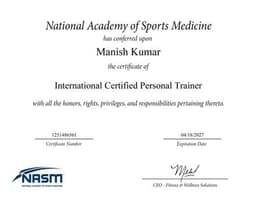
NASM Certified
Certified Personal Trainer & Sports Nutritionist from the National Academy of Sports Medicine
Disclaimer: This tool is for informational and personal journaling purposes only. Results are estimates based on published formulas and may vary based on individual factors such as genetics, training history, and measurement technique.