
Key Takeaways
- Paddling time is distance divided by speed[2]. At 3 mph, 5 miles takes 1:40:00, and 12 nautical miles at 3 knots takes 4:00:00.
- A current along the route adds to your speed over the ground or takes from it[3]. 8 miles at 3.5 mph takes 2:17:09 in still water, 1:46:40 with a 1 mph current and 3:12:00 against one.
- A round trip loses time to a current. 4 miles each way at 3.5 mph takes 2:17:09 in still water and 2:29:20 with a 1 mph current, whichever leg it helps.
- Wind, waves and tides change the real speed. Enter a speed that already allows for them, and plan a tidal crossing with a vector method[4].
How the Calculator Works
Enter a distance and your paddling speed through the water. You can work in miles, kilometres or nautical miles, and in mph, km/h or knots.
Add a steady current along the route, a time stopped and a start time. The result gives the paddling time, the total time and your arrival, and it shows the same trip at nearby speeds.
The second tab solves for speed, pace or distance. Use it with a timed paddle, or with the time you have to see what speed a trip needs.
The Kayaking Time Formulas
Two relationships cover the tool. A current changes the speed you divide by, not the distance.
| To find | Formula | Example |
|---|---|---|
| Time | Distance ÷ speed | 12 nmi ÷ 3 kn = 4:00:00 |
| Speed | Distance ÷ time | 1 nmi ÷ 0.5 h = 2 kn |
| Speed over the ground | Paddling speed ± current | 3.5 mph − 1 mph = 2.5 mph |
| Round trip with a current | d ÷ (v + c) + d ÷ (v − c) | 4 ÷ 4.5 + 4 ÷ 2.5 h = 2:29:20 |
| Total time | Paddling time + time stopped | 10 mi at 3 mph = 3:20:00, + 45 min = 4:05:00 |
The kayaking time formulas with a worked example for each.
A mile is exactly 1,609.344 m, a nautical mile is exactly 1,852 m and a knot is one nautical mile per hour[1]. 1 knot is 1.852 km/h or about 1.151 mph.
How Long Does It Take to Kayak 1, 5 or 10 Miles?
Each time assumes one steady speed through still water and no stops. Find your distance in the first column, then read across to the speed closest to yours.
| Distance | 2 mph | 2.5 mph | 3 mph | 3.5 mph | 4 mph |
|---|---|---|---|---|---|
| 1 mile | 30:00 | 24:00 | 20:00 | 17:09 | 15:00 |
| 2 miles | 1:00:00 | 48:00 | 40:00 | 34:17 | 30:00 |
| 3 miles | 1:30:00 | 1:12:00 | 1:00:00 | 51:26 | 45:00 |
| 5 miles | 2:30:00 | 2:00:00 | 1:40:00 | 1:25:43 | 1:15:00 |
| 8 miles | 4:00:00 | 3:12:00 | 2:40:00 | 2:17:09 | 2:00:00 |
| 10 miles | 5:00:00 | 4:00:00 | 3:20:00 | 2:51:26 | 2:30:00 |
| 12 miles | 6:00:00 | 4:48:00 | 4:00:00 | 3:25:43 | 3:00:00 |
| 15 miles | 7:30:00 | 6:00:00 | 5:00:00 | 4:17:09 | 3:45:00 |
| 20 miles | 10:00:00 | 8:00:00 | 6:40:00 | 5:42:51 | 5:00:00 |
Paddling time in h:mm:ss for common distances in miles at five speeds in mph.
| Distance | 4 km/h | 5 km/h | 6 km/h | 7 km/h | 8 km/h |
|---|---|---|---|---|---|
| 2 km | 30:00 | 24:00 | 20:00 | 17:09 | 15:00 |
| 5 km | 1:15:00 | 1:00:00 | 50:00 | 42:51 | 37:30 |
| 8 km | 2:00:00 | 1:36:00 | 1:20:00 | 1:08:34 | 1:00:00 |
| 10 km | 2:30:00 | 2:00:00 | 1:40:00 | 1:25:43 | 1:15:00 |
| 15 km | 3:45:00 | 3:00:00 | 2:30:00 | 2:08:34 | 1:52:30 |
| 20 km | 5:00:00 | 4:00:00 | 3:20:00 | 2:51:26 | 2:30:00 |
| 25 km | 6:15:00 | 5:00:00 | 4:10:00 | 3:34:17 | 3:07:30 |
| 30 km | 7:30:00 | 6:00:00 | 5:00:00 | 4:17:09 | 3:45:00 |
Paddling time in h:mm:ss for common distances in km at five speeds in km/h.
| Distance | 2 kn | 2.5 kn | 3 kn | 3.5 kn | 4 kn |
|---|---|---|---|---|---|
| 3 nmi | 1:30:00 | 1:12:00 | 1:00:00 | 51:26 | 45:00 |
| 6 nmi | 3:00:00 | 2:24:00 | 2:00:00 | 1:42:51 | 1:30:00 |
| 12 nmi | 6:00:00 | 4:48:00 | 4:00:00 | 3:25:43 | 3:00:00 |
| 15 nmi | 7:30:00 | 6:00:00 | 5:00:00 | 4:17:09 | 3:45:00 |
| 20 nmi | 10:00:00 | 8:00:00 | 6:40:00 | 5:42:51 | 5:00:00 |
Paddling time in h:mm:ss for common distances in nautical miles at five speeds in knots.
The speed columns are examples to read across, not labels for paddler levels.
Current and Round Trips
Your speed over the ground is your speed through the water plus the current along the route[3]. A helping current adds to it and an opposing current subtracts from it.
If the current is as strong as your paddling speed and runs against you, you cannot make headway. The calculator shows that as a message and not as a time.
| Current | Way out | Way back | Round trip | Extra vs still water |
|---|---|---|---|---|
| None | 1:08:34 | 1:08:34 | 2:17:09 | 0 sec |
| 0.5 mph | 1:20:00 | 1:00:00 | 2:20:00 | +2 min 51 sec |
| 1 mph | 1:36:00 | 53:20 | 2:29:20 | +12 min 11 sec |
| 1.5 mph | 2:00:00 | 48:00 | 2:48:00 | +30 min 51 sec |
A 4 mile out-and-back at 3.5 mph through the water, with the current against you on the way out.
The round trip is slower with any current because you spend more time on the slow leg. The same total comes out whether the current helps on the way out or on the way back.
A steady current only
Which Speed Should You Enter?
The most reliable number is a speed you have timed on a similar paddle in similar water. Divide the distance by the moving time.
With no timed paddle, sea kayak planning notes give starting figures[2]. An inexperienced group might expect 2 knots, and a small experienced group might cruise at 3 knots. A fast and fit paddler might cruise at 4 knots and sprint at 5 knots for a short time.
- Those figures are planning guidance for sea kayaks in tidal water, not measured averages for all paddlers or boats.
- Plan with the slowest paddler in the group.
- For a speed from a timed paddle, or the speed a goal time needs, use the second tab. 2 knots is 3.70 km/h and 3 knots is 5.56 km/h.
Time Stopped and Arrival Time
Time stopped is added after the division. 10 miles at 3 mph is 3:20:00 of paddling, and with 45 minutes stopped it is 4:05:00.
Add a start time to get an arrival on a 24-hour clock. If you are working back from a deadline, use the second tab with the time you have to find the speed you need.
Not Included
- Wind and waves are not modelled. Published headwind tables for a 3 knot paddler differ by author[5], so no single figure is applied. If you expect a headwind, enter a lower speed from a paddle in similar conditions.
- Hull type, boat load and paddler fitness are not multiplied in. A kayak physics study tested national-level athletes in racing K1 boats[6], and a physiology review covers competitive paddlers[7], so this calculator does not borrow their numbers for recreational boats.
- Calories, VO2 max and power are not calculated here. For calories, use the sports calorie calculator.
- The notes for speeds above 5 knots, below 1 knot and over 8 hours of paddling are prompts to check your inputs, not published limits.
For other time and pace tools, see the cycling time calculator, the hiking time calculator and the erg to boat speed calculator.
Frequently Asked Questions
Sources & References
- NIST Guide to the SI, Appendix B.8: Factors for Units Listed Alphabetically. National Institute of Standards and Technology. NIST Special Publication 811
- Notes on Sea Kayak Navigation and Tidal Planning, section 1.4 Distance, speed and time. Bown R. Online course notes, Cambridge Canoe Club (2026)
- Notes on Sea Kayak Navigation and Tidal Planning, section 5.5 Navigation for short crossings. Bown R. Online course notes, Cambridge Canoe Club (2026)
- Sea Kayaking: BCU Coaching Handbook. British Canoeing Awarding Body. BCU Coaching Handbook, Sea Kayaking
- Paddling in the wind. Kevin's Sea Kayaking Pages. Secondary summary of headwind tables from sea kayaking books
- On the Physics of Kayaking. Prétot, Carmigniani, Hasbroucq, Labbé. Applied Sciences 12(18):8925 (2022)
- The metabolic demands of kayaking: a review. Michael JS, Rooney KB, Smith R. Journal of Sports Science and Medicine 7(1):1-7 (2008)

Certified Personal Trainer & Sports Nutritionist
NASM-certified fitness and nutrition coach with over 10 years of hands-on experience helping people build strength, lose fat, and live healthier lives. Specializing in gym-based workouts with a strong focus on lifting technique, biomechanics, and practical exercise science. Through FitLifeRegime, sharing the tools, tips, and insights that have worked for hundreds of clients — helping you start your own fitness journey with confidence and clarity.
Learn more about Manish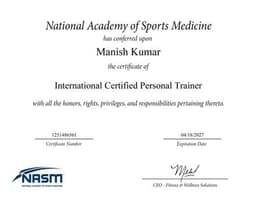
NASM Certified
Certified Personal Trainer & Sports Nutritionist from the National Academy of Sports Medicine
Disclaimer: This calculator does arithmetic on the distance, speed, current and stop time you enter. Real paddling varies with wind, waves, tides, load and fatigue, and a tidal crossing needs a proper plan. It is not a navigation or safety tool, so check the weather, tides and your own skills before you launch.