
Key Takeaways
- This tool scores a 1-minute maximum push-up test, matching how many ACSM field charts are used.
- Tables show five tiers (Excellent through Very Poor) by age and sex.[1]
- Men: standard push-ups from the toes. Women: same published charts usually assume modified (knee) push-ups.
- Tier labels are not statistical percentiles—they are rep-count bands from reference tables. Excellent uses published "> X" cutoffs (e.g. >54 means 55+ reps).
What Is the Push-Up Test?
The push-up test is a simple upper-body endurance check. You perform as many good reps as you can in one minute, then compare your count to age- and sex-specific reference bands.[1]
It needs no equipment, which is why it appears in fitness batteries, military prep, and classroom labs. It loads the chest, shoulders, and triceps through a closed-chain pattern.
Using the Guided 1-Minute Test
Choose Guided test in the calculator, enter your age, then tap Start guided test. You get a short countdown, a 60-second timer, and a large +1 REP button so you can count without a separate stopwatch.
When time is up, your rep total is scored automatically against the ACSM-style tiers.
- Use Manual entry if a partner timed you or you already know your count.
- Turn optional beeps on if you want audio cues at the start and end (off by default).
- Results can be saved in a progress log on this device and shared via the link in your browser bar after scoring.
Test Protocol (1 Minute)
Count maximum push-ups in 1 minute with good form. Rest only in the up position if needed. Men's table: standard (toes). Women's table: modified (knees) in common ACSM handouts.
- Warm up briefly. Use the same start position each time (hands under or just outside shoulders).
- Men: standard plank from the toes unless you are intentionally testing modified form.
- Women: modified position from the knees matches most published female charts in ACSM handouts.[1]
- Lower until the chest is close to the floor (many ACSM handouts cite about 3 inches / 7–8 cm without touching), then press to full extension.[2]
- Start the timer when the first rep begins. Count only full reps in 60 seconds. Rest in the up position if needed.
- Stop counting reps with poor form; do not add partial reps to inflate the score.
Not the same as a max-to-failure test
Standard vs Modified Push-Ups
Standard push-ups from the toes load more body mass through the arms. Modified push-ups from the knees reduce that load. A higher rep count on modified form does not equal the same score on standard form.
This calculator applies the men's table to standard push-ups and the women's table to modified push-ups, which mirrors common ACSM dissemination. If you pick the other variation, read the rating note in your results before comparing to the table.
Reference Tables in This Calculator
Values below match five-tier, age-adjusted charts reproduced from ACSM 1-minute push-up guidance. Excellent appears as "> X" in source tables (more than X reps). Good, Average, and Poor show inclusive rep ranges between the listed lower bounds.[1][2]
Other push-up norms exist
Men (standard push-ups, 1 minute)
| Age | Excellent | Good | Average | Poor | Very Poor |
|---|---|---|---|---|---|
| 20-29 | >54 | 45–53 | 35–44 | 20–34 | <20 |
| 30-39 | >44 | 35–43 | 24–34 | 15–23 | <15 |
| 40-49 | >39 | 30–38 | 20–29 | 12–19 | <12 |
| 50-59 | >34 | 25–33 | 15–24 | 8–14 | <8 |
| 60+ | >29 | 20–28 | 10–19 | 5–9 | <5 |
Women (modified push-ups, 1 minute)
| Age | Excellent | Good | Average | Poor | Very Poor |
|---|---|---|---|---|---|
| 20-29 | >48 | 34–47 | 17–33 | 6–16 | <6 |
| 30-39 | >39 | 25–38 | 12–24 | 4–11 | <4 |
| 40-49 | >34 | 20–33 | 8–19 | 3–7 | <3 |
| 50-59 | >29 | 15–28 | 6–14 | 2–5 | <2 |
| 60+ | >19 | 5–18 | 3–4 | 1–2 | <1 |
Improving Your Score
Train push-ups 2–3 days per week. Add a rep or two per week on your timed set rather than testing to failure every session. Pair pushing with rows or other pulling work for shoulder balance.
Retest on the same protocol every 4–8 weeks. For a broader battery, see our Physical Fitness Test Calculator or Sit-Ups Test Calculator.
Common Mistakes
- Using a to-failure test but scoring against 1-minute tables
- Counting partial reps or hips that sag or pike
- Comparing modified reps to the men's standard table (or the reverse)
- Changing hand width or depth between retests
Frequently Asked Questions
Sources & References
- ACSM's Guidelines for Exercise Testing and Prescription. American College of Sports Medicine. 11th ed. Wolters Kluwer (2021)
- Fitness Self-Assessment — Push-Up Test (1 minute). Howard Payne University (reproducing ACSM age/sex tier charts). Campus wellness PDF (2021)

Certified Personal Trainer & Sports Nutritionist
NASM-certified fitness and nutrition coach with over 10 years of hands-on experience helping people build strength, lose fat, and live healthier lives. Specializing in gym-based workouts with a strong focus on lifting technique, biomechanics, and practical exercise science. Through FitLifeRegime, sharing the tools, tips, and insights that have worked for hundreds of clients — helping you start your own fitness journey with confidence and clarity.
Learn more about Manish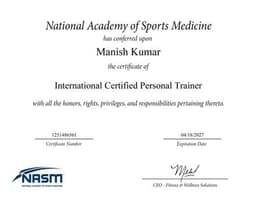
NASM Certified
Certified Personal Trainer & Sports Nutritionist from the National Academy of Sports Medicine
Disclaimer: This tool is for informational and personal journaling purposes only. Results are estimates based on published formulas and may vary based on individual factors such as genetics, training history, and measurement technique.