
Key Takeaways
- Enter two to five all-out pieces of different lengths. The tool fits a straight line through power and 1/time, and reads off critical power (CP) and W′ (the work you can do above CP)[3].
- CP is not your steady pace. In 14 male rowers, CP was 37% higher than the power they could hold at a steady lactate level[4]. Treat CP as a measure of performance, not an easy training intensity.
- In 38 well-trained rowers, CP from a 500 m piece and a 5 or 6 km piece had the strongest link to 2000 m performance, stronger than two lactate threshold methods[3].
- There is no FTP estimate, no CP per kg bands and no "typical W′" range, because no published source supports them. For training zones, use the Rowing FTP Calculator.
What CP and W′ Mean
Two numbers describe how your best power falls as a piece gets longer.
The power you can hold falls as a piece gets longer, and the fall follows a curve. The critical power model describes that curve with two numbers. CP is the power the curve levels off toward.
W′ is a fixed amount of work you can do above CP before you have to stop. Hard rowing above CP uses W′ up, and the harder you go, the faster it goes[2].
The idea goes back to a 1965 paper by Monod and Scherrer on the work capacity of a group of muscles working together[9]. A 2016 review calls CP a fatigue threshold, the line between intensities where the body's responses can be held steady and intensities where they cannot[2].
Rowing data complicate that picture, as the research section below shows.
How the Calculator Works
Power in watts, time in seconds, and a straight-line fit.
| Piece | What it does | Basis |
|---|---|---|
| Watts from distance and time | watts = 2.80 / pace3, pace in seconds per metre | The Concept2 Watts Calculator page[1] |
| The model | power = CP + W′ / time, fitted by least squares through your efforts | The linear 1/time form of the CP model, used on rowing ergometer pieces in Dwyer and colleagues[3] |
| Split at CP | The Concept2 formula turned around, from watts to a split per 500 m | Same formula[1] |
| Model times | The time at which the formula watts for a distance equal CP + W′ / time. Only shown inside the range of your efforts | Arithmetic on the fitted model. Not a published prediction method |
What each piece uses. Source numbers match the sources list.
Worked example: 3:00.0 at 361 W and 12:00.0 at 267 W
Time goes to 1/time: 1/180 = 0.00556 and 1/720 = 0.00139. The line through those two points has a slope of (361 − 267) / (0.00556 − 0.00139) = 22,560 J. That slope is W′, so W′ is 22.6 kJ.
CP is the intercept: 267 − 22,560 / 720 = 236 W. By the Concept2 formula that is a split of 1:54.1 per 500 m.
For 2,000 m the model gives 7:06.6, a 1:46.6 split at about 289 W. That is the model at an even pace, using only these two round-number efforts.
Which Efforts to Row
The studies do not agree on one protocol, so keep yours the same every time.
Published rowing work gives a feel for the range. Dwyer and colleagues took CP and W′ from a 500 m piece and a 5 or 6 km piece, and compared them with a separate 2000 m trial[3].
Possamai and colleagues used pieces of 500, 1,000, 2,000 and 6,000 m[4].
A review of how CP is measured says the protocol has not been standardised, and that the length of the pieces, how many there are, the rest between them and the maths used all change CP and W′[5].
My practical advice, which is not from a single study:
- Row each piece as a maximal effort, paced as evenly as you can. A piece that is not maximal puts a wrong point on the line and throws off both numbers.
- Make the pieces clearly different in length. The tool rejects efforts that are less than 1.25 times apart, because it cannot separate CP from W′ then. That limit is a safeguard, not a published number.
- Rest enough between pieces, ideally on different days, so a tired piece does not understate you.
- Add a third effort if you can. Two efforts always fit a line exactly, so only three or more give you a fit check.
- Use the same pieces each time you retest, so changes in CP mean something.
What Rowing Research Shows
Real results from erg studies, and what they do not tell you.
CP and 2000 m performance. Dwyer and colleagues tested 20 male and 18 female well-trained national or international standard rowers[3]. CP averaged 311 W (SD 67). That was lower than the power at the second lactate threshold, 324 W by one method and 323 W by the other.
CP had the strongest link to 2000 m performance (r² of .81), against .75 for both lactate methods. With W′ included, the model's predicted 2000 m time was highly correlated with actual time (r² of .92 in men and .81 in women).
A correlation is not the same as an error in seconds, and the abstract does not give that.
CP is not a steady pace. Possamai and colleagues tested 14 male rowers[4]. CP averaged 257 W and the power at maximal lactate steady state averaged 187 W, so CP was 37% higher. That gap is much bigger than the roughly 10% usually reported in running and cycling.
In these rowers, CP was not a power to sit at comfortably. A 2026 review of common criticisms of the CP model lists "critical power represents an indefinitely sustainable power output" among the ideas it examines[10].
The 3-minute all-out test. Cheng and colleagues tried a 3-minute all-out rowing test on 18 male rowers[6]. The end-test power matched CP from constant-work tests. The work done above that power did not correlate with W′ and was significantly higher than it.
This calculator does not process a 3-minute all-out test. It needs the average power of separate maximal pieces.
A related model for 1,500 m. Astridge and colleagues used a critical speed model, built on distance and time rather than power, from a 2000 m and a 500 m piece. In 34 elite under-23 rowers it predicted 1,500 m time with a mean absolute error under 1 second[8].
In 20 highly trained rowers, the predicted distance in a time-to-exhaustion trial was 1,589 m against 1,587 m covered[7]. That is a different model from the one here, so those accuracy figures do not transfer to the model times in this tool.
What It Cannot Tell You
The honest limits of a two-parameter model.
- CP and W′ change with the pieces you choose and with how well you row them[5]. Different protocols give different numbers.
- The tool accepts efforts of 1 to 30 minutes. That is my practical limit, not a published one. The rowing studies above used pieces from 500 m to 5 or 6 km. Model times are only shown inside the range of your own efforts, because the line is only fitted there.
- With two efforts there is no fit check, and the model passes through both by construction.
- Distance and time are turned into watts with the Concept2 formula at the average pace[1]. Watts you type in are used as given.
- There are no CP per kg bands, no W′ norms and no FTP estimate, because no published source exists for them. Without a norm, your own CP across repeat tests is the useful comparison.
To plan a race from a target time, use the Rowing Race Pace Calculator. For training zones from a 2K or 20-minute result, use the Rowing FTP Calculator. For a rough on-water 2K estimate from an erg score, try the Erg-to-Boat Speed Calculator.
Frequently Asked Questions
Sources & References
- Watts Calculator (pace to watts and watts to pace). Concept2. Concept2.com
- Critical Power: An Important Fatigue Threshold in Exercise Physiology. Poole DC, Burnley M, Vanhatalo A, Rossiter HB, Jones AM. Medicine and Science in Sports and Exercise 48(11):2320-2334 (2016)
- Critical Power Is More Strongly Associated With Rowing Performance Than the Second Lactate Threshold. Dwyer DB, Lester KD, Siegel R, Rice AJ, Hoffmann SM. International Journal of Sports Physiology and Performance 20(10):1341-1348 (2025)
- Agreement of maximal lactate steady state with critical power and physiological thresholds in rowing. Possamai LT, Borszcz FK, de Aguiar RA, de Lucas RD, Turnes T. European Journal of Sport Science 22(3):371-380 (2022)
- Methodological approaches and related challenges associated with the determination of critical power and curvature constant. Muniz-Pumares D, Karsten B, Triska C, Glaister M. Journal of Strength and Conditioning Research 33(2):584-596 (2019)
- Determination of critical power in trained rowers using a three-minute all-out rowing test. Cheng CF, Yang YS, Lin HM, Lee CL, Wang CY. European Journal of Applied Physiology 112(4):1251-1260 (2012)
- Critical-speed modeling using familiar performance tests can accurately predict 1500-m rowing-ergometer performance capability. Astridge DJ, Bartam JC, Peeling P, Goods PSR, Girard O, Binnie MJ. International Journal of Sports Physiology and Performance 20(11):1538-1544 (2025)
- Rowing at the 2028 Los Angeles Olympic Games: 1500-m versus 2000-m performance and the predictive accuracy of a critical speed model. Astridge DJ, Peeling P, Goods PSR, Girard O, Binnie MJ. International Journal of Sports Physiology and Performance 21(3):482-486 (2026)
- The work capacity of a synergic muscular group. Monod H, Scherrer J. Ergonomics 8(3):329-338 (1965)
- Ten common criticisms of the critical power model revisited. Black MI, Burnley M, Skiba PF, Poole DC, Vanhatalo A, Jones AM. International Journal of Sports Medicine, 21 August 2026 (2026)

Certified Personal Trainer & Sports Nutritionist
NASM-certified fitness and nutrition coach with over 10 years of hands-on experience helping people build strength, lose fat, and live healthier lives. Specializing in gym-based workouts with a strong focus on lifting technique, biomechanics, and practical exercise science. Through FitLifeRegime, sharing the tools, tips, and insights that have worked for hundreds of clients — helping you start your own fitness journey with confidence and clarity.
Learn more about Manish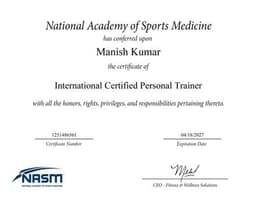
NASM Certified
Certified Personal Trainer & Sports Nutritionist from the National Academy of Sports Medicine
Disclaimer: This calculator is for informational and personal journaling purposes only. It logs measurements and compares them to published reference values. It is not health, medical, or nutrition advice.