
Key Takeaways
- It is a bike test you stop well short of exhaustion. You ride at 50 rpm in 3-minute stages, and the heart rates from your last two steady stages give the VO2max estimate[4].
- The maths is a straight line. Heart rate against work rate, extended to 220 minus age, then the ACSM leg-cycling equation turns that work rate into VO2[7][8]. The 70 kg example below works out to 34.0 ml/kg/min.
- Accuracy is mixed. One study found it overpredicted VO2max by 5.4% in men and 11.8% in women[2], and another found it underpredicted by 4.0 ml/kg/min[3].
- Treat the result as an estimate, not a lab value. The HUNT3 averages below give some context, but they are not a rating scale.
- It does not suit people on beta blockers[12] or in mid-pregnancy[14]. If either applies, or you have a heart condition, talk to your doctor first.
What the YMCA Cycle Test Is
The YMCA cycle test (also called the YMCA bike test or cycle ergometer test) is a submaximal fitness test. You never ride to exhaustion. Instead, the load goes up every 3 minutes and your heart rate at the last two steady stages shows how quickly it climbs as the work gets harder.
The calculator then draws a line through those two points, follows it to your estimated maximum heart rate, and reads off the work rate you could manage there. That work rate becomes your VO2max estimate.
The protocol comes from the YMCA fitness testing manual by Golding and colleagues (1989). I could not open that manual, so the protocol here is taken from the Canadian Society for Exercise Physiology's write-up of it[4], and I cross-checked it against a second source[5].
YMCA Cycle Test Protocol and Stage Table
Stage 1 is the same for everyone: 150 kgm/min (25 W, or 0.5 kp on a Monark bike) at 50 rpm for 3 minutes[4]. Your heart rate at the end of stage 1 decides which column of the table you follow.
| Stage 1 heart rate | Stage 2 | Stage 3 | Stage 4 |
|---|---|---|---|
| Below 80 bpm | 750 kgm125 W, 2.5 kp | 900 kgm150 W, 3 kp | 1050 kgm175 W, 3.5 kp |
| 80 to 89 bpm | 600 kgm100 W, 2 kp | 750 kgm125 W, 2.5 kp | 900 kgm150 W, 3 kp |
| 90 to 100 bpm | 450 kgm75 W, 1.5 kp | 600 kgm100 W, 2 kp | 750 kgm125 W, 2.5 kp |
| Above 100 bpm | 300 kgm50 W, 1 kp | 450 kgm75 W, 1.5 kp | 600 kgm100 W, 2 kp |
YMCA cycle test loads for stages 2 to 4, by heart rate at the end of stage 1 (kgm/min, with watts and kp)
If you need more than four stages, add 150 kgm/min (25 W) each time[4]. The Plan the stages tab in the calculator does this lookup for you.
The heart rate window
The two stages you use should each have a steady heart rate of at least 110 bpm and no more than about 85% of your estimated maximum[4][5]. Here is that window for a few ages.
| Age | Estimated maximum | Window |
|---|---|---|
| 20 | 200 bpm | 110 to 170 bpm |
| 30 | 190 bpm | 110 to 162 bpm |
| 40 | 180 bpm | 110 to 153 bpm |
| 50 | 170 bpm | 110 to 145 bpm |
| 60 | 160 bpm | 110 to 136 bpm |
Heart rate window for the two stages, using 220 minus age
One source gives a different window
A Western Kentucky thesis that reproduces the YMCA guide describes the plotting range as 110 to 150 beats per minute[6]. The CSEP summary and Fysiqal both give 110 bpm up to about 85% of maximum, so that is what this tool uses. Without the 1989 manual I cannot settle it.
How to run the test
- Work out 85% of your estimated maximum heart rate (220 minus age). The test ends when your steady heart rate is within 10 beats of it.
- Pedal at 50 rpm for 3 minutes at 150 kgm/min (25 W, 0.5 kp on a Monark bike).
- Record your heart rate in the last 15 to 30 seconds of minutes 2 and 3. If the two differ by more than 5 bpm, add a minute until they settle.
- Use the heart rate from the end of stage 1 to choose the load for stage 2 from the table. Stages 3 and 4 follow the same column.
- Keep adding stages until two steady heart rates in a row fall between 110 bpm and 85% of your maximum.
- Enter the last two stages in the calculator to estimate VO2max.
The YMCA Cycle Test Formula, Step by Step
There are three steps: extend your heart rate line to your estimated maximum, read the work rate at that point, then convert it to VO2.
Slope = (W2 − W1) ÷ (HR2 − HR1)
Maximum work = W2 + slope × (maximum heart rate − HR2)
VO2max (ml/kg/min) = 1.8 × maximum work ÷ body mass (kg) + 7
W1 and HR1 are the second-to-last stage, and W2 and HR2 are the last. Work rate is in kgm/min, and the protocol takes maximum heart rate as 220 minus age[4].
The last line is the ACSM leg-cycling equation, which appears in both the 10th and 11th editions of ACSM's Guidelines[7][8]. The 7 is resting oxygen use (3.5) plus the cost of pedalling with no load (3.5).
Worked example: 70 kg, age 40, 75 W at 120 bpm then 100 W at 135 bpm
75 W = 450 kgm/min and 100 W = 600 kgm/min
Slope = (600 − 450) ÷ (135 − 120) = 10 kgm/min per bpm
Maximum heart rate = 220 − 40 = 180
Maximum work = 600 + 10 × (180 − 135) = 1050 kgm/min
VO2max = 1.8 × 1050 ÷ 70 + 7 = 34.0 ml/kg/min
You get the same answer if you convert each stage to VO2 first and extend that line, because the equation is itself a straight line.
Watts, kgm/min and kp
The YMCA and ACSM convention is 1 W = 6 kgm/min, so 25 W is 150 kgm/min[4]. The exact physical value is closer to 6.12, which is why some calculators give slightly different answers from this one.
On a Monark bike, work rate is flywheel kilograms × rpm × 6 metres per revolution[7]. At 50 rpm that makes 1 kp equal to 300 kgm/min. If your bike has a different flywheel or is electronically braked, use its watts reading instead.
The YMCA Bike Test Chart and Graph
The chart in the calculator plots heart rate against work rate. The solid line joins your two stages, and the dashed line carries on to your estimated maximum heart rate.
In the example above, the points are (450 kgm/min, 120 bpm) and (600 kgm/min, 135 bpm). The dashed line reaches 180 bpm at 1050 kgm/min, which is 175 W. The shaded band is the valid heart rate window.
What Your YMCA Test Result Means
Your result is a number, not a grade. I could not find a rating scale for this test that I could trace to a source, so the calculator compares you with the HUNT3 Fitness Study instead. HUNT3 measured VO2max on a treadmill in 3,816 healthy Norwegians[10].
| Age | Men | Women |
|---|---|---|
| 20-29 | 54.4 (SD 8.4) | 43 (SD 7.7) |
| 30-39 | 49.1 (SD 7.5) | 40 (SD 6.8) |
| 40-49 | 47.2 (SD 7.7) | 38.4 (SD 6.9) |
| 50-59 | 42.6 (SD 7.4) | 34.4 (SD 5.7) |
| 60-69 | 39.2 (SD 6.7) | 31.1 (SD 5.1) |
Average VO2max in ml/kg/min with the standard deviation, HUNT3 Fitness Study
If your estimate is within one SD of the average, you are close to the middle of that group. Keep in mind that HUNT3 used a treadmill and healthy Norwegians, while this test estimates from cycling, so the comparison is rough.
For another way to place yourself, try the Fitness Age Calculator.
How Accurate Is the YMCA Cycle Test?
Not very predictable. The studies I could read disagree, and they disagree in both directions.
| Study | What it found |
|---|---|
| Garatachea 2007[2] | 56 adults aged 35 to 55. VO2max was overpredicted by 5.4% in men and 11.8% in women, and only the women's difference was significant. With each person's measured maximum heart rate in place of 220 minus age, there was no significant difference. The paper notes that an earlier study did find one in women. |
| Jamnick 2016[3] | 56 men and women. The YMCA test gave 41.1 ml/kg/min against a verified 45.1, an underestimate (P = 0.002), with a weak correlation (ICC 0.29). |
| Conference abstract and honors thesis, one lab[15][16] | 35 fit adults aged 19 to 31. A Monark bike gave 40.8 ml/kg/min against 50.3 on the treadmill. The underestimate was bigger in people with higher VO2max (R = 0.74), and an electronically braked bike did not help. |
| Beekley 2004[1] | 102 adults (55 men, 47 women), compared with a treadmill test. The abstract says the test predicts VO2max "to a degree based on several assumptions". I could not open the full text, and the honors thesis describes it as showing no significant difference, with a correlation of 0.77[16]. |
What the validation studies found
That same thesis lists four other studies with underestimates of about 14%, 22.3%, 8.8% and 12.3%, and two with overestimates of 12.1% and 39%[16]. I have not checked those one by one.
Two reasons come up. One is the maximum heart rate you assume: 220 minus age has a standard error of 7 to 11 beats[11].
The other is the line itself. Jamnick's team credited their own better-performing test to a stage above the gas exchange threshold, which the YMCA protocol does not include[3].
The calculator shows what happens to your result if your real maximum is 10 beats lower or higher. In the example, 170 bpm gives 31.4 and 190 bpm gives 36.6. That is arithmetic on one assumption, not a confidence interval.
What the test cannot do
It cannot match a lab test that measures the air you breathe out and checks that you really reached your maximum. If you need your actual VO2max, that is the only way.
Who Should Not Use It, and What Changes the Result
The test assumes your heart rate follows your effort. Beta blockers slow the heart, and Mayo Clinic says there is no way to know the exact effect[12]. If you take them or have a heart condition, ask your doctor before you test.
Pregnancy is another case. In 37 women at about 22 weeks, the YMCA result did not correlate with measured VO2max (r = 0.14), while ten non-pregnant women did (r = 0.71)[14]. The authors called it not valid in mid-pregnancy.
On age, the studies I could confirm covered adults from about 19 to 55. I found no data outside that range, and the calculator warns you when you enter an age beyond it.
The ACSM cycling equation is described as most accurate for 300 to 1200 kgm/min, which is 50 to 200 W[9]. I only saw that range in a secondary source.
ACSM also says the equations assume steady state[8]. The maximum your line reaches is not a steady-state stage, so that is one more assumption in the chain.
Two smaller things to watch. If your two heart rates are less than 10 bpm apart, a misread of a few beats changes the slope a lot. And Tanaka's equation gives a different maximum from 220 minus age[13], but I found no study that tested this protocol with it.
Cycle Test or Step Test?
The step tests on this site use your recovery pulse after stepping, so they need a step instead of a bike. The cycle test needs a bike with a known work rate and several stages, and it uses your heart rate while you ride.
Each test has its own method, so do not mix their numbers. Try the YMCA 3-Minute Step Test Calculator or the Queens College Step Test Calculator.
If you train by heart rate, the Fat Burning Zone Calculator compares maximum heart rate equations, and the Cycling RPE Calculator covers effort on the bike.
What Changed From the Old Version
If you used the earlier version of this page, note that its stage plan was wrong. It started stage 1 at 150 W and branched on heart rates of 120 and 130 bpm, none of which match the protocol above.
I also removed its fitness rating table and its "85 to 90% accuracy" claim, because I could not source either.
Frequently Asked Questions
Sources & References
- Cross-validation of the YMCA submaximal cycle ergometer test to predict VO2max. Beekley MD, Brechue WF, deHoyos DV, Garzarella L, Werber-Zion G, Pollock ML. Research Quarterly for Exercise and Sport 75(3):337-342 (full text not opened) (2004)
- Estimation of energy expenditure in healthy adults from the YMCA submaximal cycle ergometer test. Garatachea N, Cavalcanti E, García-López D, González-Gallego J, de Paz JA. Evaluation & the Health Professions 30(2):138-149 (2007)
- Comparison of the YMCA and a custom submaximal exercise test for determining VO2max. Jamnick NA, By S, Pettitt CD, Pettitt RW. Medicine & Science in Sports & Exercise 48(2):254-259 (abstract read) (2016)
- YMCA cycle ergometer submaximal test (summary of Golding et al. 1989; the original manual was not opened). Canadian Society for Exercise Physiology
- YMCA submaximal cycle ergometer test (secondary source, used to cross-check the protocol). Fysiqal Knowledge Library
- Improving the accuracy of the VO2 max prediction obtained from submaximal YMCA testing (thesis, secondary source). Western Kentucky University
- Metabolic calculations in action, part 2 (ACSM Guidelines, 10th ed., Table 6.3, written out as equations). Bushman BA. ACSM's Health & Fitness Journal (2020)
- Metabolic calculations cases (ACSM Guidelines, 11th ed., Table D.1, written out as equations). Bushman BA. ACSM's Health & Fitness Journal 27(2):6-10 (2023)
- How to calculate calories expended (quoted for the 300 to 1,200 kgm/min range; secondary source). IDEA Health & Fitness Association
- Aerobic capacity reference data in 3816 healthy men and women 20-90 years. Loe H, Rognmo Ø, Saltin B, Wisløff U. PLoS ONE 8(5):e64319. A correction to Table 2 was published in November 2013 (2013)
- The surprising history of the "HRmax=220-age" equation. Robergs RA, Landwehr R. Journal of Exercise Physiology online (2002)
- Beta blockers: How do they affect exercise?. Mayo Clinic
- Age-predicted maximal heart rate revisited. Tanaka H, Monahan KD, Seals DR. Journal of the American College of Cardiology (2001)
- Validity of the 6-minute walk test and YMCA submaximal cycle test during mid-pregnancy. Tinius RA, Blankenship M, Maples JM, Pitts BC, Furgal K, Norris ES, Hoover DL, Olenick A, Lambert J, Cade WT. Journal of Strength and Conditioning Research 35(11):3236-3242 (2021)
- Validity and reliability of the YMCA submaximal cycle test using an electrically-braked ergometer (conference abstract; authors and year not shown in the record I read). Authors unavailable. Medicine & Science in Sports & Exercise, supplement
- Validity and reliability of the YMCA submaximal cycle test using an electrically braked ergometer (honors thesis, secondary source for other studies). James Madison University

Certified Personal Trainer & Sports Nutritionist
NASM-certified fitness and nutrition coach with over 10 years of hands-on experience helping people build strength, lose fat, and live healthier lives. Specializing in gym-based workouts with a strong focus on lifting technique, biomechanics, and practical exercise science. Through FitLifeRegime, sharing the tools, tips, and insights that have worked for hundreds of clients — helping you start your own fitness journey with confidence and clarity.
Learn more about Manish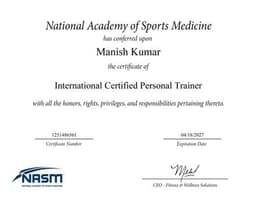
NASM Certified
Certified Personal Trainer & Sports Nutritionist from the National Academy of Sports Medicine
Disclaimer: This tool is for informational and personal journaling purposes only. Results are estimates based on published formulas and may vary based on individual factors such as genetics, training history, and measurement technique.