
Key Takeaways
- No study cited here turns a 5x5 weight into a 1RM. This calculator takes the hardest set of your session and runs it through seven published equations[2], or through a published RPE chart if that set stopped short of failure[3].
- A 5x5 weight is at or below your 5RM, because finishing five sets does not show you reached it. The estimate is more likely to read low than high, and it comes with a range, not a single verdict.
- The next-session line uses the StrongLifts 5x5 defaults: add weight after a completed session, repeat it after a miss, and drop 10% after 3 failed workouts in a row[7][8][9]. That is one program's rule.
- No source gives a 5x5 percentage of 1RM, and there is no per-lift correction factor, so neither is used. The last section lists what the page does not cover.
What 5x5 Is, and Why Its Weight Is Not a Max
5x5 means five sets of five reps with the same weight, so the weight on the bar is a work weight, not a max.
StrongLifts describes 5x5 exactly that way: squat 225 lb for five reps, rest about three minutes, then repeat until five sets are done[7].
Your 5RM is the heaviest weight you could lift for one set of five. If you finish all five sets, the weight was at or below that, and by how much is unknown.
That gap is why a 5x5 calculator cannot be exact. The estimate below is a planning number built from your hardest set.
How the 1RM Estimate Works
The calculator picks one set, treats it as the best evidence of your limit, and applies the same method as the 5 Rep Max Calculator.
What happens when you press Estimate
- If every set reached 5 reps, it uses the last set, because it is the most fatigued. If a set fell short, it uses the set with the fewest reps and treats it as taken to failure.
- If that set went to failure, each of the seven equations turns the weight and reps into a 1RM, and the page shows the average and the range.
- If you said the set stopped short, it reads the Helms RPE chart for those reps and that RPE, because the equations would read low[3].
- It then divides the session weight by the estimate to show how heavy the session was, and applies the StrongLifts rule for the next session.
LeSuer and colleagues print the seven equations in their Table 1[2]. Here they are, with the share of 1RM each gives for 5 reps:
| Equation | Form | 5 reps as % of 1RM | Original publication |
|---|---|---|---|
| Epley | 1RM = w × (1 + 0.0333 × r) | 85.7% | Epley, Poundage Chart, 1985 (not opened) |
| Brzycki | 1RM = 100 × w ÷ (102.78 − 2.78 × r) | 88.9% | Brzycki, 1993 (reference confirmed, full text not read) |
| Lander | 1RM = 100 × w ÷ (101.3 − 2.67123 × r) | 87.9% | Lander, NSCA Journal, 1985 (not opened) |
| Lombardi | 1RM = w × r^0.1 | 85.1% | Lombardi, Beginning Weight Training, 1989 (not opened) |
| Mayhew | 1RM = 100 × w ÷ (52.2 + 41.9 × e^(−0.055 × r)) | 84% | Mayhew et al., J Appl Sport Sci Res, 1992 (not opened) |
| O'Conner | 1RM = w × (1 + 0.025 × r) | 88.9% | O'Conner et al., Weight Training Today, 1989 (not opened) |
| Wathan | 1RM = 100 × w ÷ (48.8 + 53.8 × e^(−0.075 × r)) | 85.8% | Wathan, in Baechle (ed.), 1994 (not opened) |
w is the weight lifted and r is the reps to fatigue. The last column is arithmetic on each equation at 5 reps.
Brzycki's paper has its own table for his equation. A 100 lb set of 5 predicts a 1RM of 112 lb[1], and the calculator reproduces that value in its tests.
Worked example: 100 kg for 5x5, last set to failure
Brzycki 1RM = 100 × 100 ÷ (102.78 − 2.78 × 5) = 112.5 kg
Epley 1RM = 100 × (1 + 0.0333 × 5) = 116.7 kg
The same session, but the last set stopped with two reps left (RPE 8)
The Helms chart puts 5 reps at RPE 8 at 81% of 1RM
1RM = 100 ÷ 0.81 = 123.5 kg
The average is there because most people want one number. No study names a best equation or tests the average itself, so lean on the range.
5x5 to 1RM: A Quick Table
Use this if you only want a number. The first columns assume the last set went to failure. The last column assumes it stopped with two reps left, read from the Helms chart.
| 5x5 weight (kg) | Average to failure (kg) | Range (kg) | At RPE 8 (kg) |
|---|---|---|---|
| 40 | 46.2 | 45 to 47.6 | 49.4 |
| 60 | 69.3 | 67.5 to 71.4 | 74.1 |
| 80 | 92.4 | 90 to 95.2 | 98.8 |
| 100 | 115.5 | 112.5 to 119 | 123.5 |
| 120 | 138.6 | 135 to 142.8 | 148.1 |
| 140 | 161.7 | 157.5 to 166.6 | 172.8 |
1RM estimated from the last set of a 5x5, in kg. Average and range of the seven equations, and the RPE 8 chart value.
If a set fell short of 5, the calculator uses that set instead. For example, 3 reps at 105 kg on set 5 gives an average of 114.8 kg, because a missed set is the closest thing to a max in the session.
What Percentage of 1RM Is a 5x5 Weight?
No source gives one, so the calculator shows the percentage as a result, not a target.
Coaching articles quote their own percentages for 5x5, and those figures differ from one to the next. No study behind them was found for this page.
What the sources do support is narrower. For one set of 5 to failure, the seven equations give 84% to 88.9% of 1RM[2], and the Helms chart gives 85%[3].
The chart also lists lower shares when a set stops short of failure. It uses an RPE scale that counts reps left in reserve[4]. For 5 reps:
| RPE | 10 | 9.5 | 9 | 8.5 | 8 | 7.5 | 7 |
|---|---|---|---|---|---|---|---|
| 5 reps, % of 1RM | 85% | 84% | 83% | 82% | 81% | 80% | 79% |
Estimated % of 1RM for 5 reps by RPE (Helms et al., 2016, Table 2). It is a coaching chart, and almost all of it is estimated, not measured.
To turn your own reps and effort into a load, use the RPE to 1RM Calculator or the RIR to RPE Calculator.
Next Session: The StrongLifts 5x5 Rules
The next-session line in the calculator applies the rules StrongLifts publishes for its own program. They are that program's defaults, and no study comparing them with other ways to progress is cited here.
| What happened | Next session |
|---|---|
| All five sets reached five reps | Add weight. Default is 5 lb or 2.5 kg[7][8] |
| Any set fell short | Repeat the weight and try to do more reps than last time[7] |
| Failed 3 workouts in a row at one weight | Drop the weight by 10%, then build back up[9] |
StrongLifts 5x5 defaults, from its workout guide and support article.
The guide gives different steps by lift. Squat and deadlift take 5 to 10 lb (2.5 to 5 kg), and bench press, overhead press and row take 2.5 to 5 lb (1.25 to 2.5 kg)[7][8].
It says 10 lb jumps on the squat are not a good idea because you squat three times a week[7]. It also gives rest times: about 3 minutes between work sets, and up to 5 minutes after the hardest ones[7].
Starting a 5x5 from scratch
For a lifter who has trained before, StrongLifts says to start with a weight you could lift for 10 reps and use it for 5x5[7].
If a last set of 5 at 100 kg went to failure, the seven equations put a 10-rep load at about 88.2 kg, with a range of 84.4 to 93.3 kg. That sits at the edge of what the equations cover.
A real set is better than this. Use the table in the results to pick a starting point, then let the first sessions correct it.
For a progression rule that is not tied to one program, see the Progressive Overload Calculator.
How Accurate Is It?
This is what each source looked at, so you can judge how far to trust a number:
| Source | What it found | Limit |
|---|---|---|
| LeSuer et al., 1997[2] | 67 untrained college students did a 1RM and a set of 10 or fewer reps to fatigue. All seven equations correlated highly with the measured 1RM (r above 0.95). On the bench press, only Mayhew and Wathan did not differ significantly from the measured 1RM. On the squat, only Wathan did not. On the deadlift, all seven came out 9 to 14% low. | Untrained students, one set to fatigue. Not a fifth set after four earlier ones. |
| Halperin et al., 2022[5] | A pooled analysis of 12 studies (414 people) found lifters under-predicted their reps in reserve by about 1 rep on average, with large differences between studies. | It does not say how this carries over to a set you call "failure", so the calculator makes no adjustment. |
| Australian Institute of Sport, 2025 (version 3.0)[6] | Its testing manual says prediction equations vary with the muscle group, exercise and training level, with large variability (about 10%) when submaximal reps predict a maximum. It also says to record the weight and reps actually lifted and not to use predictive equations to calculate a 1RM. | A testing manual written for athlete testing, not a new experiment. |
- The set should go to failure. The equations assume reps to fatigue. If you stopped with reps left, pick the lower effort on the form and the page switches to the chart.
- Fatigue lowers the last set. The first four sets make the fifth harder than a fresh set of five, so the estimate is more likely to read low than high. No study measures how much.
- Keep reps low. LeSuer describes the equations as built on sets of 10 or fewer reps to fatigue, and reports that Brzycki and another study found estimates better below 10 reps[2]. The calculator accepts 2 to 10 reps per set and warns at 8 or more.
- Not every lift was tested. LeSuer tested the bench press, squat and deadlift. Overhead press and barbell row have no accuracy data in these sources, so the page warns for them.
Using the Result
- Enter the weight and the reps you actually got on each set. A missed set counts for more than a clean one, because it is closer to your limit.
- Be honest about the last set. If you could have done more reps, say so, and the chart will replace the equations.
- Read the range, not only the average. A wide range means less reason to trust any single number.
- Use the result as a planning figure. For a firm 1RM, test it with a warm-up, a spotter or safety bars, and the AIS guidance[6].
- For a 5-rep-max view, see the 5 Rep Max Calculator. For one set of any size, use the One Rep Max Calculator.
- To load the bar, use the Barbell Plate Calculator, and for lighter sets before your work weight, the Warm-Up Calculator.
What This Page Does Not Cover
A 5x5 percentage of 1RM
No source gives one, and the figures in coaching articles differ.
Per-lift correction factors
Some calculators multiply the result by a number such as 1.02 for squats. No source supports any such factor, so none is applied.
Bill Starr, Madcow and Starting Strength weights
Their primary texts were not available for this page, so their percentages and weekly jumps are left out.
Strength standards by bodyweight
No sourced standards were found, and a fixed table would ignore bodyweight and training age.
Warm-up percentages and nutrition advice
Neither is tied to a study here. Use the Warm-Up Calculator for warm-up sets.
Whether 5x5 is the best way to train
The StrongLifts rules are applied as that program states them, and no trial comparing them with other methods is cited here.
Epley, Lander, Lombardi, Mayhew, O'Conner and Wathan are cited through LeSuer's table. The AIS manual cited is version 3.0, the PDF linked from the AIS page. The StrongLifts rules come from three of its web pages, which its authors can change.
Frequently Asked Questions
Sources & References
- Strength testing: predicting a one-rep max from reps-to-fatigue. Brzycki M. Journal of Physical Education, Recreation & Dance 64(1):88-90 (1993)
- The accuracy of prediction equations for estimating 1-RM performance in the bench press, squat, and deadlift. LeSuer DA, McCormick JH, Mayhew JL, Wasserstein RL, Arnold MD. Journal of Strength and Conditioning Research 11(4):211-213 (1997)
- Application of the repetitions in reserve-based rating of perceived exertion scale for resistance training. Helms ER, Cronin J, Storey A, Zourdos MC. Strength and Conditioning Journal 38(4):42-49 (2016)
- Novel resistance training-specific rating of perceived exertion scale measuring repetitions in reserve. Zourdos MC, Klemp A, Dolan C, Quiles JM, Schau KA, Jo E, Helms E, Esgro B, Duncan S, Garcia Merino S, Blanco R. Journal of Strength and Conditioning Research 30(1):267-275 (2016)
- Accuracy in predicting repetitions to task failure in resistance exercise: a scoping review and exploratory meta-analysis. Halperin I, Malleron T, Har-Nir I, Androulakis-Korakakis P, Wolf M, Fisher J, Steele J. Sports Medicine 52(2):377-390 (2022)
- National Protocols for the Assessment of Strength and Power, Version 3.0 (April 2025 revision). Australian Institute of Sport and the National Institute Network. Australian Sports Commission (2025)
- StrongLifts 5x5 Workout Program: Quick Start Guide. StrongLifts. stronglifts.com (web page, current version)
- How to Progress on StrongLifts 5x5. StrongLifts. stronglifts.com (web page, current version)
- How do I change my increments and deload settings?. StrongLifts support. support.stronglifts.com (web page, current version)

Certified Personal Trainer & Sports Nutritionist
NASM-certified fitness and nutrition coach with over 10 years of hands-on experience helping people build strength, lose fat, and live healthier lives. Specializing in gym-based workouts with a strong focus on lifting technique, biomechanics, and practical exercise science. Through FitLifeRegime, sharing the tools, tips, and insights that have worked for hundreds of clients — helping you start your own fitness journey with confidence and clarity.
Learn more about Manish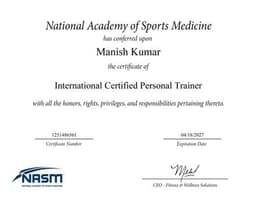
NASM Certified
Certified Personal Trainer & Sports Nutritionist from the National Academy of Sports Medicine
Disclaimer: This tool is for informational and personal journaling purposes only. Results are estimates based on published formulas and may vary based on individual factors such as genetics, training history, and measurement technique.