
Key Takeaways
- This is the set-level RPE scale built around reps in reserve (RIR). RPE 10 means no reps left, RPE 9 means 1 left, RPE 8 means 2 left, and RPE 7 means 3 left[1][2]. The half points are 9.5 (no more reps, but you could have added weight), 8.5 (1 to 2 left) and 7.5 (2 to 3 left)[10].
- Below 7 the scale gets vague. RPE 5 to 6 stands for 4 to 6 reps remaining, and RPE 1 to 4 are effort words with no rep count[2].
- Studies disagree on how well people judge reps left. A pooled analysis of 414 people found they under-predicted reps to failure by about 1 rep on average, with a lot of spread[4]. A study of 24 trained lifters on the bench press found their 1 and 3 RIR calls were off by under a rep on average[7]. Calls made closer to failure tend to be better[4][8].
- The % of 1RM figures come from a chart in Helms and colleagues. Only three of its cells came from measured data, in trained lifters squatting. The rest are estimates[2].
- This is not the session RPE used for weekly training load. Same name, different scale and a different question.
What the Scale Means
Zourdos and colleagues built the scale in 2016 and tied each rating to reps in reserve: RPE 10 = 0 RIR, RPE 9 = 1 RIR, and so on[1]. Here it is in full:
| RPE | Reps in reserve | Description |
|---|---|---|
| 10 | 0 | Maximum effort |
| 9.5 | 0 | No further repetitions but could increase load |
| 9 | 1 | 1 repetition remaining |
| 8.5 | 1–2 | 1–2 repetitions remaining |
| 8 | 2 | 2 repetitions remaining |
| 7.5 | 2–3 | 2–3 repetitions remaining |
| 7 | 3 | 3 repetitions remaining |
| 5–6 | 4–6 | 4–6 repetitions remaining |
| 3–4 | – | Light effort |
| 1–2 | – | Little to no effort |
- Where the wording comes from. Helms and colleagues reprint the whole-number rows[2]. The half-point rows are the wording of Zourdos' scale as reproduced in an open-access review[10]. They are not checked against the original Zourdos paper, so treat the half-point wording as second-hand.
- RPE 10 versus 9.5. Both mean you had no reps left. The difference is that at 9.5 you felt you could have used more weight. The calculator shows RPE 10 for 0 reps in reserve and mentions 9.5 alongside it.
- Why 5 and 6 share a row. Helms explains that the scale uses rep counts for 5 to 10 and effort words for 1 to 4. It groups 5 to 6 as 4 to 6 reps remaining because it is easier to give a range when you have more than 3 reps left[2].
- Where the idea came from. Helms notes that a scale of this kind first appeared in The Reactive Training Systems Manual in 2008, and that Zourdos et al. brought it into the scientific literature[2].
This is not session RPE
How the Conversion Works
The conversion is a lookup in the scale above. Whole numbers from 7 to 10 are 10 minus the reps left, so 2 reps in reserve is RPE 8.
In between, 1 to 2 reps left is RPE 8.5 and 2 to 3 is RPE 7.5. Type 1.5 or 2.5 into the calculator for those. 4 to 6 reps in reserve is RPE 5 to 6, and RPE 4 or lower has no rep count.
The % of 1RM figure is a lookup in Table 2 of Helms and colleagues[2]. It covers 1 to 8 reps at RPE 7 to 10. Here it is in full:
| RPE | 1 rep | 2 reps | 3 reps | 4 reps | 5 reps | 6 reps | 7 reps | 8 reps |
|---|---|---|---|---|---|---|---|---|
| 10 | 100%* | 95% | 91% | 87% | 85% | 83% | 81% | 79% |
| 9.5 | 97% | 93% | 89% | 86% | 84% | 82% | 80% | 77.5% |
| 9 | 95% | 91% | 87% | 85% | 83% | 81% | 79% | 76% |
| 8.5 | 93% | 89% | 86% | 84% | 82% | 80% | 77.5% | 74.5% |
| 8 | 91%* | 87% | 85% | 83% | 81% | 79% | 76% | 73% |
| 7.5 | 89% | 86% | 84% | 82% | 80% | 77.5% | 74.5% | 71.5% |
| 7 | 87% | 85% | 83% | 81% | 79% | 76% | 73% | 70%* |
Estimated % of 1RM by reps performed and RPE. Starred cells are the three marked as taken from measured data. The rest are estimates (Helms et al., 2016, Table 2).
Working it through
- Only three cells came from data. Helms says the chart is based on the mean ratings of experienced squatters for single reps at 90% and 100% of 1RM and for 8 reps at 70%. Every other combination is an estimate[2].
- The whole-number rows have a pattern. The percentage depends on reps done plus reps left. Five reps at RPE 8 and seven reps at RPE 10 are both 81%, because both are sets with about 7 reps available. I noticed this from the grid itself. The paper doesn't state it as a rule.
- People differ. The standard deviation for 8 reps at 70% was 1.2 reps in reserve. Helms notes that around two-thirds of lifters might report between 2 and 4 RIR there, and some would report 1 or 5[2].
- It is squat data. Helms warns the relationship may change for machines, single-joint moves and upper-body lifts, and that the chart should not be treated as an exact conversion[2].
What the Research Says, and What It Doesn't
Here is what each study looked at, so you can judge how far to trust a number:
| Source | What it found | Limit |
|---|---|---|
| Zourdos et al., 2016[1] | In 29 people squatting (15 experienced, 14 novice), RPE and bar speed were strongly and inversely related (r = −0.88 in experienced, −0.77 in novices). Experienced squatters rated the 1RM higher than novices. | Squat only, with one rep per load plus one 8-rep set. |
| Ormsbee et al., 2019[3] | In 27 college-aged men on the bench press, RPE and bar speed were strongly related in both groups (r = 0.85, as reported). Experienced benchers rated their 1RM 9.86 against 9.35 for novices. | Men only, bench press only. |
| Hackett et al., 2012[6] | In 17 male bodybuilders, estimated reps to failure correlated closely with actual reps (r ≥ 0.93) and predicted them well in sets 3 to 5. Traditional RPE at failure was less than maximal. | Bench press and squat, 10 reps at 70% of 1RM. |
| Steele et al., 2017[5] | 141 people predicted reps to failure across a full-body session. They under-predicted, with a tendency toward better accuracy in more experienced trainees. | Single sets to failure. The authors advise using RIR cautiously. |
| Halperin et al., 2022[4] | Pooled 12 studies (414 people): under-prediction of about 0.95 reps on average (95% CI 0.17 to 1.73), with very high heterogeneity. Predictions were slightly better closer to failure, with 12 reps or fewer, and in later sets. Training status didn't seem to matter. | An exploratory meta-analysis. The authors say it is not clear whether this error is acceptable. |
| Remmert et al., 2023[8] | In 27 men and 31 women doing machine curls, pushdowns and rows at 72.5% of 1RM, predictions were more accurate closer to failure and in later sets. Sex and training experience didn't significantly affect accuracy. | Single-joint and seated row machine work, young adults. |
| Refalo et al., 2024[7] | In 24 resistance-trained men and women on the bench press at 75% of 1RM, lifters called out when they reached 1 or 3 reps in reserve. The average error was −0.17 reps (absolute error 0.65), with a minor tendency to under-predict. Accuracy wasn't related to sex or training experience. | Two sets, one lift. The authors only claim this for the bench press. |
- The studies don't agree on accuracy. Some found lifters under-predicted by a rep or more[4][5], and others found errors under a rep[7]. They used different lifts, loads and prediction methods, so which number applies to you can't be told.
- Does experience matter? Experienced squatters and benchers rated their 1RM closer to 10 than novices did[1][3], and Steele saw a tendency toward better prediction with experience[5]. The pooled analysis, the machine-exercise study and the bench press study all found no link with training experience[4][7][8]. Treat the evidence as mixed.
- Closer to failure is easier to judge. Helms describes Hackett's finding that estimates improved as lifters got nearer to failure[2][6]. The pooled analysis and the machine study found the same[4][8], and a 2024 scoping review of 31 studies suggests making the prediction close to failure[9]. That is why the scale uses rep counts only for the hard end.
- RPE does track load. A systematic review of 18 studies found moderate positive correlations between RPE scales (including the RIR-based one), movement speed and % of 1RM[10].
- Mostly male, young adults. The scoping review notes that its 855 participants were mostly male adults, and it calls for more work on sex, experience and exercise choice[9]. Newer studies in women and on other lifts are starting to fill that gap[7][8].
- No single accuracy figure. No source gives one accuracy rate for lifters in general, so the page doesn't quote one.
Using It in Practice
- If you are new to lifting, log your RIR for a while without basing your loading on it. Helms suggests novices practise the scale first and rely on it more once their ratings are accurate[2].
- To check yourself, do a set short of failure, write down your rating, then repeat the same load to failure and compare. Helms describes this approach[2]. Use a lift where failing is safe, such as a machine or with a spotter.
- Use it for sets that end near failure, roughly RPE 7 to 10, which is where the scale is meant to work[2]. Make your call late in the set, because that is when predictions are most accurate[4][9].
- Pair it with a load or rep target if you like. Helms gives the example of 3 sets of 3 at 90% of 1RM with a note of 0–1 RIR, so the lifter knows to back off if they miss reps or add weight if sets are easy[2].
For rest between sets, see the Rest Time Between Sets Calculator. To track how hard your sets are across a block, try the Volume-to-Intensity Ratio Calculator.
Frequently Asked Questions
Sources & References
- Novel resistance training-specific rating of perceived exertion scale measuring repetitions in reserve. Zourdos MC, Klemp A, Dolan C, Quiles JM, Schau KA, Jo E, Helms E, Esgro B, Duncan S, Garcia Merino S, Blanco R. Journal of Strength and Conditioning Research 30(1):267-275 (2016)
- Application of the repetitions in reserve-based rating of perceived exertion scale for resistance training. Helms ER, Cronin J, Storey A, Zourdos MC. Strength and Conditioning Journal 38(4):42-49 (2016)
- Efficacy of the repetitions in reserve-based rating of perceived exertion for the bench press in experienced and novice benchers. Ormsbee MJ, Carzoli JP, Klemp A, Allman BR, Zourdos MC, Kim JS, Panton LB. Journal of Strength and Conditioning Research 33(2):337-345 (2019)
- Accuracy in predicting repetitions to task failure in resistance exercise: a scoping review and exploratory meta-analysis. Halperin I, Malleron T, Har-Nir I, Androulakis-Korakakis P, Wolf M, Fisher J, Steele J. Sports Medicine 52(2):377-390 (2022)
- Ability to predict repetitions to momentary failure is not perfectly accurate, though improves with resistance training experience. Steele J, Endres A, Fisher J, Gentil P, Giessing J. PeerJ 5:e4105 (2017)
- A novel scale to assess resistance-exercise effort. Hackett DA, Johnson NA, Halaki M, Chow CM. Journal of Sports Sciences 30(13):1405-1413 (2012)
- Accuracy of intraset repetitions-in-reserve predictions during the bench press exercise in resistance-trained male and female subjects. Refalo MC, Remmert JF, Pelland JC, Robinson ZP, Zourdos MC, Hamilton DL, Fyfe JJ, Helms ER. Journal of Strength and Conditioning Research 38(3):e78-e85 (2024)
- Accuracy of predicted intraset repetitions in reserve (RIR) in single- and multi-joint resistance exercises among trained and untrained men and women. Remmert JF, Laurson KR, Zourdos MC. Perceptual and Motor Skills 130(3):1239-1254 (2023)
- Feasibility and usefulness of repetitions-in-reserve scales for selecting exercise intensity: a scoping review. Bastos V, Machado S, Teixeira DS. Perceptual and Motor Skills 131(3):940-970 (2024)
- Validity of rating of perceived exertion scales in relation to movement velocity and exercise intensity during resistance exercise: a systematic review. Petro JL, Ferrari G, Cardozo LA, Vargas-Molina S, Carbone L, Kreider RB, Bonilla DA. Sports Health 17(3):621-628 (2025)

Certified Personal Trainer & Sports Nutritionist
NASM-certified fitness and nutrition coach with over 10 years of hands-on experience helping people build strength, lose fat, and live healthier lives. Specializing in gym-based workouts with a strong focus on lifting technique, biomechanics, and practical exercise science. Through FitLifeRegime, sharing the tools, tips, and insights that have worked for hundreds of clients — helping you start your own fitness journey with confidence and clarity.
Learn more about Manish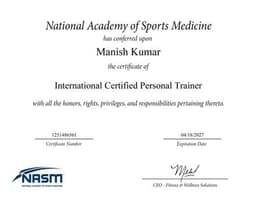
NASM Certified
Certified Personal Trainer & Sports Nutritionist from the National Academy of Sports Medicine
Disclaimer: This tool is for informational and personal journaling purposes only. Results are estimates based on published formulas and may vary based on individual factors such as genetics, training history, and measurement technique.