
The formula at a glance, age 30, resting 60
Maximum (220 − age)
190bpm
220 − 30. An estimate, not a measurement.
Heart rate reserve
130bpm
190 − 60. The gap the percentages apply to.
Target at 70%
151bpm
60 + 70% × 130.
70% of maximum alone
133bpm
A different scale, so a different number.
Key Takeaways
- The Karvonen method adds a percentage of your heart rate reserve to your resting heart rate. Reserve is maximum minus resting. At maximum 180, resting 60 and 60%, ACSM's journal gives 132 beats a minute[4].
- The 1957 paper expressed training intensity as a percentage of the pulse range from rest to the maximum a student could reach by running. It reports a critical limit at or slightly above 60% of that range[1]. It has no age equation. The 220 minus age rule comes from a 1971 paper by Fox and colleagues[4].
- Percent of heart rate reserve and percent of maximum are different scales. Reserve tracks percent of oxygen uptake reserve, not percent of VO2max[2], so the same percentage gives different beats.
- Your maximum is the weak link. Age equations have a standard error of 7 to 11 beats[14], and Mayo Clinic says yours can differ by 15 to 20[5]. ACSM's guidelines prefer a directly measured maximum[4].
- ACSM classes effort by percent of reserve: moderate is 40 to 59, vigorous is 60 to 89[3]. Check my pulse mode places any heart rate in those classes.
- Beta blockers blunt the heart rate response, so a predicted maximum can sit above what you can reach[4][16]. A cardiac rehab study recommends a measured maximum for these patients[17]. Ask your doctor for a target.
The Karvonen Formula, With a Worked Example
Target heart rate = resting heart rate + percent × (maximum − resting).
The calculation has two steps. Subtract resting from maximum to get your reserve. Then add the percentage of that reserve you want to your resting rate.
Reserve = maximum − resting
Target = resting + percent × reserve
Worked example: age 30, resting 60, 60 to 70%
Maximum (220 − age) = 220 − 30 = 190 bpm
Reserve = 190 − 60 = 130 bpm
Low = 60 + 60% × 130 = 138 bpm
High = 60 + 70% × 130 = 151 bpm
The same percentages on maximum alone give 114 to 133. The gap is why you should not mix the two methods.
Three published examples run through the same arithmetic. Each matches the figure the source prints.
| Source | Maximum | Resting | Percent | Result |
|---|---|---|---|---|
| ACSM journal | 180 | 60 | 60% | 132 |
| Mayo Clinic, age 45 | 176.5 | 80 | 70 to 85% | 148 to 162 |
| ACE, age 34 | 186 | 62 | 75% | 155 |
Sources: ACSM through Bushman[4], Mayo Clinic[5] and ACE[6]. Mayo takes its maximum from the Tanaka equation. Results are rounded to the nearest beat, halves up.
Percent of reserve from a pulse
(heart rate − resting) ÷ reserve × 100
The target formula solved for the percentage. Plain algebra, used by Check my pulse mode.
Beats in 10 seconds
beats per minute ÷ 6
Arithmetic. Mayo describes a 15 second count times 4 instead.
What Heart Rate Reserve Is
Heart rate reserve is the gap between your maximum and your resting heart rate.
Cleveland Clinic defines it as maximum minus resting heart rate, and says another name for the formula is the Karvonen method[7]. Mayo Clinic uses the same subtraction in its heart rate reserve steps[5].
Because the formula starts at your resting rate, two people with the same age and maximum get different targets if their resting rates differ. At maximum 190, a 70% target is 148 with a resting rate of 50 and 154 with a resting rate of 70.
Where the Karvonen Method Comes From
The source is a 1957 study of six medical students, and it does not contain 220 minus age.
The paper is "The effects of training on heart rate: a longitudinal study", by Karvonen, Kentala and Mustala of the Institute of Occupational Health in Helsinki[1].
Six male medical students aged 20 to 23 ran on a treadmill for 30 minutes a day, 4 to 5 days a week, for 4 weeks. One of them repeated the experiment after five weeks.
The treadmill speed was adjusted to hold each student's working heart rate at a preset level. When training lowered the heart rate at a given speed, the speed went up[1].
Each student counted his resting pulse every morning in bed. His maximum was counted after running at a submaximal speed to exhaustion, which took 2 minutes or less. Intensity was written as a percentage of the range between the two[1].
Training lowered the working heart rate in some experiments, and the paper reads that as a sign of higher maximum oxygen uptake. Oxygen uptake itself was not measured. Expressed as a percentage of the available range, "there appeared to be a critical limit at or slightly above the 60 per cent training level"[1].
The summary puts that limit at more than 60% of the range, or above about 140 beats a minute. The discussion adds that pulse rates above 150, or at least 70% of the range, will lower the working rate[1].
What the paper does not give
It prints no target heart rate formula and no equation for predicting maximum heart rate. The study had six people, all young men, so it cannot say what is right for anyone else. The formula on this page is how later guidance writes the percent-of-range idea[4].
One printing quirk. In the scanned paper the percentage reads WR ÷ (MR − RR) × 100, with WR the working rate, MR the maximum and RR the resting rate. Its table only works if RR is also taken off the top: 136, 52 and 170 give 71.2%, and the caption says 71%[1].
That is the (WR − RR) ÷ (MR − RR) form used here. Worked this way, three of the seven table rows reproduce to the whole percent and the other four land within 5 points, so the table is approximate.
The 220 minus age rule is a separate idea. Fox, Naughton and Haskell suggested it in 1971 as "a line not far from many data points"[4]. A 2008 study compares "the prediction equations developed by Karvonen and Tanaka"[15], yet the 1957 paper has no such equation.
Which Maximum Heart Rate to Use
The 1957 study measured maximum by running to exhaustion. Most calculators estimate it from age.
220 minus age is the default here because the American Heart Association chart uses it[8]. Pick another equation, or enter a measured maximum, and every number on the page follows. ACSM's guidelines prefer a directly measured maximum and accept an estimate when that is not feasible[4].
| Equation | Built from | Age 30 |
|---|---|---|
| 220 − age | Not developed from original research. Age-based estimates have a standard error of 7 to 11 beats[14] | 190 |
| Tanaka (2001)208 − 0.7 × age | Review of 351 studies (18,712 people), checked in 514 healthy adults[9] | 187 |
| Gellish (2007)207 − 0.7 × age | 132 people with 908 maximal tests over 25 years[10] | 186 |
| HUNT (2013)211 − 0.64 × age | 3,320 healthy adults, standard error 10.8 beats[11] | 192 |
| Gulati (2010)206 − 0.88 × age | 5,437 asymptomatic women[12] | 180 |
| Inbar (1994)205.8 − 0.685 × age | 1,424 men aged 20 to 70[13] | 185 |
Six published equations for maximum heart rate, with the result at age 30
Mayo Clinic says your own maximum can differ from an estimate by 15 to 20 beats[5]. The Target Heart Rate Zones Calculator tool shows all six equations side by side with the AHA and ACSM ranges.
If you know your real maximum
Choose "I know my measured maximum" and enter it. A maximum from a supervised test is closest to what the 1957 study used.
Heart Rate Reserve vs Percent of Maximum
The same percentage gives different beats on the two scales, and they track different things.
Swain and Leutholtz tested 63 adults on a cycle ergometer. Percent of heart rate reserve matched percent of oxygen uptake reserve, with a slope of 1.00 and an intercept of -0.1[2].
Against percent of VO2max the slope was 1.12 and the intercept -11.6. They concluded that percent of reserve should not be treated as equal to percent of VO2max[2].
An ACSM journal article says the two methods are not necessarily equivalent[4]. At age 30 with a resting rate of 60, 60% is 138 by reserve and 114 by maximum alone.
The same article adds that the reserve method has been suggested as potentially preferable[4]. None of the sources here tests which gives you the better target, and both depend on the maximum you feed in. Pick one scale and stay with it.
ACSM Classes and the Five Zones
ACSM puts moderate effort at 40 to 59% of reserve and vigorous at 60 to 89%.
The ACSM position stand sorts effort into classes by percent of heart rate reserve and gives a perceived exertion rating for each[3]. The table uses age 30 and a resting rate of 60.
| Class | % of reserve | bpm | RPE (6 to 20) |
|---|---|---|---|
| Very light | under 30 | under 99 | under 9 |
| Light | 30 to 39 | 99 to 111 | 9 to 11 |
| Moderate | 40 to 59 | 112 to 137 | 12 to 13 |
| Vigorous | 60 to 89 | 138 to 176 | 14 to 17 |
| Near maximal | 90 and above | 177 and above | 18 and above |
ACSM intensity classes at maximum 190, resting 60, in beats per minute
The first four classes appear with the same percentages in an ACSM journal article quoting the Guidelines, 11th edition[4]. ACSM prints whole percentages, so this tool rounds to a whole percent before choosing a class. A pulse at 59.6% of reserve counts as 60%, which is vigorous.
The five-zone view cuts the range at 50, 60, 70, 80 and 90 percent. Cleveland Clinic lists the same cut points for percent of maximum[18]. No study tests them as physiological boundaries, so the calculator gives numbers and no zone names.
For a fat-burning range see the Fat Burning Zone Calculator. For easy aerobic work see the Zone 2 Heart Rate Calculator.
Resting Heart Rate for the Formula
Use a resting rate you counted yourself, in the morning, before you get up.
The American Heart Association says a resting rate of 60 to 100 beats a minute is normal for most adults, and that an athlete or more active person may be as low as 40[8]. It suggests checking it in the morning after a good night's sleep, before you get out of bed.
The 1957 students counted theirs every morning in bed[1]. Mayo Clinic also says to check it first thing in the morning[5]. No source here gives a single required counting protocol.
The calculator accepts 30 to 150 bpm. A rate outside the normal range still calculates, with a note. To turn your resting rate into a fitness estimate, try the Fitness Age Calculator.
Medication, Heart Conditions and Age
On a beta blocker, a predicted maximum can send you to the wrong target.
Beta blockers blunt the heart rate response. In a coronary disease study summarised by Bushman, patients who took them on test day reached a significantly lower maximum[4]. Mayo Clinic says you might never reach your target heart rate on one, however hard you exercise[16].
A cardiac rehabilitation study is titled to recommend a measured, not predicted, maximum for patients taking them[17]. Mayo suggests a perceived exertion scale as another way to judge effort[16].
If you take medicine for your heart or blood pressure, or have a heart condition, ask your doctor for a target instead of using these numbers.
The equations were built on adults. The calculator warns under 18 and above 89, the top of the HUNT sample, and blocks ages below 10 and above 100.
Not Covered
Fuel and benefit per zone
Fat or carbohydrate shares, minutes per zone and training adaptations are not shown. No primary source for them was found.
Resting heart rate categories
No fitness categories by age or sex are given. No primary source for them was found.
Sex and fitness adjustments
The target formula has no input for either. Gulati and Inbar are offered as maximum equations and labelled by who they were built on.
The 60% limit as a prescription
It comes from six young men in 1957 and is described as a finding of that study, not as a target for you.
Frequently Asked Questions
Sources & References
- The effects of training on heart rate; a longitudinal study (the PubMed record has no abstract). Karvonen MJ, Kentala E, Mustala O. Annales Medicinae Experimentalis et Biologiae Fenniae (1957)
- Heart rate reserve is equivalent to %VO2 reserve, not to %VO2max. Swain DP, Leutholtz BC. Medicine & Science in Sports & Exercise (1997)
- American College of Sports Medicine position stand. Quantity and quality of exercise for developing and maintaining cardiorespiratory, musculoskeletal, and neuromotor fitness in apparently healthy adults: guidance for prescribing exercise (Table 5). Garber CE, Blissmer B, Deschenes MR, Franklin BA, Lamonte MJ, Lee IM, et al.. Medicine & Science in Sports & Exercise (2011)
- Estimating Maximal Heart Rate. Bushman BA. ACSM's Health & Fitness Journal (2023)
- Exercise intensity: How to measure it. Mayo Clinic (2023)
- Essential Math Formulas (Karvonen formula, heart rate reserve). American Council on Exercise
- Heart Rate Reserve: How to Calculate It & What It Means. Cleveland Clinic
- Target Heart Rates Chart (reviewed August 2024). American Heart Association (2024)
- Age-predicted maximal heart rate revisited. Tanaka H, Monahan KD, Seals DR. Journal of the American College of Cardiology (2001)
- Longitudinal modeling of the relationship between age and maximal heart rate. Gellish RL, Goslin BR, Olson RE, McDonald A, Russi GD, Moudgil VK. Medicine & Science in Sports & Exercise (2007)
- Age-predicted maximal heart rate in healthy subjects: The HUNT fitness study. Nes BM, Janszky I, Wisløff U, Støylen A, Karlsen T. Scandinavian Journal of Medicine & Science in Sports (2013)
- Heart rate response to exercise stress testing in asymptomatic women: the St. James Women Take Heart Project. Gulati M, Shaw LJ, Thisted RA, Black HR, Bairey Merz CN, Arnsdorf MF. Circulation (2010)
- Normal cardiopulmonary responses during incremental exercise in 20- to 70-yr-old men (abstract gives the slope only; the intercept is confirmed through Robergs and Landwehr). Inbar O, Oren A, Scheinowitz M, Rotstein A, Dlin R, Casaburi R. Medicine & Science in Sports & Exercise (1994)
- The surprising history of the "HRmax=220-age" equation. Robergs RA, Landwehr R. Journal of Exercise Physiology online (2002)
- Comparison of maximal heart rate using the prediction equations proposed by Karvonen and Tanaka. Camarda SR, Tebexreni AS, Páfaro CN, Sasai FB, et al.. Arquivos Brasileiros de Cardiologia (2008)
- Beta blockers: How do they affect exercise?. Mayo Clinic
- Among Patients Taking Beta-Adrenergic Blockade Therapy, Use Measured (Not Predicted) Maximal Heart Rate to Calculate a Target Heart Rate for Cardiac Rehabilitation. Keteyian SJ, Steenson K, Grimshaw C, Mandel N, et al.. Journal of Cardiopulmonary Rehabilitation and Prevention (2023)
- What Are the Five Heart Rate Zones?. Cleveland Clinic

Certified Personal Trainer & Sports Nutritionist
NASM-certified fitness and nutrition coach with over 10 years of hands-on experience helping people build strength, lose fat, and live healthier lives. Specializing in gym-based workouts with a strong focus on lifting technique, biomechanics, and practical exercise science. Through FitLifeRegime, sharing the tools, tips, and insights that have worked for hundreds of clients — helping you start your own fitness journey with confidence and clarity.
Learn more about Manish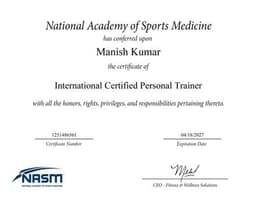
NASM Certified
Certified Personal Trainer & Sports Nutritionist from the National Academy of Sports Medicine
Disclaimer: This calculator provides estimates based on published formulas and population averages. Results are for informational and personal logging purposes only. Individual results may vary.