
Key Takeaways
- No source read for this page gives an RDL to deadlift ratio. Neither Lee and colleagues nor Coratella and colleagues report both a conventional deadlift max and an RDL max for the same lifters[1][2].
- The 85% default is a convention of this tool, not a result from a study. If an RDL is 85% of a deadlift, a 225 lb RDL corresponds to a 265 lb deadlift, and a 315 lb deadlift corresponds to a 270 lb RDL.
- Find my ratio works out your own percent. Enter your RDL max and your deadlift max, and the calculator divides one by the other. You can then carry that percent into the converter.
- The percent moves the answer. For a 225 lb RDL, the deadlift comes to 280 lb at 80%, 265 lb at 85%, and 250 lb at 90%. This is arithmetic. It does not mark a range that any study supports.
How the Conversion Works
The ratio is the Romanian deadlift max divided by the conventional deadlift max. A percent of 85 is a ratio of 0.85, which means the RDL is 85% of the deadlift.
Deadlift = RDL ÷ ratio
RDL = deadlift × ratio
You can enter a tested one-rep max, or the reps of a set taken to failure. The answer is rounded to the nearest 5 lb or 2.5 kg by default, and you can change that under More options.
Worked example: a 225 lb RDL to the deadlift
Deadlift: 225 ÷ 0.85 = 264.7 lb
Nearest 5 lb: 265 lb
Worked example: a 315 lb deadlift to the RDL
RDL: 315 × 0.85 = 267.8 lb
Nearest 5 lb: 270 lb
Romanian Deadlift to Deadlift Chart
Each row is an RDL weight, and each column is a percent of the deadlift, from 65% to 90% in steps of 5 points. A 225 lb RDL at 85% matches a 265 lb deadlift. Weights round to the nearest 5 lb or 2.5 kg.
Pounds
| RDL (lb) | at 65% | at 70% | at 75% | at 80% | at 85% | at 90% |
|---|---|---|---|---|---|---|
| 95 | 145 | 135 | 125 | 120 | 110 | 105 |
| 115 | 175 | 165 | 155 | 145 | 135 | 130 |
| 135 | 210 | 195 | 180 | 170 | 160 | 150 |
| 155 | 240 | 220 | 205 | 195 | 180 | 170 |
| 185 | 285 | 265 | 245 | 230 | 220 | 205 |
| 205 | 315 | 295 | 275 | 255 | 240 | 230 |
| 225 | 345 | 320 | 300 | 280 | 265 | 250 |
| 245 | 375 | 350 | 325 | 305 | 290 | 270 |
| 275 | 425 | 395 | 365 | 345 | 325 | 305 |
| 295 | 455 | 420 | 395 | 370 | 345 | 330 |
| 315 | 485 | 450 | 420 | 395 | 370 | 350 |
| 365 | 560 | 520 | 485 | 455 | 430 | 405 |
Deadlift in lb for each RDL listed, when the RDL is each percent of the deadlift. Rounded to the nearest 5 lb. This is arithmetic. The percents are steps of 5 points, and no study cited here supports any of them.
Kilograms
| RDL (kg) | at 65% | at 70% | at 75% | at 80% | at 85% | at 90% |
|---|---|---|---|---|---|---|
| 40 | 62.5 | 57.5 | 52.5 | 50 | 47.5 | 45 |
| 50 | 77.5 | 72.5 | 67.5 | 62.5 | 60 | 55 |
| 60 | 92.5 | 85 | 80 | 75 | 70 | 67.5 |
| 70 | 107.5 | 100 | 92.5 | 87.5 | 82.5 | 77.5 |
| 80 | 122.5 | 115 | 107.5 | 100 | 95 | 90 |
| 90 | 137.5 | 127.5 | 120 | 112.5 | 105 | 100 |
| 100 | 155 | 142.5 | 132.5 | 125 | 117.5 | 110 |
| 110 | 170 | 157.5 | 147.5 | 137.5 | 130 | 122.5 |
| 120 | 185 | 172.5 | 160 | 150 | 140 | 132.5 |
| 130 | 200 | 185 | 172.5 | 162.5 | 152.5 | 145 |
| 140 | 215 | 200 | 187.5 | 175 | 165 | 155 |
| 150 | 230 | 215 | 200 | 187.5 | 177.5 | 167.5 |
Deadlift in kg for each RDL listed, when the RDL is each percent of the deadlift. Rounded to the nearest 2.5 kg. This is arithmetic. The percents are steps of 5 points, and no study cited here supports any of them.
Deadlift to Romanian Deadlift Chart
Each row is a deadlift weight. Each column is a percent of the deadlift, and the cell is the RDL weight at that percent. A 315 lb deadlift gives a 270 lb RDL at 85%, or a 250 lb RDL at 80%.
Pounds
| Deadlift (lb) | at 65% | at 70% | at 75% | at 80% | at 85% | at 90% |
|---|---|---|---|---|---|---|
| 135 | 90 | 95 | 100 | 110 | 115 | 120 |
| 185 | 120 | 130 | 140 | 150 | 155 | 165 |
| 225 | 145 | 160 | 170 | 180 | 190 | 205 |
| 275 | 180 | 195 | 205 | 220 | 235 | 250 |
| 315 | 205 | 220 | 235 | 250 | 270 | 285 |
| 365 | 235 | 255 | 275 | 290 | 310 | 330 |
| 405 | 265 | 285 | 305 | 325 | 345 | 365 |
| 455 | 295 | 320 | 340 | 365 | 385 | 410 |
| 495 | 320 | 345 | 370 | 395 | 420 | 445 |
| 545 | 355 | 380 | 410 | 435 | 465 | 490 |
RDL in lb for each Deadlift listed, when the RDL is each percent of the deadlift. Rounded to the nearest 5 lb. This is arithmetic. The percents are steps of 5 points, and no study cited here supports any of them.
Kilograms
| Deadlift (kg) | at 65% | at 70% | at 75% | at 80% | at 85% | at 90% |
|---|---|---|---|---|---|---|
| 60 | 40 | 42.5 | 45 | 47.5 | 50 | 55 |
| 80 | 52.5 | 55 | 60 | 65 | 67.5 | 72.5 |
| 100 | 65 | 70 | 75 | 80 | 85 | 90 |
| 120 | 77.5 | 85 | 90 | 95 | 102.5 | 107.5 |
| 140 | 90 | 97.5 | 105 | 112.5 | 120 | 125 |
| 160 | 105 | 112.5 | 120 | 127.5 | 135 | 145 |
| 180 | 117.5 | 125 | 135 | 145 | 152.5 | 162.5 |
| 200 | 130 | 140 | 150 | 160 | 170 | 180 |
| 220 | 142.5 | 155 | 165 | 175 | 187.5 | 197.5 |
| 240 | 155 | 167.5 | 180 | 192.5 | 205 | 215 |
RDL in kg for each Deadlift listed, when the RDL is each percent of the deadlift. Rounded to the nearest 2.5 kg. This is arithmetic. The percents are steps of 5 points, and no study cited here supports any of them.
Romanian Deadlift to Deadlift Ratio
At 85%, your RDL is 0.85 times your deadlift, and your deadlift is 1.18 times your RDL. No source read for this page gives a percent. The table below shows both multipliers at each percent of the charts.
| RDL as a percent of deadlift | RDL ÷ deadlift | Deadlift ÷ RDL |
|---|---|---|
| 65% | 0.65 | 1.54 |
| 70% | 0.70 | 1.43 |
| 75% | 0.75 | 1.33 |
| 80% | 0.80 | 1.25 |
| 85% | 0.85 | 1.18 |
| 90% | 0.90 | 1.11 |
The multipliers at each percent of the charts. This is arithmetic, and no source cited here supports any of the percents.
Here is how a 225 lb RDL converts at nearby percents. This is arithmetic. It does not mark a range that any study supports.
| RDL as a percent of deadlift | Deadlift (lb) |
|---|---|
| 75% | 300 |
| 80% | 280 |
| 85%in use | 265 |
| 90% | 250 |
| 95% | 235 |
The same weight at other percents. It shows how far the answer moves. It is arithmetic, and it does not mark a likely range.
What the Studies Measured
Two papers on the Romanian deadlift were read in full for this page[1][2]. Both compared muscle activity between lifts. Neither gives a strength ratio.
| Study | Lifters | Lifts | Load in the trials | Maxes reported |
|---|---|---|---|---|
| Lee 2018[1] | 21 men, age 22.4 ± 2.2 years, at least three years on both lifts | Conventional deadlift and RDL | 70% of the RDL 1RM, the same weight for both lifts | RDL 1RM tested but not printed. No deadlift 1RM reported |
| Coratella 2022[2] | 10 male competitive bodybuilders, age 29.8 ± 3.0 years | RDL, step RDL and stiff-leg deadlift. No conventional deadlift | 80% of a 1-RM for each lift | 1-RM tested for each lift but not printed |
Both papers compared muscle activity between lifts. Figures are as each paper prints them.
Lee and colleagues tested 21 men on the conventional deadlift and the RDL[1]. They compared the activity of three muscles and the net joint torques at the hip, knee and ankle.
The rectus femoris and gluteus maximus were significantly more active in the conventional deadlift[1]. Its knee and ankle torques were also significantly greater. The paper reports no conventional deadlift max, so no ratio can be worked out from it.
Coratella and colleagues tested 10 male competitive bodybuilders on the RDL, a step RDL and the stiff-leg deadlift at 80% of a 1-RM[2]. They recorded the activity of six posterior chain muscles in each lift. The paper has no conventional deadlift, so it gives no ratio either.
Three PubMed searches on 2026-11-20 returned 14, 1 and 4 records. Lee 2018 appeared in two of them, so the searches found 18 different papers.
No abstract among them gives an RDL max and a conventional deadlift max for the same lifters. Of those papers, only Lee 2018 and Coratella 2022 were read in full.
Which Romanian Deadlift Does a Ratio Describe?
Coratella and colleagues describe the RDL with the knees slightly bent and the stiff-leg deadlift with the knees extended[2]. Lee and colleagues say the two terms were not clearly separated in some studies, and that one study used the RDL label for what was actually a stiff-leg deadlift[1].
Lee and colleagues asked their lifters for about 15° of knee flexion in the RDL[1]. The average knee flexion in the RDL was 33.86 ± 12.59°[1]. They conclude that the RDL can be performed with 15° to 33° of knee flexion[1].
They suggest that how far the bar travels may explain the gap between 15° and 33°[1]. In the study they refer to, lifters lowered the bar to just below the knee. In theirs, lifters touched the floor with the bar.
A percent worked out from your own maxes describes the RDL and the deadlift as you did them.
Find Your Own Ratio
Find my ratio works out your own percent from your own numbers. Enter a tested one-rep max, or the reps of a set taken to failure, for both lifts.
Ratio = RDL max ÷ deadlift max
For example, a 275 lb RDL and a 315 lb deadlift give a ratio of 0.87 (87.3%). The button below your result copies that percent into the converter.
The calculator accepts ratios from 0.2 to 2, to catch typing mistakes. A ratio above 1 shows a note, because it means the RDL is heavier than the deadlift.
From a Set of Reps
You do not need to test a true one-rep max. Enter the reps of a set taken to failure, from 2 to 10, and the tool estimates your max with seven prediction equations[3][4].
LeSuer and colleagues tested the seven equations on the bench press, squat and deadlift in 67 untrained college students[3]. All seven significantly underestimated the deadlift[3]. No source cited here tests them on the Romanian deadlift, so treat a set-based answer as rough.
Reynolds and colleagues studied the bench press and the plate-loaded leg press[5]. They found that 5RM data gave the greatest prediction accuracy, and say no more than 10 repetitions should be used in linear equations for those two lifts[5]. The calculator accepts up to 10 reps.
Example: 5 reps with a 185 lb RDL
Seven equations, RDL 1RM: 210 to 220 lb, average 215 lb
Deadlift 1RM at 85%: average 250 lb, or 245 to 260 lb across the equations
| Equation | RDL max | Deadlift max |
|---|---|---|
| Epley | 215 | 255 |
| Brzycki | 210 | 245 |
| Lander | 210 | 245 |
| Lombardi | 215 | 255 |
| Mayhew | 220 | 260 |
| O'Conner | 210 | 245 |
| Wathan | 215 | 255 |
Weights in lb, with the other lift at the percent in use. Each equation turns the reps in your set into a one-rep max.
Not Covered
- A sourced ratio. No source read for this page gives an RDL max and a conventional deadlift max for the same lifters, so the percent is a convention of this tool.
- Ratios by age, sex, body weight or training years. The two papers read in full tested 21 men and 10 male bodybuilders[1][2]. No source read for this page gives a ratio for any group.
- Technique variations. The conversion does not adjust for lifting straps, foot stance width or knee bend.
- Accuracy of the equations on the RDL. No source cited here tests the seven equations on the Romanian deadlift. LeSuer's abstract covers the bench press, squat and deadlift[3].
- Direct set-to-set conversions. The tool turns a set into a one-rep max first. It does not turn 5 RDL reps into 5 deadlift reps.
- Medical or coaching advice. The output is arithmetic, not advice on safe loading.
Frequently Asked Questions
Sources & References
- An electromyographic and kinetic comparison of conventional and Romanian deadlifts. Lee S, Schultz J, Timgren J, Staelgraeve K, Miller M, Liu Y. J Exerc Sci Fit 2018;16(3):87-93. Full text read. 21 men did both deadlifts at 70% of their Romanian deadlift max. No deadlift max is reported (2018)
- An electromyographic analysis of Romanian, step-Romanian, and stiff-leg deadlift: implication for resistance training. Coratella G, Tornatore G, Longo S, Esposito F, Cè E. Int J Environ Res Public Health 2022;19(3):1903. Full text read. 10 male bodybuilders at 80% of a 1-RM in three lifts. No conventional deadlift (2022)
- The accuracy of prediction equations for estimating 1-RM performance in the bench press, squat, and deadlift. LeSuer DA, McCormick JH, Mayhew JL, Wasserstein RL, Arnold MD. J Strength Cond Res 1997;11(4):211-213. Only the abstract is available. The seven equations used for the set estimates, tested in 67 untrained college students (1997)
- The effects of barbell resistance exercise on information processing speed and conflict-related ERP in older adults: a crossover randomized controlled trial. Lin TY, Hsieh SS, Chueh TY, Huang CJ, Hung TM. Sci Rep 2021;11:9137. Open access. Its Table 1 prints the seven equations from LeSuer et al., so the constants can be checked there (2021)
- Prediction of one repetition maximum strength from multiple repetition maximum testing and anthropometry. Reynolds JM, Gordon TJ, Robergs RA. J Strength Cond Res 2006;20(3):584-592. Only the abstract is available. 70 adults aged 18 to 69 (2006)

Certified Personal Trainer & Sports Nutritionist
NASM-certified fitness and nutrition coach with over 10 years of hands-on experience helping people build strength, lose fat, and live healthier lives. Specializing in gym-based workouts with a strong focus on lifting technique, biomechanics, and practical exercise science. Through FitLifeRegime, sharing the tools, tips, and insights that have worked for hundreds of clients — helping you start your own fitness journey with confidence and clarity.
Learn more about Manish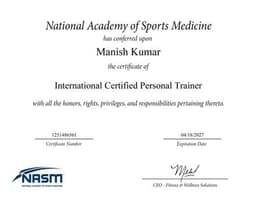
NASM Certified
Certified Personal Trainer & Sports Nutritionist from the National Academy of Sports Medicine
Disclaimer: This calculator turns one lift into the other at a percent you choose. No study cited here supports any percent, so the answer is an estimate and not a prediction. It does not say what weight is safe for you, and it does not replace advice from a coach, a physician or another qualified professional.