
Key Takeaways
- The Army Fitness Test (AFT) has been the Army's fitness test of record since 1 June 2025. It has five events worth 100 points each, so the top score is 500[1][3].
- To pass you need at least 60 points in every event. The Combat standard also needs 350 in total. The General standard asks for 300 in total, which 60 in five events already gives you[1][3].
- The General standard is scored by sex and age. The Combat standard is one sex-neutral scale, still split by age[1][3].
- The Combat standard covers 24 specialties since Army Directive 2026-07 added 12D, 89D and 89E. Combat specialties also take a separate pass or fail Combat Field Test[4][5].
- Since 1 July 2026 a high AFT score no longer exempts anyone from the body composition standard, which is now a waist-to-height ratio under 0.55[6].
What the AFT Changed From the ACFT
The AFT replaced the Army Combat Fitness Test (ACFT) on 1 June 2025 under Army Directive 2025-06. It dropped one event, the Standing Power Throw, and kept the other five[1].
The Army's stated reasons for removing the throw were its technical nature and injury risk[3]. That takes the maximum from 600 to 500.
The events carried over, but the scoring did not. The AFT uses new score tables approved on 15 May 2025[2], and the directive says it raises standards for all Soldiers[1]. Do not use old ACFT charts to guess an AFT score.
ACFT for-record tests taken before 31 May 2025 stay valid under current policy[1]. If you need the old six-event format, the ACFT Calculator is still online.
| Date | What happened |
|---|---|
| 1 June 2025 | AFT becomes the test of record and the ACFT ends. The score tables are effective the same day[1][2]. |
| 1 October 2025 | Promotion actions start using AFT General scores[3]. |
| 1 January 2026 | Combat standard required for combat specialties in the Regular Army, Active Guard Reserve and Reserve Soldiers on active-duty orders of more than 60 days[1]. |
| 17 April 2026 | Phased rollout of the Combat Field Test begins under Army Directive 2026-07, which also makes 12D, 89D and 89E combat specialties[3][4]. |
| 1 June 2026 | Same Combat standard requirement for the remaining Reserve Component combat specialties[1]. |
| 1 July 2026 | Army Directive 2026-13 makes waist-to-height ratio the body composition standard and rescinds the 465-point AFT exemption[6]. |
| 17 April 2027 | Record Combat Field Tests start to carry consequences. Failed attempts before 16 April 2027 bring no adverse administrative action[3]. |
The Five AFT Events
- 3-Rep Max Deadlift (MDL): lift the heaviest weight you can for three continuous reps with a 60-pound hex bar and plates. Each rep ends with the plates on the ground. You get at most two attempts. If you miss the first, you can retry at a lower weight. If you make it, you can choose a heavier second attempt[3].
- Hand-Release Push-Up (HRP): as many reps as you can in 2 minutes. Chest, hips and thighs touch down together, then both arms go out into a T before you push up again[3].
- Sprint-Drag-Carry (SDC): five 50-meter shuttles for time: sprint, drag a 90-pound sled, lateral shuffle, carry two 40-pound kettlebells, sprint. Each shuttle is 25 meters out and back, 250 meters in all[3].
- Plank (PLK): hold a straight line from head to heels for as long as you can. The event ends if anything other than your feet, forearms or fists and palms touches the ground, or if you lose the line. The grader gives one verbal warning first[3].
- 2-Mile Run (2MR): two miles for time on a measured, generally flat course. An indoor or outdoor track or an improved surface such as a road works, but unimproved terrain does not[3].
If you are training for the run, our Physical Fitness Test Calculator covers other services' tests too.
How the AFT Is Scored
Every event is scored from 0 to 100 by looking your result up on the official score table[2]. You get the points of the best printed row you reach. Nothing is averaged or interpolated, so a result between two rows earns the lower row.
That matters most near the 60-point line. A man aged 17 to 21 who lifts 149 pounds is not at 59 points. The table jumps from 150 pounds for 60 points to 130 pounds for 50, so 149 earns 50.
The table has two scales. The General scale has separate columns for men and women in each of ten age groups, from 17 to 21 up to 62 and over.
The Army prints men and Combat in one column, headed "M | C", so the Combat standard uses that column for everyone[2]. Under both standards age still sets the target[3].
Worked example: man aged 22 to 26, General standard
60 and 100 Point Marks by Age
These tables show the two marks that matter most: the 60 points you need in every event and the 100 points that max it out. The full tables have a printed value for most of the points in between, and the calculator uses all of them[2].
The Combat standard uses the same numbers as the men's columns.
3-Rep Max Deadlift (MDL)
Pounds for three repetitions. More is better.
| Age | Men and Combat: 60 | Men and Combat: 100 | Women: 60 | Women: 100 |
|---|---|---|---|---|
| 17 to 21 | ≥ 150 lbs | ≥ 340 lbs | ≥ 120 lbs | ≥ 220 lbs |
| 22 to 26 | ≥ 150 lbs | ≥ 350 lbs | ≥ 120 lbs | ≥ 230 lbs |
| 27 to 31 | ≥ 150 lbs | ≥ 350 lbs | ≥ 120 lbs | ≥ 240 lbs |
| 32 to 36 | ≥ 140 lbs | ≥ 350 lbs | ≥ 120 lbs | ≥ 230 lbs |
| 37 to 41 | ≥ 140 lbs | ≥ 350 lbs | ≥ 120 lbs | ≥ 220 lbs |
| 42 to 46 | ≥ 140 lbs | ≥ 350 lbs | ≥ 120 lbs | ≥ 210 lbs |
| 47 to 51 | ≥ 140 lbs | ≥ 340 lbs | ≥ 120 lbs | ≥ 200 lbs |
| 52 to 56 | ≥ 140 lbs | ≥ 330 lbs | ≥ 120 lbs | ≥ 190 lbs |
| 57 to 61 | ≥ 140 lbs | ≥ 250 lbs | ≥ 120 lbs | ≥ 170 lbs |
| 62 and over | ≥ 140 lbs | ≥ 230 lbs | ≥ 120 lbs | ≥ 170 lbs |
Hand-Release Push-Up (HRP)
Repetitions in 2 minutes. More is better.
| Age | Men and Combat: 60 | Men and Combat: 100 | Women: 60 | Women: 100 |
|---|---|---|---|---|
| 17 to 21 | ≥ 15 reps | ≥ 58 reps | ≥ 11 reps | ≥ 53 reps |
| 22 to 26 | ≥ 14 reps | ≥ 61 reps | ≥ 11 reps | ≥ 50 reps |
| 27 to 31 | ≥ 14 reps | ≥ 62 reps | ≥ 11 reps | ≥ 48 reps |
| 32 to 36 | ≥ 13 reps | ≥ 60 reps | ≥ 11 reps | ≥ 47 reps |
| 37 to 41 | ≥ 12 reps | ≥ 59 reps | ≥ 10 reps | ≥ 43 reps |
| 42 to 46 | ≥ 11 reps | ≥ 57 reps | ≥ 10 reps | ≥ 40 reps |
| 47 to 51 | ≥ 11 reps | ≥ 55 reps | ≥ 10 reps | ≥ 38 reps |
| 52 to 56 | ≥ 10 reps | ≥ 51 reps | ≥ 10 reps | ≥ 36 reps |
| 57 to 61 | ≥ 10 reps | ≥ 46 reps | ≥ 10 reps | ≥ 24 reps |
| 62 and over | ≥ 10 reps | ≥ 43 reps | ≥ 10 reps | ≥ 24 reps |
Sprint-Drag-Carry (SDC)
Time for five 50-meter shuttles. Faster is better.
| Age | Men and Combat: 60 | Men and Combat: 100 | Women: 60 | Women: 100 |
|---|---|---|---|---|
| 17 to 21 | ≤ 2:28 | ≤ 1:29 | ≤ 3:15 | ≤ 1:55 |
| 22 to 26 | ≤ 2:31 | ≤ 1:30 | ≤ 3:15 | ≤ 1:55 |
| 27 to 31 | ≤ 2:32 | ≤ 1:30 | ≤ 3:15 | ≤ 1:55 |
| 32 to 36 | ≤ 2:36 | ≤ 1:33 | ≤ 3:22 | ≤ 1:59 |
| 37 to 41 | ≤ 2:41 | ≤ 1:36 | ≤ 3:27 | ≤ 2:02 |
| 42 to 46 | ≤ 2:45 | ≤ 1:40 | ≤ 3:42 | ≤ 2:09 |
| 47 to 51 | ≤ 2:53 | ≤ 1:45 | ≤ 3:51 | ≤ 2:11 |
| 52 to 56 | ≤ 3:00 | ≤ 1:52 | ≤ 4:03 | ≤ 2:18 |
| 57 to 61 | ≤ 3:12 | ≤ 1:58 | ≤ 4:48 | ≤ 2:26 |
| 62 and over | ≤ 3:16 | ≤ 2:09 | ≤ 4:48 | ≤ 2:26 |
Plank (PLK)
Hold time. Longer is better.
| Age | Men and Combat: 60 | Men and Combat: 100 | Women: 60 | Women: 100 |
|---|---|---|---|---|
| 17 to 21 | ≥ 1:30 | ≥ 3:40 | ≥ 1:30 | ≥ 3:40 |
| 22 to 26 | ≥ 1:25 | ≥ 3:35 | ≥ 1:25 | ≥ 3:35 |
| 27 to 31 | ≥ 1:20 | ≥ 3:30 | ≥ 1:20 | ≥ 3:30 |
| 32 to 36 | ≥ 1:15 | ≥ 3:25 | ≥ 1:15 | ≥ 3:25 |
| 37 to 41 | ≥ 1:10 | ≥ 3:20 | ≥ 1:10 | ≥ 3:20 |
| 42 to 46 | ≥ 1:10 | ≥ 3:20 | ≥ 1:10 | ≥ 3:20 |
| 47 to 51 | ≥ 1:10 | ≥ 3:20 | ≥ 1:10 | ≥ 3:20 |
| 52 to 56 | ≥ 1:10 | ≥ 3:20 | ≥ 1:10 | ≥ 3:20 |
| 57 to 61 | ≥ 1:10 | ≥ 3:20 | ≥ 1:10 | ≥ 3:20 |
| 62 and over | ≥ 1:10 | ≥ 3:20 | ≥ 1:10 | ≥ 3:20 |
2-Mile Run (2MR)
Time for two miles. Faster is better.
| Age | Men and Combat: 60 | Men and Combat: 100 | Women: 60 | Women: 100 |
|---|---|---|---|---|
| 17 to 21 | ≤ 19:57 | ≤ 13:22 | ≤ 22:55 | ≤ 16:00 |
| 22 to 26 | ≤ 19:45 | ≤ 13:25 | ≤ 22:45 | ≤ 15:30 |
| 27 to 31 | ≤ 19:45 | ≤ 13:25 | ≤ 22:45 | ≤ 15:30 |
| 32 to 36 | ≤ 20:44 | ≤ 13:42 | ≤ 22:50 | ≤ 15:48 |
| 37 to 41 | ≤ 20:44 | ≤ 13:42 | ≤ 22:59 | ≤ 15:51 |
| 42 to 46 | ≤ 22:04 | ≤ 14:05 | ≤ 23:15 | ≤ 16:00 |
| 47 to 51 | ≤ 22:04 | ≤ 14:30 | ≤ 23:30 | ≤ 16:30 |
| 52 to 56 | ≤ 22:50 | ≤ 15:09 | ≤ 24:00 | ≤ 16:59 |
| 57 to 61 | ≤ 23:36 | ≤ 15:28 | ≤ 24:48 | ≤ 17:18 |
| 62 and over | ≤ 23:36 | ≤ 15:28 | ≤ 25:00 | ≤ 17:18 |
Source: Army Fitness Test Score Tables, effective 1 June 2025[2]. The chart's oldest group is headed "Over 62". The tables follow the 57 to 61 group, so this page treats it as 62 and over.
Passing, Retests and Combat Specialties
- Pass mark: at least 60 points in each event. The General standard has no separate total beyond that. The Combat standard also needs 350 points in total[1][3]. You can fail the Combat standard with 60 in every event if the total is under 350.
- Which specialties are Combat: 11A, 11B, 11C, 11Z, 12A, 12B, 13A, 13F, 18A, 180A, 18B, 18C, 18D, 18E, 18F, 18Z, 19A, 19C, 19D, 19K and 19Z under the original directive[1], plus 12D, 89D and 89E from Army Directive 2026-07[4]. Everyone else is General[1].
- Testing frequency: Regular Army, Active Guard Reserve and Reserve Soldiers on orders of more than 60 days pass two record AFTs a year, at least 4 months apart. Other Reserve Soldiers pass one a year, at least 8 months apart[1]. Combat specialties now also take a Combat Field Test each year, as described below[4].
- After a failure: pass a record AFT within 90 days if you are active, or 180 days in the Reserve Component[1].
- Combat specialty, General only: Soldiers in a combat specialty who pass the General standard but not the Combat standard are subject to in-service reclassification or utilization, based on the needs of the Army[1].
- Permanent profiles: you take every event the profile allows. Combat specialties must average 70 points across the events they can take, for example 280 over four or 140 over two[1]. That 70 average is where the number 70 comes from. It is not a 70-point minimum for every event.
Alternate Aerobic Events
If a permanent profile rules out the run, you can take an alternate aerobic event. These are Go/No-Go with no points, and you must get a GO if you take one[1]. The table shows the maximum time for each.
The swim and the row share the same times[2]. This calculator does not score them.
| Age | 2.5-mile walk: men, Combat | Walk: women | 12 km bike: men, Combat | Bike: women | 1 km swim or 5 km row: men, Combat | Swim or row: women |
|---|---|---|---|---|---|---|
| 17 to 21 | 31:00 | 34:00 | 26:25 | 28:58 | 30:48 | 33:48 |
| 22 to 26 | 30:45 | 33:30 | 26:12 | 28:31 | 30:30 | 33:18 |
| 27 to 31 | 30:30 | 33:00 | 26:00 | 28:07 | 30:20 | 32:48 |
| 32 to 36 | 30:45 | 33:30 | 26:12 | 28:31 | 30:30 | 33:18 |
| 37 to 41 | 31:00 | 34:00 | 26:25 | 28:58 | 30:48 | 33:48 |
| 42 to 46 | 31:00 | 34:00 | 26:25 | 28:58 | 30:48 | 33:48 |
| 47 to 51 | 32:00 | 35:00 | 27:16 | 29:50 | 31:48 | 34:48 |
| 52 to 56 | 32:00 | 35:00 | 27:16 | 29:50 | 31:48 | 34:48 |
| 57 to 61 | 33:00 | 36:00 | 28:07 | 30:41 | 32:50 | 35:48 |
| 62 and over | 33:00 | 36:00 | 28:07 | 30:41 | 32:50 | 35:48 |
Combat Field Test and Body Composition
Combat Field Test (CFT). Army Directive 2026-07 requires the CFT for Soldiers in combat specialties. It is pass or fail with no points, and it does not replace the AFT[4].
The Army describes it as a seven-event sequence done continuously and finished in 30 minutes or less: a one-mile run, 30 dead-stop push-ups, a 100-meter sprint, 16 lifts of a 40-pound sandbag to a 65-inch platform, a 50-meter carry of two 40-pound water cans, a 50-meter movement drill and a final one-mile run[5].
Regular Army, Active Guard Reserve and Reserve combat Soldiers on orders of 365 days or more take one CFT and one AFT a year. Other Reserve combat Soldiers alternate the two by calendar year[4].
The rollout starts with a diagnostic period through 16 April 2027, when failing the CFT brings no adverse administrative action. Record testing with consequences starts on 17 April 2027[3][5].
Body composition. Army Directive 2025-17 once exempted Soldiers who scored 465 or more with at least 80 in each event and no alternate events[7]. Army Directive 2026-13 rescinded it on 1 July 2026.
Waist-to-height ratio is now the only authorized standard, with a pass below 0.55, and no AFT score exempts a Soldier from it[6]. Leave at least 7 days between the AFT and the measurement unless a commander needs otherwise[6]. To check yours, use the Army Body Fat Calculator.
Limitations
- This is a practice tool. Official scores are recorded by your unit's graders. If your unit has a different chart, use theirs.
- The calculator reads the printed table row by row. The Army's chart is the authority, and the Army says the AFT may change over time[3]. As of 31 October 2026, army.mil has no score tables newer than the 1 June 2025 set.
- The chart header says "Three-Repetitions (LBS)" and does not say whether the 60-pound hex bar counts. The lowest scored weight for women is 60 pounds, the weight of the bar alone, which suggests the chart counts total weight on the bar. That is an interpretation. Confirm with your grader.
- The calculator scores the five main events only. It does not score alternate aerobic events, permanent-profile averages or the Combat Field Test.
- It cannot convert an ACFT score. The scoring tables are different, so an old score does not carry over.
Frequently Asked Questions
Sources & References
- Army Directive 2025-06 (Army Fitness Test). Department of the Army. armypubs.army.mil, dated 17 April 2025 (2025)
- Army Fitness Test Score Tables (approved 15 May 2025, effective 1 June 2025). Department of the Army. army.mil (2025)
- Army Fitness Test: overview, FAQ and event standards. Department of the Army. army.mil
- Army Directive 2026-07 (Army Physical Fitness Standards). Department of the Army. api.army.mil, April 2026 (2026)
- US Army announces new Combat Field Test to enhance Soldier readiness. U.S. Army Public Affairs. army.mil, 22 April 2026 (2026)
- Army Directive 2026-13 (Army Body Composition Program and Standards). Department of the Army. armypubs.army.mil, dated 1 July 2026 (2026)
- Army exempts Soldiers who score 465+ on the AFT from body fat standards (Army Directive 2025-17, now rescinded). U.S. Army Public Affairs. army.mil (2025)

Certified Personal Trainer & Sports Nutritionist
NASM-certified fitness and nutrition coach with over 10 years of hands-on experience helping people build strength, lose fat, and live healthier lives. Specializing in gym-based workouts with a strong focus on lifting technique, biomechanics, and practical exercise science. Through FitLifeRegime, sharing the tools, tips, and insights that have worked for hundreds of clients — helping you start your own fitness journey with confidence and clarity.
Learn more about Manish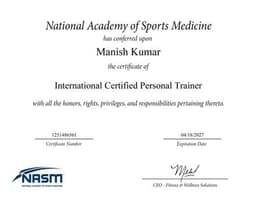
NASM Certified
Certified Personal Trainer & Sports Nutritionist from the National Academy of Sports Medicine
Disclaimer: This tool is for informational and personal journaling purposes only. Results are estimates based on published formulas and may vary based on individual factors such as genetics, training history, and measurement technique.