
Key Takeaways
- Total load = effective bodyweight + added weight. Six published rep-to-1RM formulas in
one-rep-max.tsrun on that total. Effective bodyweight is subtracted afterward to estimate max added weight. - Pull-ups, chin-ups, dips, and muscle-ups use full body mass as the bodyweight term. That is a common training shortcut, not a value from our cited sources. Push-ups use about 64% of body mass from peak ground-reaction force on a regular push-up in Ebben et al. (2011)[1].
- The headline number follows the same rules as other 1RM tools here: Brzycki at reps 2–7, Epley at 11–15, a linear Brzycki–Epley blend at reps 8–10, and your entered weight at 1 rep. Use it for logging, not as a tested max attempt.
- Dohoney et al. (2002) found 4–6 RM tests predicted 1RM more closely than 7–10 RM on free-weight and machine lifts in 34 untrained young men[2]. That study did not test weighted calisthenics, and this calculator has not been validated on them either.
How Bodyweight 1RM Estimation Works
| Step | Formula in this app |
|---|---|
| 1. Effective BW | bodyweight × bwFactor |
| 2. Set total load | effectiveBW + addedWeight |
| 3. Estimated 1RM total | recommended rule in one-rep-max.ts |
| 4. Estimated 1RM added | max(0, 1RM total − effectiveBW) |
For RPE-style barbell work on this site, see the RIR to RPE Calculator.
Push-Up Load Factor
Ebben et al. (2011) measured peak vertical ground-reaction force during six push-up variations with a force platform (23 recreationally fit adults; two trials per variation at a two-second cadence). Regular push-ups averaged 0.64 ± 0.04 of body mass at peak[1].
Hands-elevated and feet-elevated setups in that study ranged from about 41% to 74% of body mass. This calculator applies the regular push-up peak value only.
Peak force is not average load through the whole rep. Using peak GRF as the bodyweight factor for submax-to-1RM math is a practical planning choice. Ebben et al. did not validate that step for 1RM prediction.
Bars, Rings, and Muscle-Ups
Bar and ring muscle-ups use the same total-load model as pull-ups (full body mass). The tool does not apply a ring multiplier. Muscle-ups combine pulling and transition skills, so treating reps like a single-load lift is only a rough journal entry.
Accuracy and Limits
- Use controlled, full-range reps. Kipping and partial reps skew rep-to-1RM math.
- Keep bodyweight current. Belt loads are usually straightforward; vests depend on fit and distribution.
- Above ~10 reps, formula spread grows. Treat high-rep outputs as rough logging numbers.
- The milestone table in the tool is informal coaching language, not published normative data.
Source Limits
[1] supports the push-up factor only. [2] compared 4–6 vs 7–10 RM prediction on bench press, incline press, leg extension, biceps curl, and triceps extension in untrained young men, not calisthenics. Standard 1RM equations in this app were developed mainly on barbell and machine tests.
Outputs are for training notes, not medical or competitive testing.
Frequently Asked Questions
Sources & References
- Kinetic Analysis of Several Variations of Push-Ups. Ebben WP, Wurm B, VanderZanden TL, Spadavecchia ML, Durocher JJ, Bickham CT, Petushek EJ. Journal of Strength and Conditioning Research (2011)
- Prediction of One Repetition Maximum (1-RM) Strength from a 4-6 RM and a 7-10 RM Submaximal Strength Test in Healthy Young Adult Males. Dohoney P, Chromiak JA, Lemire D, Abadie BR, Kovacs C. Journal of Exercise Physiology online (2002)

Certified Personal Trainer & Sports Nutritionist
NASM-certified fitness and nutrition coach with over 10 years of hands-on experience helping people build strength, lose fat, and live healthier lives. Specializing in gym-based workouts with a strong focus on lifting technique, biomechanics, and practical exercise science. Through FitLifeRegime, sharing the tools, tips, and insights that have worked for hundreds of clients — helping you start your own fitness journey with confidence and clarity.
Learn more about Manish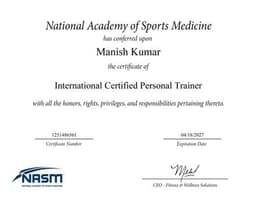
NASM Certified
Certified Personal Trainer & Sports Nutritionist from the National Academy of Sports Medicine
Disclaimer: This calculator is for informational and personal journaling purposes only. It logs measurements and compares them to published reference values. It is not health, medical, or nutrition advice.