
Key Takeaways
- For heavy strength and power sets, the ACSM position stand recommends 3–5 minutes of rest[1]. A review of 35 studies also found 3–5 minutes produced greater strength gains than shorter rests[2].
- For hypertrophy, ACSM gives 1–2 minutes[1], which this tool uses for isolation work. We extend that to 2–3 minutes for heavy compound lifts, based on ACSM's 2–3 minute advice for core lifts[1]and a trial where 3 minutes beat 1 minute[4]. A 2024 meta-analysis found a small benefit to resting more than 60 seconds and no clear extra benefit beyond about 90 seconds[5].
- The range comes from published guidance. Where you land inside it depends on how hard your last set was. That mapping is a rule of thumb, not a published formula.
- Use the range as a starting point. If your reps fall off sharply from set to set, rest longer.
How the Recommendation Works
You pick a goal. For strength and hypertrophy you also pick compound or isolation, since ACSM separates core lifts from assistance lifts[1]. The calculator returns a guideline range, then a suggested rest based on your last set.
Two numbers extend the published ranges: 2–3 minutes for compound hypertrophy work, and the 30-second lower bound for endurance.
| Last set | Suggested rest |
|---|---|
| RPE 6–7 | Low end of the range |
| RPE 8–9 | Middle of the range |
| RPE 10 or failure | High end of the range |
Session time = sets × time per set + (sets − 1) × suggested rest. Example: hypertrophy, compound, hard last set, 16 sets at 45 seconds each. Range is 2–3 minutes, so suggested rest is 2:30.
That gives 16 × 45 + 15 × 150 = 2,970 seconds, about 50 minutes. The 45-second default is our assumption for 8–12 reps.
Change it if your tempo is slower or faster. For tempo math, try the Tempo TUT Calculator.
What the Research Says
Strength. A systematic review of 23 studies (491 participants) concluded that robust strength gains are possible even with rests under 60 seconds. It also found rests longer than 2 minutes appear necessary to maximize gains in trained lifters, while 60–120 seconds looked sufficient for beginners[3].
That review notes it is unclear whether rests over 5 minutes add anything, so this tool caps the strength range at 5 minutes[3].
Hypertrophy. In an 8-week trial of 21 resistance-trained men, 3-minute rests beat 1-minute rests for squat and bench strength and for thigh muscle thickness[4].
A later Bayesian meta-analysis of 9 randomized studies found a small benefit for resting more than 60 seconds and no clear extra benefit beyond about 90 seconds, with considerable variation between studies[5]. An older review suggested 30–60 seconds for hypertrophy with moderate loads[2].
The newer meta-analysis does not support shorter rest as better for growth, so this tool does not use that range. ACSM's own hypertrophy figure is 1–2 minutes[1], and its 2–3 minute advice is written for heavy core lifts aimed at maximal strength[1].
That is why we call 2–3 minutes for compound hypertrophy work an extension.
Endurance. ACSM puts local muscular endurance work at under 90 seconds of rest[1]. The older review reports short rests of 20 seconds to 1 minute helped endurance outcomes, but called the evidence less clear than for strength[2].
Exercise choice matters. ACSM notes that Olympic lifts and their variations need longer rest, and that not every exercise in a session needs the same interval[1]. If you are programming load and effort too, see the RIR to RPE Calculator.
Supersets and Paired Sets
This tool does not shorten rest for supersets. No verified figure exists for how much rest to cut.
What the research does show: a meta-analysis of 19 studies found supersets kept total reps and volume load similar to straight sets while cutting session time by about 37%, with higher perceived exertion[7]. Agonist-antagonist pairs held up volume best. Pairing exercises for the same muscle reduced volume load[7].
One study of 18 recreationally trained men used antagonist pairs. Resting 1 minute between pairs reduced total volume compared with 2 or 3 minutes, and 2 minutes performed about as well as self-selected rest[8].
A practical way to use this calculator with supersets is to treat the suggested rest as the break between rounds, not between the two exercises. That is a coaching suggestion, not a tested protocol.
Why Rest Matters: The Energy Side
Phosphocreatine (PCr) is the fastest energy reserve for short, hard efforts. Intense exercise can drop it below 30% of resting levels[6].
Recovery has a fast first phase followed by a slower phase[6]. ACSM also notes that strength recovery may not be complete within 3 minutes[1].
Published recovery times depend on the muscle, the exercise, and the person, and no verified curve applies to lifting sets, so the page shows no recovery percentage. Use the ranges above instead.
Limitations
- Guidelines describe groups, not you. Training age, the lift, sleep, and how far you took the last set all shift how much rest you need.
- Most strength-review participants were men (413 of 491), and the hypertrophy trial used young men[3][4]. Results may not carry over equally to everyone.
- The hypertrophy meta-analysis found wide variation between studies, so treat the 90-second point as a trend[5].
- Session time covers sets and rests only. It leaves out warm-ups, exercise changes, and setup time. For logging real sessions, use the Gym Workout Tracker.
- This calculator is a training reference. It is not medical advice.
Source Limits
[1] to [5] support the ranges. [6] describes PCr physiology and does not give lifting-specific recovery times. [7] and [8] cover supersets. The mapping from last-set effort to a point in the range, and the 45-second default set time, are our own assumptions and are not drawn from a paper.
Where sources disagree, such as hypertrophy rest, the ACSM ranges are used and the disagreement is described in the research section.
Frequently Asked Questions
Sources & References
- American College of Sports Medicine position stand. Progression models in resistance training for healthy adults. American College of Sports Medicine. Med Sci Sports Exerc 41(3):687-708 (2009)
- Rest interval between sets in strength training. de Salles BF, Simão R, Miranda F, et al.. Sports Med 39(9):765-777 (2009)
- Effects of rest interval duration in resistance training on measures of muscular strength: a systematic review. Grgic J, Schoenfeld BJ, Skrepnik M, Davies TB, Mikulic P. Sports Med 48(1):137-151 (2018)
- Longer interset rest periods enhance muscle strength and hypertrophy in resistance-trained men. Schoenfeld BJ, Pope ZK, Benik FM, et al.. J Strength Cond Res 30(7):1805-1812 (2016)
- Give it a rest: a systematic review with Bayesian meta-analysis on the effect of inter-set rest interval duration on muscle hypertrophy. Singer A, Wolf M, Generoso L, et al.. Front Sports Act Living 6:1429789 (2024)
- Factors affecting the rate of phosphocreatine resynthesis following intense exercise. McMahon S, Jenkins D. Sports Med 32(12):761-784 (2002)
- Superset versus traditional resistance training prescriptions: a systematic review and meta-analysis exploring acute and chronic effects on mechanical, metabolic, and perceptual variables. Zhang X, Weakley J, Li H, Li Z, García-Ramos A. Sports Med 55(4):953-975 (2025)
- The effect of different rest intervals between agonist-antagonist paired sets on training performance and efficiency. Behenck C, Sant'Ana H, Pinto de Castro JB, Willardson JM, Miranda H. J Strength Cond Res 36(3):781-786 (2022)

Certified Personal Trainer & Sports Nutritionist
NASM-certified fitness and nutrition coach with over 10 years of hands-on experience helping people build strength, lose fat, and live healthier lives. Specializing in gym-based workouts with a strong focus on lifting technique, biomechanics, and practical exercise science. Through FitLifeRegime, sharing the tools, tips, and insights that have worked for hundreds of clients — helping you start your own fitness journey with confidence and clarity.
Learn more about Manish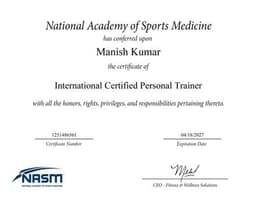
NASM Certified
Certified Personal Trainer & Sports Nutritionist from the National Academy of Sports Medicine
Disclaimer: This tool is a training reference only. Ranges come from published guidelines and research on groups of people, and your needs may differ. It is not medical advice. Check with a qualified professional before changing your training.