
Key Takeaways
- Strength progress is the change in your estimated 1RM between two comparable sets. With the same reps and effort both times, the percent change equals the change on the bar, whichever equation is used, because each equation scales with the weight.
- A repeated 1RM test varies by a median 4.2% (range 0.5% to 12.1%) across 32 studies, so a smaller change may be noise[5].
- There is no month-by-month norm here. I found no peer-reviewed table of expected gains, and one study of 585 adults saw arm-curl 1RM gains from 0 to 250% over 12 weeks[6].
- The ACSM position stand adds 2 to 10% load once you beat your target reps by 1 or 2[8].
- The goal date is your own gain carried forward in a straight line. It is arithmetic, not a forecast.
How the Calculator Works
You enter one hard set from the start and one from now, plus the time between them. The tool turns each set into an estimated 1RM and compares the two.
The 1RM comes from the same equations as the one rep max calculator. A single to failure is a tested max, a set stopped short uses the RPE chart, and any other set uses seven published equations and their mean[2][3].
| Step | What happens | Source |
|---|---|---|
| Estimate each 1RM | Seven equations, the RPE chart, or the weight itself for a single | [2][3] |
| Change and rate | Difference, percent, then per week, month (4.35 weeks) and session | Arithmetic |
| Noise check | Your percent change against the 4.2% median and 12.1% highest test-retest CV in those studies | [5] |
| Next load | 2 to 10% above your load, if you beat the target reps by 1 or 2 | [8] |
| Goal | Gap divided by your own weekly gain, and the weekly gain a date would need | Arithmetic |
What the tool works out, in order.
Worked Examples
Take 100 kg for 5 reps at the start and 110 kg for 5 reps eight weeks later, with two sessions a week. The estimated 1RM goes from 115.5 kg to 127 kg, a gain of 11.5 kg.
That is 10% in total, about 1.44 kg a week, 6.3 kg a month and 0.72 kg a session. The percent is the same as 110 divided by 100, because both sets use the same multiplier.
With tested singles of 100 kg and then 105 kg, the change is 5% in eight weeks, or 2.7 kg a month. At 2% (100 kg to 102 kg) the change is smaller than the median test-retest variation.
Is the Change Bigger Than Noise?
Lifting the same weight on two days does not give the same result every time. A review of 32 studies (1,595 people) found the 1RM test repeated with a median coefficient of variation of 4.2%, from 0.5% to 12.1%[5].
| Your change | What the tool says |
|---|---|
| Under 4.2% | Smaller than the median variation. A repeat test could show it by chance |
| 4.2% to under 12.1% | Larger than the median, inside the highest CV in those studies. More likely real |
| 12.1% or more | Larger than the highest CV in those studies. Check that the sets were comparable |
How the tool reads your percent change, up or down.
What this check is not
Reading Your Rate
The rate is what happened to you over that gap. It is not a target, and it is not a norm for anyone else.
Responses differ a lot. In 585 adults who trained the elbow flexors of one arm for 12 weeks, 1RM gains ranged from 0 to 250%[6]. That was one arm exercise, so it shows the spread and not a rate for squats or bench.
A meta-analysis found larger 1RM gains in untrained than in trained people[7].
That is why there is no "good" or "bad" label here. Many pages print gains by experience level, but I found no peer-reviewed table behind them, and the ones I compared disagreed with each other. If a gap is under 4 weeks the tool warns you, and that line is my own choice.
If progress stalls, the 2026 ACSM overview of reviews found strength rose with loads of 80% of 1RM or more, a full range of motion, 2 to 3 sets and at least 2 sessions a week[9].
It found that exercise complexity, set structure and periodization did not consistently change outcomes[9]. One earlier meta-analysis favoured periodized plans[7].
When to Add Weight
The ACSM position stand says that when you train at a set rep maximum, you can raise the load by 2 to 10% once you can do the current load for one to two reps over your target[8]. The tool applies that rule to your current weight.
For 100 kg, that is 102 to 110 kg. The abstract gives one range for all lifts, so choose the jump your plates and your recovery allow.
Goal Dates and Their Limits
Enter a goal and the tool divides the gap by your own weekly gain. With 100 kg to 105 kg over 8 weeks and a goal of 120 kg, that gives 24 weeks.
If you also enter weeks left, it shows the weekly gain that date needs. For 120 kg in 12 weeks that is 1.25 kg a week, 2 times your own.
A straight line is the simplest assumption. Untrained people gained more than trained people in one meta-analysis, so an early rate may not hold[7].
The tool does not show a date when the sets are under 4 weeks apart, when your estimate did not rise, or when the date is more than 10 years away.
Limits and Who This Is For
- Use sets of 1 to 10 reps. The equations were built on sets of 10 or fewer, and the RPE chart covers 1 to 8 reps[1][3].
- Compare the same lift, range of motion, equipment and effort. A change in any of them changes the number.
- The equations assume the set went to failure. A set stopped short is read from the RPE chart instead[3].
- The equations read low for the deadlift in one study of untrained students, and little data covers the overhead press[2].
- The studies behind the figures are in healthy adults. Teenagers, older adults and anyone training around injury are not covered.
- Untrained people gained more than trained people in one meta-analysis, so do not expect an early rate to last[7].
To see session load, use the workout volume calculator. To log sets over time, use the gym workout tracker. For RPE conversions, see the RIR to RPE calculator.
Not Included
The earlier version of this page was a program generator. It multiplied your max by a fixed weekly gain by experience level, and it added a complexity factor and a percent gain by periodization model.
- Gain percentages by experience level or periodization model. No source I found supports those figures.
- A complexity factor and weak-point advice. They had no source and no effect on the result.
- Phase splits and deload weeks. They were fixed tables with no source.
- Claims that cluster sets add 15 to 25% volume, that daily undulating periodization beats linear in trained people, and that RPE training lowers injury risk. None is backed by a source on this page.
- Month-by-month norms and good or bad labels. See the section on reading your rate.
- A training plan, sets or reps. This tool measures progress and does not prescribe it.
Frequently Asked Questions
Sources & References
- Strength testing: predicting a one-rep max from reps-to-fatigue. Brzycki M. Journal of Physical Education, Recreation & Dance 64(1):88-90 (1993)
- The accuracy of prediction equations for estimating 1-RM performance in the bench press, squat, and deadlift. LeSuer DA, McCormick JH, Mayhew JL, Wasserstein RL, Arnold MD. Journal of Strength and Conditioning Research 11(4):211-213 (1997)
- Application of the repetitions in reserve-based rating of perceived exertion scale for resistance training. Helms ER, Cronin J, Storey A, Zourdos MC. Strength and Conditioning Journal 38(4):42-49 (2016)
- National Protocols for the Assessment of Strength and Power, Version 2.0 (effective July 2022). Australian Institute of Sport and the National Institute Network. Australian Sports Commission (2022)
- Test-Retest Reliability of the One-Repetition Maximum (1RM) Strength Assessment: a Systematic Review. Grgic J, Lazinica B, Schoenfeld BJ, Pedisic Z. Sports Medicine - Open 6(1):31 (2020)
- Variability in muscle size and strength gain after unilateral resistance training. Hubal MJ, Gordish-Dressman H, Thompson PD, Price TB, Hoffman EP, Angelopoulos TJ, Gordon PM, Moyna NM, Pescatello LS, Visich PS, Zoeller RF, Seip RL, Clarkson PM. Medicine & Science in Sports & Exercise 37(6):964-972 (2005)
- Comparison of Periodized and Non-Periodized Resistance Training on Maximal Strength: A Meta-Analysis. Williams TD, Tolusso DV, Fedewa MV, Esco MR. Sports Medicine 47(10):2083-2100 (2017)
- American College of Sports Medicine position stand. Progression models in resistance training for healthy adults. American College of Sports Medicine. Medicine & Science in Sports & Exercise 41(3):687-708. Abstract only; full text not opened (2009)
- American College of Sports Medicine Position Stand. Resistance Training Prescription for Muscle Function, Hypertrophy, and Physical Performance in Healthy Adults: An Overview of Reviews. Currier BS, D'Souza AC, Singh MAF, Lowisz CV, Rawson ES, Schoenfeld BJ, Smith-Ryan AE, Steen JP, Thomas GA, Triplett NT, Washington TA, Werner TJ, Phillips SM. Medicine & Science in Sports & Exercise 58(4):851-872. Abstract only; full text not opened (2026)
- Maximal Number of Repetitions at Percentages of the One Repetition Maximum: A Meta-Regression and Moderator Analysis of Sex, Age, Training Status, and Exercise. Nuzzo JL, Pinto MD, Nosaka K, Steele J. Sports Medicine 54(2):303-321 (2024)

Certified Personal Trainer & Sports Nutritionist
NASM-certified fitness and nutrition coach with over 10 years of hands-on experience helping people build strength, lose fat, and live healthier lives. Specializing in gym-based workouts with a strong focus on lifting technique, biomechanics, and practical exercise science. Through FitLifeRegime, sharing the tools, tips, and insights that have worked for hundreds of clients — helping you start your own fitness journey with confidence and clarity.
Learn more about Manish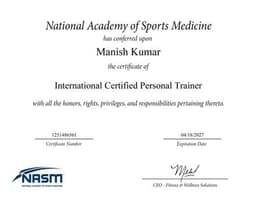
NASM Certified
Certified Personal Trainer & Sports Nutritionist from the National Academy of Sports Medicine
Disclaimer: This tool is for informational and personal journaling purposes only. Results are estimates based on published formulas and may vary based on individual factors such as genetics, training history, and measurement technique.