
Key Takeaways
- Log workouts with exercises, sets, reps, weight (kg or lb), and optional RPE.
- Working-set volume uses reps × load with lb converted to kg; warmups are excluded.
- Progress tab shows PRs, muscle-group volume bars, and weekly session counts from your log.
- Data lives in localStorage only. Export JSON or CSV for backup or spreadsheets.
- This is a training log, not a program generator or medical tool.
Why Log Workouts?
If you cannot remember last week's working weights, progressive overload becomes guesswork. A simple log shows whether you added load, reps, or sets over time.
Peterson et al. (2011) studied young men and women after 12 weeks of progressive unilateral arm training and reported how total volume load related to strength and muscle-size changes (with sex-specific patterns).[1] Schoenfeld et al. (2017) meta-analysis reports a dose–response between weekly set volume and hypertrophy in published trials.[2]
Those papers used controlled protocols; this tracker only stores what you log.
How to Use
- Open Log, name the session, and set the date. Load a starter or custom template if you want exercise names pre-filled.
- Add exercises, pick a muscle group, and enter reps and weight per set. Tap W on warmup sets so they stay in the log but drop out of volume math.
- Save the workout. Browse History for details, export, or delete.
- Open Progress for PRs, muscle-group volume, and weekly frequency. Use Templates to save reusable layouts.
Back up often
Clearing browser data removes localStorage. Export JSON from History before you reset a browser profile or switch devices, then Import on the new setup.
Features
| Feature | What it does |
|---|---|
| Exercise logging | Unlimited exercises per session; kg or lb per set; optional RPE 1–10. |
| Warmup flag | Keeps warmup sets visible but excludes them from volume and set counts. |
| Personal records | Heaviest load and best single-session volume per exercise name. |
| Muscle-group volume | Sums working-set volume by the muscle group you assign to each exercise. |
| Templates | Built-in push, pull, legs, upper, lower, and full-body starters plus custom saves. |
| Export / import | JSON for full restore; CSV for spreadsheet analysis. |
Volume & Progress
For each working set, the app computes reps × load (kg). Pounds use the standard 0.45359237 conversion before totals. Session volume is the sum across exercises; muscle-group bars use the tag you pick on each exercise.
Weekly set volume matters for hypertrophy in the research literature, but optimal targets depend on training status, exercise choice, and recovery.[2] Use the log to spot trends, not to chase a magic number.
For planning weekly sets, see the Hypertrophy Volume Landmarks Planner. For RPE and RIR math, use the RIR to RPE Calculator.
Limitations
- Browser-only storage. Export regularly.
- Volume is reps × load (kg) per working set. It ignores tempo, range of motion, and rest periods. Weekly bars in Progress count sessions, not sets per week.
- PRs use case-insensitive exercise names. Different spellings (e.g. "Bench" vs "Bench Press") stay separate.
- Cardio and technique work are not captured beyond optional notes and duration.
- Not a substitute for coaching or medical advice.
Pair lifting logs with the Body Measurements Tracker if you also track circumferences.
Frequently Asked Questions
Sources & References
- Progression of volume load and muscular adaptation during resistance exercise. Peterson MD, Pistilli E, Haff GG, Hoffman EP, Gordon PM. European Journal of Applied Physiology (2011)
- Dose-response relationship between weekly resistance training volume and increases in muscle mass: A systematic review and meta-analysis. Schoenfeld BJ, Ogborn D, Krieger JW. Journal of Sports Sciences (2017)

Certified Personal Trainer & Sports Nutritionist
NASM-certified fitness and nutrition coach with over 10 years of hands-on experience helping people build strength, lose fat, and live healthier lives. Specializing in gym-based workouts with a strong focus on lifting technique, biomechanics, and practical exercise science. Through FitLifeRegime, sharing the tools, tips, and insights that have worked for hundreds of clients — helping you start your own fitness journey with confidence and clarity.
Learn more about Manish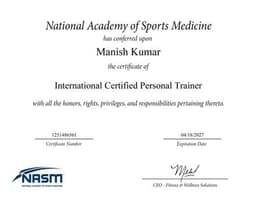
NASM Certified
Certified Personal Trainer & Sports Nutritionist from the National Academy of Sports Medicine
Disclaimer: This tool is for informational and personal journaling purposes only. Results are estimates based on published formulas and may vary based on individual factors such as genetics, training history, and measurement technique.