
The answer at a glance
Pounds version
lb ÷ 30oz
200 lb: about 6.7 oz a drink.
Kilogram version
kg × 2mL
90 kg: 180 mL a drink.
How often
15 to 20min
Same amount each time, sipped slowly.
After exercise
125%
Of the net weight lost. Some papers say up to 150%.
Key Takeaways
- Take your weight in pounds, divide by 30, and drink that many ounces every 15 to 20 minutes. In metric it's 2 mL per kg[1]. A 200 lb (90 kg) person drinks about 6.7 oz, or 180 mL, each time.
- The metric version is the original. Galpin says he turned it into pounds and ounces, and that he neither named the rule nor did the research behind it[1].
- The 2 mL per kg dose matches one 1996 study of 8 young adults, which compared that plan with drinking nothing[2]. It never tested whether this amount is the best one[3].
- After a session, weigh yourself before and after, add back what you drank, and replace 125% of the net loss[1]. That weigh-in is also the best way to check the equation against your own sweat.
- Drinking more than you lose is what causes exercise-associated hyponatremia, and the 2015 consensus advises drinking to thirst[6]. Use the equation as a starting point, not a quota.
What Is the Galpin Equation?
A simple rule for how much to drink while you exercise, based on your body weight.
Andy Galpin shared it in episode 6 of the Huberman Lab Guest Series, published on 22 February 2023[1]. Andrew Huberman gave it the name. Galpin says he didn't choose it[1].
Galpin also says he didn't do the research. He read other scientists' papers and turned the metric equation into pounds and ounces for people who don't use metric[1]. His own Perform site uses the pound version[7].
The rule is for drinking during exercise. For a normal day, Galpin gives a separate rough rule of half an ounce per pound, which is 100 oz for 200 lb and leaves out what you lose exercising[1].
How the Galpin Equation Works
You multiply your weight by a fixed amount and drink that much every 15 to 20 minutes. In pounds, divide by 30 and read the answer as fluid ounces. In kilograms, multiply by 2 and read it as millilitres[1].
The amount stays the same whatever the gap. Drink it every 15 minutes and that's four drinks an hour. Every 20 minutes, it's three.
Pounds version, per drink
pounds ÷ 30 = fluid ounces
Metric version, per drink
kilograms × 2 = millilitres
Per hour
per drink × 3 (20 min gap) to × 4 (15 min gap)
Whole session
per drink × minutes ÷ 20, to × minutes ÷ 15
Pounds version: 200 ÷ 30 = 6.67 fl oz, which is 197 mL
Metric version: 90 × 2 = 180 mL, which is 6.1 fl oz
Every 15 min
Every 20 min
Every dot is 6.7 fl oz. The gap changes how much you drink in an hour, not the size of each drink.
Sip, don't chug
Why pounds and kilograms don't match
For 200 lb, pounds ÷ 30 gives 197 mL and 2 mL per kg gives 181 mL, so the pound version is 9% higher.
Galpin doesn't explain the gap. An exact conversion of 2 mL per kg would be pounds ÷ 32.6 (worked out here), so ÷ 30 looks like a rounded version.
How Much to Drink by Body Weight
At 75 kg, one drink is 150 mL and an hour is 450 to 600 mL.
The table shows both versions per drink, then the hourly range and the heat range. Pound weights are rounded to the nearest pound.
| Weight | Per drink (kg version) | Per drink (lb version) | Per hour (kg version) | Per drink in heat |
|---|---|---|---|---|
| 50 kg110 lb | 100 mL | 3.7 fl oz | 300 to 400 mL | 150 to 200 mL |
| 60 kg132 lb | 120 mL | 4.4 fl oz | 360 to 480 mL | 180 to 240 mL |
| 70 kg154 lb | 140 mL | 5.1 fl oz | 420 to 560 mL | 210 to 280 mL |
| 80 kg176 lb | 160 mL | 5.9 fl oz | 480 to 640 mL | 240 to 320 mL |
| 90 kg198 lb | 180 mL | 6.6 fl oz | 540 to 720 mL | 270 to 360 mL |
| 100 kg220 lb | 200 mL | 7.3 fl oz | 600 to 800 mL | 300 to 400 mL |
Where the Galpin Equation Comes From
The 2 mL per kg dose matches one 1996 treadmill study of 8 young adults, which compared it with no fluid.
The study is by Fallowfield and colleagues in the Journal of Sports Sciences[2]. Four men and four women, averaging 21.4 years and 63.1 kg, ran at 70% of their VO2 max until they couldn't continue.
One run was with no fluid. In the other they drank 3.0 mL per kg just before starting, then 2.0 mL per kg every 15 minutes. For the average runner that's 189 mL up front and 126.2 mL every 15 minutes.
- No fluid77.7 min
- Fluid (2 mL per kg every 15 min)103 min
Run time was 77.7 minutes without fluid and 103 with it (P below 0.01)[2]. That's about 33% longer, a figure worked out here from the two averages, not one printed in the abstract.
What the study showed
In these 8 people, at this effort, drinking water let them run longer. Even so, body mass corrected for the water drunk fell 2.7% by the end of the fluid run, against 2% with no fluid, because those runs lasted longer[2].
What it didn't show
It compared one plan with none, so it can't say whether other amounts work better. The Wu Tsai Human Performance Alliance points out that the rule rests on one study of young people with similar body types[3].
None of the sources above cites a trial that tests the rule against other doses, or the 15 minute gap against the 20 minute one. So it's a convenient reading of one study, which Galpin presents as a rough guide[1].
After Exercise: The Sweat Test and the 125% Rule
Weigh yourself before and after, add back what you drank, and replace 125% of the net loss.
Galpin's method is simple. Weigh yourself naked before, do the session, weigh yourself naked again, and account for anything you drank during it[1]. The ACSM says the same thing in other words: sweat rate can be estimated from body weight before and after exercise[5].
Then drink back 125% of the net loss. Galpin calls that a rough guideline and says some papers go as high as 150%[1].
Net loss
weight before − weight after
Sweat loss
net loss + fluid drunk during the session
Drink back
net loss × 1.25 (up to × 1.5)
Sweat rate
sweat loss ÷ minutes × 60
Galpin's example, no drinking
160 lb before and 158 lb after is a loss of 2 lb. Replacing 125% is 2.5 lb of water, about 38 fl oz.
Galpin's example, with drinking
200 lb before, 198 lb after, and 1 lb of water drunk means 3 lb of sweat but a net loss of 2 lb. Replacing 125% of the net loss is 2.5 lb.
The tool takes 1 mL of water as 1 g, so a kilogram on the scale is a litre of fluid. That's how Galpin's pounds of water become the fluid ounces shown above.
The ACSM's goal for drinking during exercise is to keep body-weight loss from a water deficit under 2%[5]. The tool flags it if your weigh-in reaches that.
Heat and Heavy Sweating
In heat or heavy sweating, the equation is raised by 50% to 100%, but the sources above cite no study for that range.
It comes from a Huberman Lab newsletter: "If you are in hot temperatures or sweating, increase the Galpin Equation guidelines by an additional 50-100%"[4]. For 75 kg, that turns 150 mL into 225 to 300 mL a drink.
Because nothing cited tests those multipliers, the tool shows them as a labelled range. In the heat, the sweat test is a better guide than any multiplier.
Galpin Equation vs Thirst and ACSM Guidance
The equation is a fixed plan. The ACSM and the 2015 consensus both lean toward individual plans.
The 2015 hyponatremia consensus calls drinking more than you lose the single most important risk factor[6]. It says the safest individual strategy is to drink palatable fluids when thirsty, and rates that advice Grade 1C.
The Galpin-side sources lean the other way. The Huberman Lab newsletter says thirst lags behind your true hydration status[4], and the Perform page says people tend to drink only about half of what they need if they go by thirst[7].
The consensus adds that earlier advice to drink before thirst was aimed at people with high sweat rates[6].
The ACSM adds that symptomatic hyponatremia in events under 4 hours comes from overdrinking, and that care is needed in exercise longer than 3 hours[5]. That's why the tool warns past 3 hours.
I'd use the equation as a starting point and let the weigh-in correct it. If you finish heavier than you started, you drank more than you lost.
For salt on long, sweaty sessions, see the sodium and salt calculator. For caffeine during exercise, there's a caffeine intake calculator.
Not Covered
These are outside what this calculator can say, because no cited source supports a number for them.
Your own optimum
The 1996 study compared one plan with none, so no cited study says this amount is the best one for you[3].
Electrolytes and carbohydrate
The ACSM says drinks with electrolytes and carbohydrate can help in some circumstances[5]. No amount is set here. See the sodium and salt calculator.
Children, pregnancy and medical conditions
The study covered adults of about 21. If you have a kidney, heart or fluid-related condition, or take medication that affects fluid balance, ask your doctor first.
Energy use and effort levels
For the calories a session uses, see the sports calorie calculator. For effort levels, see the target heart rate zones calculator.
Frequently Asked Questions
Sources & References
- Guest Series | Dr. Andy Galpin: Optimal Nutrition & Supplementation for Fitness (Galpin equation at 00:49:49). Huberman A, Galpin A. Huberman Lab Guest Series, episode 6 (2023)
- Effect of water ingestion on endurance capacity during prolonged running. Fallowfield JL, Williams C, Booth J, Choo BH, Growns S. Journal of Sports Sciences 14(6):497-502 (1996)
- Hydrating for Athletic Performance (discussion of the Galpin equation and the 1996 study). Wu Tsai Human Performance Alliance. humanperformancealliance.org
- Optimize Your Water Quality and Intake for Health (heat and sweating increase of 50 to 100%). Huberman Lab. hubermanlab.com newsletter
- American College of Sports Medicine position stand. Exercise and fluid replacement. Sawka MN, Burke LM, Eichner ER, Maughan RJ, Montain SJ, Stachenfeld NS. Medicine and Science in Sports and Exercise 39(2):377-390 (2007)
- Statement of the Third International Exercise-Associated Hyponatremia Consensus Development Conference, Carlsbad, California, 2015. Hew-Butler T, Rosner MH, Fowkes-Godek S, et al.. Clinical Journal of Sport Medicine 25(4):303-320 (2015)
- Hydration Calculator (The Galpin Equation). Perform with Dr. Andy Galpin. performpodcast.com

Certified Personal Trainer & Sports Nutritionist
NASM-certified fitness and nutrition coach with over 10 years of hands-on experience helping people build strength, lose fat, and live healthier lives. Specializing in gym-based workouts with a strong focus on lifting technique, biomechanics, and practical exercise science. Through FitLifeRegime, sharing the tools, tips, and insights that have worked for hundreds of clients — helping you start your own fitness journey with confidence and clarity.
Learn more about Manish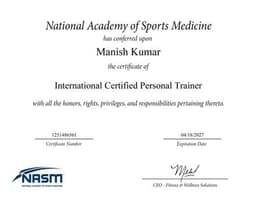
NASM Certified
Certified Personal Trainer & Sports Nutritionist from the National Academy of Sports Medicine
Disclaimer: This tool is for informational and personal journaling purposes only. Results are estimates based on published formulas and may vary based on individual factors such as genetics, training history, and measurement technique.