
Key Takeaways
- WHO (2020) aerobic targets for adults 18–64: 150–300 minutes of moderate activity per week, or vigorous minutes counted at 2× in Weekly Goals mode, plus strength work on 2+ days.[1]
- Daily Tracker calories use Compendium MET values: kcal = MET × weight (kg) × hours active.[2]
- IPAQ Quick Assessment uses fixed METs (walk 3.3, moderate 4.0, vigorous 8.0) and official short-form category rules. It does not replace the WHO checklist in Weekly Goals.[3][4]
- PAL/TDEE mode uses Mifflin-St Jeor BMR and a simplified occupation + exercise PAL model capped at 2.4. Treat TDEE as a planning number, not a lab result.[6][7]
- Less sitting and more light movement still helps health even when you already train.
What Is Physical Activity?
Physical activity is any skeletal muscle movement that raises energy use above rest.[1] Lifting, running, and sport count. So do walks, stairs, and active chores if the intensity is high enough to matter for your goal.
Exercise is planned, repeated activity aimed at fitness. Both exercise and general movement can count toward weekly targets when intensity and duration match the guidelines you are tracking.
WHO 2020 Guidelines
WHO updated global guidance in 2020: some activity beats none, and more moderate-to-vigorous work generally brings more benefit up to the stated ranges.[1]
Aerobic
150–300 min/week moderate, or 75–150 min/week vigorous, or a mix where 1 min vigorous ≈ 2 min moderate.
Strength
At least 2 days/week targeting major muscle groups at moderate or greater effort.
Sedentary time
Reduce long sitting where you can. Replace some sitting with movement of any intensity.
Weekly Goals mode
This calculator compares your entered moderate and vigorous minutes (vigorous ×2) to 150 and 300, and checks strength days separately.
MET Values & Calories
One MET is roughly resting energy cost (about 1 kcal/kg/hour). The Daily Tracker pulls METs from the Compendium list bundled in this site.[2]
Intensity bands in code: light under 3 METs, moderate 3 to under 6, vigorous 6 and above. That matches the breakdown bars in Daily Tracker results.
| Activity (examples) | MET | Band in this tool | kcal/hr @ 75 kg |
|---|---|---|---|
| Sitting quietly | 1.0 | Light | 75 |
| Walking ~2 mph | 2.0 | Light | 150 |
| Walking ~3.5 mph | 3.5 | Moderate | 263 |
| Cycling, moderate | 5.5 | Moderate | 413 |
| Running ~6 mph | 9.8 | Vigorous | 735 |
IPAQ Classification
The IPAQ short form sums MET-minutes per week from walking, moderate, and vigorous bouts.[3] Quick Assessment mode implements the same category logic documented in the IPAQ scoring guidelines.[4]
| Category | Any one rule met |
|---|---|
| Low | Does not meet Moderate or High rules. |
| Moderate | 3+ days vigorous ≥20 min/day, OR 5+ days moderate/walking ≥30 min/day, OR ≥600 MET-min/week total. |
| High | ≥1500 vigorous MET-min/week on 3+ days, OR ≥3000 total MET-min/week on 7 days. |
PAL & TDEE (This Tool)
FAO/WHO/UNU reports describe PAL as total energy need divided by basal need for population planning.[6] This calculator uses a simplified PAL estimate:
- Base PAL from occupation (1.2 sedentary up to 1.725 heavy manual work).
- Small bonus from weekly exercise frequency and self-rated intensity (capped at PAL 2.4).
- BMR from Mifflin-St Jeor, then TDEE = BMR × PAL.
Not the same as a food-scale TDEE
Many nutrition calculators use fixed activity multipliers. This PAL mode blends job type and exercise habits. Cross-check hunger, weight trend, and performance before large calorie changes.
Daily Tracker Labels
After you log activities, the daily badge uses moderate-equivalent minutes for that day only: moderate minutes plus 2× vigorous minutes.
| Label | Moderate-equivalent min (day) |
|---|---|
| Sedentary | Under 15 |
| Lightly Active | 15–29 |
| Active | 30–59 |
| Very Active | 60+ |
Sedentary Time
Long sitting is its own health concern, separate from whether you hit a weekly exercise target.[5] Break up long desk blocks with short walks or standing when you can.
Getting Started
If you are starting from low activity, build consistency before intensity. Weekly Goals mode shows how many minutes you still need for WHO aerobic and strength targets.
Weeks 1–2
10–15 minutes of brisk walking most days. Same time after a meal helps habit.
Weeks 3–4
Work toward 20–30 minutes per day. Add one weekend session you enjoy.
Weeks 5–6
Add 2 short strength sessions (bodyweight squats, push-ups, rows).
Week 7+
Aim for 150+ moderate-equivalent minutes and 2 strength days. Use Daily Tracker to see calorie impact.
Pair with Tempo & TUT Calculator for set pacing, or Japanese Interval Walking for a simple walking structure.
Frequently Asked Questions
Sources & References
- WHO Guidelines on Physical Activity and Sedentary Behaviour. World Health Organization. WHO (2020)
- 2024 Adult Compendium of Physical Activities. Ainsworth BE, Haskell WL, Herrmann SD, et al.. Journal of Sport and Health Science (2024)
- International Physical Activity Questionnaire (IPAQ): study protocol and reliability/validity. Craig CL, Marshall AL, Sjöström M, et al.. Medicine & Science in Sports & Exercise (2003)
- Guidelines for Data Processing and Analysis of the International Physical Activity Questionnaire (IPAQ). IPAQ Research Committee. IPAQ (2005)
- Too much sitting: the population-health science of sedentary behavior. Owen N, Healy GN, Matthews CE, Dunstan DW. Exercise and Sport Sciences Reviews (2010)
- Human Energy Requirements: Report of a Joint FAO/WHO/UNU Expert Consultation. FAO/WHO/UNU. FAO Food and Nutrition Paper (2001)
- A new predictive equation for resting energy expenditure in healthy individuals. Mifflin MD, St Jeor ST, Hill LA, et al.. American Journal of Clinical Nutrition (1990)
- Physical Activity and Public Health: Updated Recommendation for Adults From the American College of Sports Medicine and the American Heart Association. Haskell WL, Lee IM, Pate RR, et al.. Medicine & Science in Sports & Exercise (2007)

Certified Personal Trainer & Sports Nutritionist
NASM-certified fitness and nutrition coach with over 10 years of hands-on experience helping people build strength, lose fat, and live healthier lives. Specializing in gym-based workouts with a strong focus on lifting technique, biomechanics, and practical exercise science. Through FitLifeRegime, sharing the tools, tips, and insights that have worked for hundreds of clients — helping you start your own fitness journey with confidence and clarity.
Learn more about Manish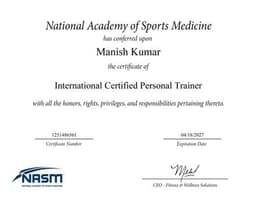
NASM Certified
Certified Personal Trainer & Sports Nutritionist from the National Academy of Sports Medicine
Disclaimer: This tool is for informational and personal journaling purposes only. Results are estimates based on published formulas and may vary based on individual factors such as genetics, training history, and measurement technique.