
Key Takeaways
- Overtraining syndrome (OTS) has no test. It is a clinical diagnosis reached by ruling out other causes, so a calculator cannot say you have it or give you a risk percentage[1][2].
- The sources tell the stages apart by how long recovery takes, not by how bad the symptoms are. Under 14 to 21 days of rest to get performance back is read as non-functional overreaching, and past that some diagnose OTS[2].
- If performance is down and you have not rested, OTS cannot be diagnosed. The first step is a real period of rest, and a doctor if other causes could apply[2].
- Illness, low fuelling, thyroid or iron problems, heart symptoms and sleep loss can look the same. They have to be checked first[1].
- About 10% of swimmers and endurance athletes had non-functional overreaching or OTS in one training cycle, but that figure merges the stages. OTS on its own is thought to be rare[1][2].
How the Check Works
You say whether performance has dropped, for how long, and whether rest has helped. Then you tick the symptoms, other explanations and triggers that apply.
The result places your timing against the time course in two sources, and it shows the three things a clinician looks for in the history: performance down despite weeks of recovery, disturbed mood, and no other cause[2]. The ticks are counted so you can see them, and they are not added into a score.
| Your answers | What the tool says | Source |
|---|---|---|
| Performance is normal | No unexplained drop, so the pattern is not there | [1] |
| Performance down, and another explanation ticked | Check that explanation first | [1] |
| Down, no rest yet | Too soon to classify. OTS cannot be diagnosed without a period of rest | [2] |
| Rested under 14 days, and it came back | Fits overreaching that recovered | [2] |
| Rested under 14 days, still down | Too early to tell | [2] |
| Rested 14 to 21 days | On the line the practical guide gives, so a clinician should place you | [2] |
| Rested over 21 days, still down | Past the line, where some clinicians diagnose OTS once other causes are excluded | [2] |
| Rested over 21 days, and it came back | Slower than the line. The guide does not say how to read this, so the tool suggests a clinician looks | [2] |
How the tool reads your timing. Rest means days off or very light training.
The 14 to 21 day line is the only cut-off the practical guide quotes for this, and it says the diagnosis can be made only in hindsight[2]. The tool treats both ends of that range as the line.
Overreaching, Non-Functional Overreaching and Overtraining Syndrome
The three terms sit on a continuum, though some researchers question whether non-functional overreaching always comes before OTS[2]. The table follows the European College of Sport Science definitions as reproduced in the practical guide.
| Term | What it means | Performance dip | Outcome |
|---|---|---|---|
| Functional overreaching | A hard block of training that causes a short dip in performance, followed by better performance after rest. | Days to weeks | Positive, through supercompensation. Training camps use it on purpose. |
| Non-functional overreaching | Intense training with a longer dip, plus more mood or hormonal symptoms. Full recovery after rest. | Weeks to months | Negative, through symptoms and lost training time. |
| Overtraining syndrome | Like extreme non-functional overreaching, but with a longer decrement, more severe symptoms across several body systems, and an additional stressor that no other disease explains. | Months, and more than 2 months in the older ECSS wording | Negative, and can end an athletic career. |
Terms and time course, as defined by the ECSS and reproduced in the practical guide.
The 2013 consensus statement describes the stages less precisely. Non-functional overreaching needs weeks or months to recover, and OTS reflects prolonged maladaptation. It adds that OTS symptoms are generally thought to be more severe, but there is no scientific evidence to confirm or refute that[1].
Overtraining Symptoms
The symptoms are varied, nonspecific and mostly anecdotal, so no one of them points to OTS[2]. The tool lists 12 you can report yourself. High blood pressure is left out because it needs a measurement.
| Group | Symptoms |
|---|---|
| More common in aerobic sports | Fatigue, depression, bradycardia (a slow heart rate), loss of motivation |
| More common in anaerobic sports | Insomnia, irritability, agitation, tachycardia (a fast heart rate), hypertension, restlessness |
| Other | Anorexia (loss of appetite), weight loss, poor concentration, heavy, sore and stiff muscles, anxiety, waking unrefreshed |
Symptoms of overtraining syndrome as listed in the practical guide.
Two clues are said to point toward overtraining rather than disease. One is starting a session but being unable to finish it, or losing your finishing kick. The other is mood changes that run through everything, rather than one low spell[2].
Resting heart rate, maximal heart rate and heart rate variability did not give consistent results, and they do not separate the three stages. Treat a change in any of them as something to mention to a clinician[2].
What Else Can Look Like Overtraining
The consensus statement says the diagnosis always requires excluding organic disease, and that the borderline between under and over diagnosis is hard to judge[1]. The tool asks about the 6 causes you can report yourself.
- Endocrine disorders such as thyroid, adrenal gland or diabetes, iron deficiency with anaemia, and infections including myocarditis, hepatitis and glandular fever[1].
- Eating disorders such as anorexia nervosa and bulimia, and simply too little energy or carbohydrate for the training load[1].
- Undiagnosed asthma, allergies, injury, heart symptoms, and recent travel across time zones[1].
- A primary mood disorder. Mood symptoms can sit alongside organic disease, and the guide says pervasive mood change in the right setting may point to overtraining instead[2].
In one of the few studies of underperforming athletes, a cause for repeated infections or fatigue was found in 68% of regional or higher level athletes[2]. That is one study, and it is a reason to look for a cause before assuming overtraining.
Possible Triggers
The statement calls a training error that upsets the balance of load and recovery one of the most certain triggers. The tool asks about 7 possible triggers, and the statement adds that the scientific evidence for most of them is not strong[1].
The practical guide adds earlier illness, a severe "bonk", heat injury and altitude exposure[2]. It also notes that underperformance is often met with more training volume and intensity, so the history should ask whether that happened[2].
To see how your load, spacing and variety look across a week, use the RPE load calculator and the rest time between workouts calculator.
How Common Is Overtraining?
Nobody has exact figures. The consensus statement says rates are hard to give because studies differ on the time frame, and that higher rates are likely inflated by merging all three stages[1].
In surveys of collegiate swimmers and other endurance athletes across one training cycle, about 10% (range 7% to 21%) had non-functional overreaching or OTS[1]. Over a career, surveys of elite runners put the share who had an episode at 60% of women and 64% of men, against 33% in non-elite adult runners[1].
The practical guide reports a lifetime rate of non-functional overreaching of about 60% in elite runners, while OTS itself appears extremely rare[2]. The two papers use different labels, so the numbers are hard to compare, and they describe athletes, not recreational lifters.
Why There Is No Risk Percentage
Many overtraining calculators, including the earlier version of this page, add up points for sleep, soreness, mood and training days and show a percentage. Neither source here supports a point table, a weight for each item, or a cut-off between low, moderate and high risk, so this version does not show one.
The earlier version also gave fixed advice, such as 7 to 14 days of complete rest and a 50% to 70% cut in volume. No source cited here backs those figures, so they were removed.
What the sources do support is a checklist and a time course, which is what the tool shows. If you want a numbers-based view of load, the RPE load calculator uses session RPE multiplied by minutes, a method the consensus statement describes as a way to monitor training load[1].
What Helps and What Prevents It
Functional overreaching needs nothing beyond balancing overload with recovery. For non-functional overreaching and OTS the treatment is rest, and some propose relative rest instead[2].
The guide describes rebuilding volume before intensity, starting from 5 to 10 minutes a day until an hour is tolerated. If full rest raises stress, depression or anxiety, it suggests relative rest with clear expectations, and involving a sports psychologist[2].
The guide says there are no evidence-based ways to prevent OTS, since it cannot be induced on purpose, and lists these measures.
- Periodise training, and taper before competition
- Adjust volume and intensity to performance and mood
- Eat enough calories for the training load, and drink enough
- Take in enough carbohydrate during exercise
- Sleep enough
- Leave more than 6 hours between exercise bouts
- Stay out of hard training after an infection, heat stroke or heat stress, or a period of high stress
- Avoid extreme environmental conditions
- Track a mood measure such as the Profile of Mood States and change the load when it worsens
Watching training load, performance and mood can help stop the move from overreaching to OTS. One early sign of overreaching is a higher rating of perceived exertion for the same work[2]. For the muscle side of recovery, see the muscle recovery calculator.
Not Included
- A risk percentage or a low, moderate and high band. No source supports one.
- Point weights for training days, sessions a day and rest days. No source gives a rest-day minimum.
- Fixed rest lengths and volume cuts. The sources give principles, not a number of days to rest for a given score.
- Blood tests, hormone ratios and heart rate variability thresholds. The sources say none separates the stages.
- The consensus statement's flowchart. It is not reproduced here.
- A diagnosis, or medical advice.
Limits of the sources
Frequently Asked Questions
Sources & References
- Prevention, diagnosis, and treatment of the overtraining syndrome: joint consensus statement of the European College of Sport Science and the American College of Sports Medicine. Meeusen R, Duclos M, Foster C, Fry A, Gleeson M, Nieman D, Raglin J, Rietjens G, Steinacker J, Urhausen A. Med Sci Sports Exerc 45(1):186-205 (2013)
- Overtraining Syndrome: A Practical Guide. Kreher JB, Schwartz JB. Sports Health 4(2):128-138 (2012)

Certified Personal Trainer & Sports Nutritionist
NASM-certified fitness and nutrition coach with over 10 years of hands-on experience helping people build strength, lose fat, and live healthier lives. Specializing in gym-based workouts with a strong focus on lifting technique, biomechanics, and practical exercise science. Through FitLifeRegime, sharing the tools, tips, and insights that have worked for hundreds of clients — helping you start your own fitness journey with confidence and clarity.
Learn more about Manish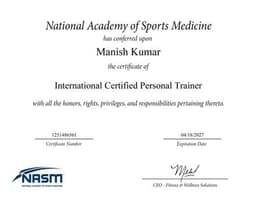
NASM Certified
Certified Personal Trainer & Sports Nutritionist from the National Academy of Sports Medicine
Disclaimer: This calculator provides estimates based on published formulas and population averages. Results are for informational and personal logging purposes only. Individual results may vary.