
Key Takeaways
- No published formula gives the hours until you are ready to train again. This page compares the gaps in your week with the times at which studies still measured a drop, or measured none.
- After 4 sets to failure at 80% of one-rep max, squat bar speed in 12 well-trained men was still down at 72 hours. Bench press bar speed was reported down straight after the session only[1].
- After interval sessions, most measures were back within 24 to 48 hours[4][5][6].
- US guidelines ask for muscle-strengthening on 2 or more days a week[10]. With weekly volume matched, training a muscle twice a week beat once a week for muscle growth[11].
- A measured drop is not a rule to skip a session. Sessions about 24 hours apart and 48 to 72 hours apart gave similar results over 12 weeks[13].
How the Checker Works
Add the sessions you do in a typical week, with the day, start time, length and type. The tool treats the week as repeating, so Sunday is followed by Monday.
For each session it finds the next one that loads the same muscles. The gap is the time from the end of the first session to the start of the next.
| Sessions | Gap |
|---|---|
| Monday 18:00 for 60 min, then Wednesday 18:00 | 47 h |
| Wednesday 18:00 for 60 min, then Monday 18:00 of the next week | 4 d 23 h |
A worked example of the gap between two lower-body lifting sessions.
Each gap then gets a plain label. Inside the measured window means a study still saw a drop at that time, and past it means studies saw none. A gap shorter than the first check in any study is labelled as untested.
The second tab does the same for one gap. Use it when you want to know whether tomorrow's session lands inside the window of today's.
What Studies Measured After Different Sessions
Each row describes what happened to those people after that session. None of them is a rule for a different session or a different person.
| Session | Who | Checked | What they found | Source |
|---|---|---|---|---|
| 4 sets to failure at 80% of one-rep max, as squat, bench press and deadlift in separate weeks | 12 well-trained men | Straight after, 24, 48, 72 and 96 h | Squat bar speed was down up to 72 h (8.6% lower). Bench press bar speed was reported down straight after the session. Deadlift bar speed did not fall. | [1] |
| Full squats at 60% or 80% of one-rep max, stopping at 20% or 40% velocity loss | 17 men | Straight after, 6, 24 and 48 h | Bar speed was still down at 6 h after 60% with 20% velocity loss and at 24 h after 80% with 40%. | [2] |
| 6 x 800 m run | 20 recreational club runners | Straight after and 24 h | Quadriceps maximal force was 3.2% lower at 24 h. Most runners had recovered by the study's change threshold, and a minority had not. | [4] |
| 8 x 15 s all-out cycling with 2 min rests | 25 healthy adults | 24 and 48 h | No drop in force at 24 h. Sprint force, velocity and power were unchanged at 24 and 48 h. | [5] |
| Short intervals, long intervals or repeated sprints, run by each runner | 33 male middle-distance runners, mean age 19.6 | Straight after, 24 and 48 h | After repeated sprints, jump and mid-thigh pull force were still down at 24 h and largely back by 48 h, with soreness and perceived recovery still worse at 48 h. Short and long intervals were less affected at 24 h. | [6] |
| Simulated half-marathon on a treadmill | 36 recreational runners, mean age 28.5 | Straight after, day 1 and day 2 | Most measures were back to baseline by day 1. Hip joint position sense took until day 2. | [7] |
| Resistance exercise, as reviewed across studies | Older adults | Up to 264 h in the longest study | Declines tended to peak within 48 h. Most studies took over 72 h to see full recovery, and some had not by the end of follow-up. The authors note some exercise was harder than usual training. | [8] |
Recovery measured in studies after specific sessions.
The calculator reads the same studies into three time points for each session type.
| Session type | First checked | Drop last seen | None seen from |
|---|---|---|---|
| Lower-body lifting to or near failure | 24 h | 72 h | 96 h |
| Upper-body lifting to or near failure | 24 h | Straight after | 24 h |
| Full-body lifting to or near failure | 24 h | 72 h | 96 h |
| Repeated sprints | 24 h | 24 h | 48 h |
| Interval session | 24 h | 24 h | 48 h |
| Long run or race effort | 24 h | 24 h | 48 h |
The time points the calculator uses for each session type, in hours after the session.
Is 48 Hours Between Workouts a Rule?
Harvard Health advises at least 48 hours between strength training sessions[14]. The studies above show why one number does not fit every session. Lower-body lifting to failure was still lower than baseline at 72 hours in one study, while bench press bar speed was not reported lower at 24 hours[1].
A 2024 review, drawing on earlier work, says lower-body exercise needs 48 to 72 hours against 24 hours or less for the upper body[3].
A 12-week trial compared three sessions a week about 24 hours apart with three sessions 48 to 72 hours apart. Strength and body-composition changes were similar[13]. It used 30 young, healthy, recreationally active men, so it does not settle the question for everyone.
The ACSM position stand gives weekly lifting days by experience level, and its abstract does not state a 48-hour rule[9].
How Often Should You Train the Same Muscles?
The US Physical Activity Guidelines ask for muscle-strengthening that involves all major muscle groups on 2 or more days a week[10]. For lifting days, the ACSM position stand gives these ranges[9].
| Level | Days a week |
|---|---|
| Novice | 2 to 3 |
| Intermediate | 3 to 4 |
| Advanced | 4 to 5 |
Resistance training days a week by experience level, from the ACSM position stand.
A meta-analysis of 10 studies found higher training frequency went with larger muscle growth. With volume equated, its authors conclude that twice a week beats once a week. Three times against twice is still undecided[11].
For strength, a second meta-analysis found the benefit of frequency came from the extra volume[12].
To plan the sets themselves, use the workout volume calculator or the hypertrophy volume landmarks planner.
Which Sessions Count as the Same Muscles?
The tool compares two sessions only when they load a region the studies measured.
- Lower-body lifting loads the lower body. Upper-body lifting loads the upper body. Full-body lifting loads both.
- Repeated sprints, interval sessions and long runs load the lower body, because the studies measured leg force, jumps or running mechanics.
- Easy sessions are listed but never compared, because no cited study measures recovery after them.
- Rowing, swimming and sport sessions are not covered, because no cited study measures them.
Heart rate recovery and session load are different questions. Use the recovery time calculator for those, and the rest time between sets calculator for the rest inside a session.
Not Included
- An hours-until-ready number. No source validates one, so none is shown.
- Age, sleep, stress, nutrition, sport, injury and recovery-tool adjustments. No source gives a multiplier for any of them.
- Gap checks for easy sessions, rowing, swimming and sport sessions.
- Medical advice. Pain, swelling, dizziness or an injury need a clinician, not a gap.
Limits of the studies
Frequently Asked Questions
Sources & References
- Time course of recovery is similar for the back squat, bench press, and deadlift in well-trained males. Belcher DJ, Sousa CA, Carzoli JP, et al.. Appl Physiol Nutr Metab 44(10):1033-1042 (2019)
- Time Course of Recovery Following Resistance Exercise with Different Loading Magnitudes and Velocity Loss in the Set. Pareja-Blanco F, Villalba-Fernández A, Cornejo-Daza PJ, et al.. Sports 7(3):59 (2019)
- The Importance of Recovery in Resistance Training Microcycle Construction. Sousa CA, Zourdos MC, Storey AG, Helms ER. J Hum Kinet 91:205-223 (2024)
- Gait and Neuromuscular Changes Are Evident in Some Masters Club Level Runners 24-h After Interval Training Run. Riazati S, Caplan N, Matabuena M, Hayes P. Front Sports Act Living 4:830278 (2022)
- Neuromuscular and autonomic function is fully recovered within 24 h following a sprint interval training session. Lloria-Varella J, Koral J, Ravel A, et al.. Eur J Appl Physiol 123(10):2317-2329 (2023)
- Repeated sprint training induces prolonged residual fatigue compared to other high-intensity interval training modalities in middle-distance runners. Yang K, Xia Y, Filipa AS. Biol Sport 43:631-645 (2026)
- Biomechanical Changes and the Time Course of Recovery in Lower Extremities of Recreational Runners Following a Simulated Treadmill Half-Marathon. Wang W, Xu S, Komnik I, et al.. Sports Med Open 11:22 (2025)
- Recovery from Resistance Exercise in Older Adults: A Systematic Scoping Review. Hayes EJ, Stevenson E, Sayer AA, Granic A, Hurst C. Sports Med Open 9:51 (2023)
- American College of Sports Medicine position stand. Progression models in resistance training for healthy adults. American College of Sports Medicine. Med Sci Sports Exerc 41(3):687-708 (2009)
- Physical Activity Guidelines for Americans, 2nd edition. US Department of Health and Human Services. Office of Disease Prevention and Health Promotion (2018)
- Effects of Resistance Training Frequency on Measures of Muscle Hypertrophy: A Systematic Review and Meta-Analysis. Schoenfeld BJ, Ogborn D, Krieger JW. Sports Med 46(11):1689-1697 (2016)
- Effect of Resistance Training Frequency on Gains in Muscular Strength: A Systematic Review and Meta-Analysis. Grgic J, Schoenfeld BJ, Davies TB, et al.. Sports Med 48(5):1207-1220 (2018)
- Effects of Consecutive Versus Non-consecutive Days of Resistance Training on Strength, Body Composition, and Red Blood Cells. Yang Y, Bay PB, Wang YR, et al.. Front Physiol 9:725 (2018)
- 7 tips for a safe and successful strength training program. Harvard Health Publishing. Harvard Health (2015)

Certified Personal Trainer & Sports Nutritionist
NASM-certified fitness and nutrition coach with over 10 years of hands-on experience helping people build strength, lose fat, and live healthier lives. Specializing in gym-based workouts with a strong focus on lifting technique, biomechanics, and practical exercise science. Through FitLifeRegime, sharing the tools, tips, and insights that have worked for hundreds of clients — helping you start your own fitness journey with confidence and clarity.
Learn more about Manish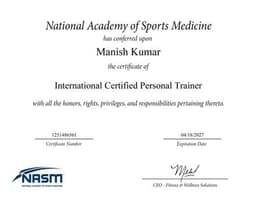
NASM Certified
Certified Personal Trainer & Sports Nutritionist from the National Academy of Sports Medicine
Disclaimer: This calculator is for informational and personal journaling purposes only. It logs measurements and compares them to published reference values. It is not health, medical, or nutrition advice.