
Key Takeaways
- Two studies supply the two equations. Leg press to squat uses Willardson and Bressel, who tested 60 men on 10-rep maxes[1]. Squat to leg press uses Wong and colleagues, who tested 14 elite male karate athletes on 6-rep maxes[2].
- Worked from the equations. A 400 lb leg press gives a squat of about 145 lb with the all-men equation, and 145 to 165 lb across all three[1]. A 225 lb squat gives a leg press of about 410 lb[2].
- No single ratio fits every weight. Each equation adds a fixed amount, so its ratio shifts with the load. The all-men equation gives 2.66 to 2.77 across leg presses of 100 to 300 kg[1], and the line of Wong and colleagues gives 1.78 to 1.93 across squats of 60 to 140 kg[2].
- Both equations were built from rep maxes. The sets were 10 reps and 6 reps, not one-rep maxes[1][2]. The novice equation explains about 25% of the differences between lifters, the advanced equation about 55% and the Wong line 57%[1][2].
- A ratio from your own lifts describes your lifts. The equations describe the study groups. Switch to Find my ratio to work out your own and to set your lifts beside the equations.
How the Conversion Works
Each published equation is a straight line in kilograms[1][2]. The answer is the weight you enter times a slope, plus a fixed number of kilograms. The tool changes pounds to kilograms first and changes the answer back.
Squat = 0.354 × leg press + 2.235 kg (All 60 men)
Squat = 0.210 × leg press + 36.244 kg (Novice group)
Squat = 0.310 × leg press + 19.438 kg (Advanced group)
Leg press = 1.66 × squat + 16.10 kg (14 elite karate athletes)
Willardson and Bressel print one equation for all 60 men and one each for a novice group and an advanced group[1]. Each equation is used only in the direction its study fitted it. No source read for this page shows how to turn one round.
Worked example: a 400 lb leg press to squat
400 lb = 181.44 kg
Squat = 0.354 × 181.44 + 2.235 = 66.46 kg
66.46 kg = 146.5 lb. Nearest 5 lb: 145 lb
Worked example: a 225 lb squat to leg press
225 lb = 102.06 kg
Leg press = 1.66 × 102.06 + 16.10 = 185.52 kg
185.52 kg = 409 lb. Nearest 5 lb: 410 lb
R² is the share of the differences between lifters that a line accounts for. Willardson and Bressel report about 25% for the novice group and about 55% for the advanced group[1]. Wong and colleagues report 57%[2].
Wong and colleagues also print a standard error of the estimate of 11.07 kg, which is 24.4 lb[2]. It is the typical distance between the results of the athletes and the line. The abstract of Willardson and Bressel gives no such figure[1].
Two checks on the printed line use only the numbers of the paper[2]. At the average squat of 96.45 kg, the line gives 176.2 kg. The athletes averaged 179.30 kg on the leg press, which is 3.1 kg higher and inside the standard error.
Slope = r × (SEM of leg press ÷ SEM of squat)
Slope = 0.76 × 8.65 ÷ 4.86 = 1.35
The correlation of 0.76 and the averages in Table 1 point to a slope of about 1.35, not the printed 1.66[2]. The paper does not comment on this. The tool uses the printed line unchanged.
Leg Press to Squat Chart
The chart puts common leg press weights through the three equations of Willardson and Bressel[1]. Each equation was built from 10-rep maxes. Every squat is rounded to the nearest 5 lb or 2.5 kg, and the last column is the leg press divided by the all-men squat.
Pounds
| Leg press (lb) | Novice group | Advanced group | All 60 men | Leg press ÷ squat, all men |
|---|---|---|---|---|
| 150 | 110 | 90 | 60 | 2.58 |
| 200 | 120 | 105 | 75 | 2.64 |
| 250 | 130 | 120 | 95 | 2.68 |
| 300 | 145 | 135 | 110 | 2.70 |
| 350 | 155 | 150 | 130 | 2.72 |
| 400 | 165 | 165 | 145 | 2.73 |
| 450 | 175 | 180 | 165 | 2.74 |
| 500 | 185 | 200 | 180 | 2.75 |
| 600 | 205 | 230 | 215 | 2.76 |
| 700 | 225 | 260 | 255 | 2.77 |
| 800 | 250 | 290 | 290 | 2.78 |
Squat in lb for each leg press weight listed, from the three equations for a 10-rep max. Rounded to the nearest 5 lb. The last column divides the leg press by the squat of the all-men equation.
Kilograms
| Leg press (kg) | Novice group | Advanced group | All 60 men | Leg press ÷ squat, all men |
|---|---|---|---|---|
| 60 | 50 | 37.5 | 22.5 | 2.56 |
| 80 | 52.5 | 45 | 30 | 2.62 |
| 100 | 57.5 | 50 | 37.5 | 2.66 |
| 120 | 62.5 | 57.5 | 45 | 2.68 |
| 140 | 65 | 62.5 | 52.5 | 2.70 |
| 160 | 70 | 70 | 60 | 2.72 |
| 180 | 75 | 75 | 65 | 2.73 |
| 200 | 77.5 | 82.5 | 72.5 | 2.74 |
| 250 | 87.5 | 97.5 | 90 | 2.76 |
| 300 | 100 | 112.5 | 107.5 | 2.77 |
| 350 | 110 | 127.5 | 125 | 2.77 |
| 400 | 120 | 142.5 | 145 | 2.78 |
Squat in kg for each leg press weight listed, from the three equations for a 10-rep max. Rounded to the nearest 2.5 kg. The last column divides the leg press by the squat of the all-men equation.
The abstract gives no range of leg press loads, so the weights at which the equations stop fitting are not known[1].
Squat to Leg Press Chart
The chart puts common squat weights through the line of Wong and colleagues[2]. The line was built from 6-rep maxes. Low and High add and take away the standard error of the estimate, 11.07 kg or 24.4 lb.
Pounds
| Squat (lb) | Leg press | Low | High | Leg press ÷ squat |
|---|---|---|---|---|
| 95 | 195 | 170 | 220 | 2.03 |
| 115 | 225 | 200 | 250 | 1.97 |
| 135 | 260 | 235 | 285 | 1.92 |
| 155 | 295 | 270 | 315 | 1.89 |
| 185 | 345 | 320 | 365 | 1.85 |
| 205 | 375 | 350 | 400 | 1.83 |
| 225 | 410 | 385 | 435 | 1.82 |
| 245 | 440 | 420 | 465 | 1.80 |
| 275 | 490 | 470 | 515 | 1.79 |
| 315 | 560 | 535 | 585 | 1.77 |
| 365 | 640 | 615 | 665 | 1.76 |
| 405 | 710 | 685 | 730 | 1.75 |
Leg press in lb for each squat listed, from the line for a 6-rep max. Low and high are the answer minus and plus the study's standard error of the estimate, 24.4 lb. Rounded to the nearest 5 lb.
Kilograms
| Squat (kg) | Leg press | Low | High | Leg press ÷ squat |
|---|---|---|---|---|
| 40 | 82.5 | 72.5 | 92.5 | 2.06 |
| 50 | 100 | 87.5 | 110 | 1.98 |
| 60 | 115 | 105 | 127.5 | 1.93 |
| 70 | 132.5 | 120 | 142.5 | 1.89 |
| 80 | 150 | 137.5 | 160 | 1.86 |
| 90 | 165 | 155 | 177.5 | 1.84 |
| 100 | 182.5 | 170 | 192.5 | 1.82 |
| 110 | 197.5 | 187.5 | 210 | 1.81 |
| 120 | 215 | 205 | 227.5 | 1.79 |
| 130 | 232.5 | 220 | 242.5 | 1.78 |
| 140 | 247.5 | 237.5 | 260 | 1.78 |
| 150 | 265 | 255 | 275 | 1.77 |
Leg press in kg for each squat listed, from the line for a 6-rep max. Low and high are the answer minus and plus the study's standard error of the estimate, 11.07 kg. Rounded to the nearest 2.5 kg.
The squat of the athletes averaged 96.45 kg, which is 212.6 lb[2]. The paper gives averages, not the range of squats tested, so a row far from that average may lie outside it.
Leg Press to Squat Ratio
The ratio here is the leg press weight divided by the squat weight. Each equation adds a fixed amount, so its ratio changes with the weight. The table shows the ratio at three loads.
| Equation | Weights compared | Light | Middle | Heavy |
|---|---|---|---|---|
| Novice group[1] | Leg press 100, 200, 300 kg | 1.75 | 2.56 | 3.02 |
| Advanced group[1] | Leg press 100, 200, 300 kg | 1.98 | 2.46 | 2.67 |
| All 60 men[1] | Leg press 100, 200, 300 kg | 2.66 | 2.74 | 2.77 |
| 14 elite karate athletes[2] | Squat 60, 100, 140 kg | 1.93 | 1.82 | 1.78 |
Weights in kg. The ratio is the leg press divided by the squat, and it is the same number in lb.
The novice equation gives a ratio of 1.75 at 100 kg and 3.02 at 300 kg. At the same three loads, the all-men equation gives 2.66 to 2.77. The two 45° leg press papers print equations, not a single ratio.
Trifa and colleagues tested a horizontal leg press in 19 students (14 men, 5 women)[3]. A line forced through zero, which fixes the ratio at every weight, gave a leg press of 1.49 times the squat. The other two studies used 45° presses, so the tool does not use this figure.
Why the Two Studies Give Different Answers
The equations come from studies that differ in lifters, lifts and sets. The table shows what each one measured[1][2][3].
| Study | Lifters | Squat | Leg press | Test | What it gives |
|---|---|---|---|---|---|
| Willardson and Bressel 2004[1] | 60 men | Free-weight parallel squat | 45° angled leg press | 10-rep max | Three equations. About 25% (novice) and 55% (advanced) of the variance explained |
| Wong and colleagues 2010[2] | 14 male elite karate athletes, age 22.6 ± 1.2 years | Back half squat | 45° inclined leg press | 6-rep max | One line. 57% of the variance explained, standard error of the estimate 11.07 kg |
| Trifa and colleagues 2025[3] | 19 students (14 men, 5 women), age 20 to 22 | Barbell back squat | Horizontal leg press | Maximal strength tests, seven days apart | One line through zero: leg press = 1.49 × squat. Correlation 0.857 |
Each row is as the paper prints it. The third study used a different machine, so the tool does not use its figure in an answer.
A 400 lb leg press gives a squat of 145 lb. Entered in the other direction, that squat gives a leg press of 275 lb, not 400 lb. The two lines come from different lifters, squats and rep counts.
The studies differ in squat (parallel and back half), reps (10 and 6) and lifters (60 men and 14 elite karate athletes)[1][2]. Neither source read says whether the weight of the sled was counted in the leg press load. No source read for this page says how much each difference moves the answer.
Wong and colleagues call a 55% share of variance reported by Willardson and Bressel close to their own 57%[2]. Similar shares of variance do not make the weights match.
Find Your Own Ratio
A ratio from your own lifts describes your own machine, squat depth and rep count. Use the heaviest weights you lift for the same number of reps on both lifts, on the same leg press and at the squat depth you train. Then divide the leg press weight by the squat weight.
Ratio = leg press ÷ squat
Squat share = squat ÷ leg press
A 400 lb leg press and a 150 lb squat, both for 10 reps, give a ratio of 2.67. The squat is 37.5% of the leg press.
| Equation | Gives (lb) | You lifted (lb) | Gap (lb) |
|---|---|---|---|
| Novice groupSquat = 0.210 × leg press + 36.244 kg | 163.9 | 150 | −13.9 |
| Advanced groupSquat = 0.310 × leg press + 19.438 kg | 166.9 | 150 | −16.9 |
| All 60 menSquat = 0.354 × leg press + 2.235 kg | 146.5 | 150 | +3.5 |
Weights in lb, for a set of 10. Each row puts your leg press through one published equation and sets the result beside your squat. A positive gap means you lifted more.
At 10 reps the tool also sets the squat beside the three equations, as in the table. A gap is not a mistake: where the papers give it, an equation explains about 25% to 57% of the differences between lifters[1][2].
Not Covered
- One-rep maxes. Both equations use rep maxes (10 and 6 reps), and no source read for this page converts a one-rep max between the two lifts[1][2].
- Women. Both studies tested men[1][2], and no equation for women was found in the sources read, including the study with 5 women among 19 students[3].
- Other machines. Both equations are for a 45° leg press[1][2]. No source read gives an equation for a seated, vertical, pendulum, hack squat or selectorized machine. The only horizontal figure is the ratio of 1.49 from 19 students[3].
- Other squats. The equations are for a free-weight parallel squat[1] and a back half squat[2]. The tool does not adjust for any other depth or style of squat.
- Sled weight. Neither source read says whether the weight of the sled was counted in the leg press load[1][2].
- The error of the leg press to squat equations. Only the abstract of Willardson and Bressel is available, and it gives no standard error[1].
- Medical or coaching advice. The tool does arithmetic on published equations. It does not say what weight is safe for you.
Frequently Asked Questions
Sources & References
- Predicting a 10 repetition maximum for the free weight parallel squat using the 45 degrees angled leg press. Willardson JM, Bressel E. J Strength Cond Res 2004;18(3):567-571. Only the abstract is available. Three equations from 60 men, built from 10-rep maxes (2004)
- Using squat testing to predict training loads for lower-body exercises in elite karate athletes. Wong DP, Tan EC, Chaouachi A, Carling C, Castagna C, Bloomfield J, Behm DG. J Strength Cond Res 2010;24(11):3075-3080. Full text read, with its Tables 1 and 2. 14 male elite karate athletes, 6-rep maxes (2010)
- Existing relationship between the performance achieved in two tests of lower limb strength. Trifa IP, Sabău AM, Ille MI. Analele Universității din Oradea, Fascicula Educație Fizică și Sport 2025;35:13-17. Full text read. 19 students on a horizontal leg press. Context only (2025)
- Strength, body composition, and functional outcomes in the squat versus leg press exercises. Rossi FE, Schoenfeld BJ, Ocetnik S, Young J, Vigotsky A, Contreras B, Krieger JW, Miller MG, Cholewa J. J Sports Med Phys Fitness 2018;58(3):263-270. Only the abstract is available. A 10-week training trial (2018)
- The impact of back squat and leg-press exercises on maximal strength and speed-strength parameters. Wirth K, Hartmann H, Sander A, Mickel C, Szilvas E, Keiner M. J Strength Cond Res 2016;30(5):1205-1212. Only the abstract is available. An 8-week training trial in 78 students (2016)

Certified Personal Trainer & Sports Nutritionist
NASM-certified fitness and nutrition coach with over 10 years of hands-on experience helping people build strength, lose fat, and live healthier lives. Specializing in gym-based workouts with a strong focus on lifting technique, biomechanics, and practical exercise science. Through FitLifeRegime, sharing the tools, tips, and insights that have worked for hundreds of clients — helping you start your own fitness journey with confidence and clarity.
Learn more about Manish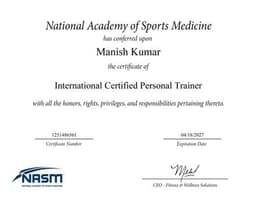
NASM Certified
Certified Personal Trainer & Sports Nutritionist from the National Academy of Sports Medicine
Disclaimer: This tool turns one lift into the other with equations from two studies. The answers describe the groups the studies tested and are not a prediction for you. It does not say what weight is safe for you, and it does not replace advice from a coach, a physician or another qualified professional.