
📐 ABSI Calculator
Calculate your A Body Shape Index to understand body composition beyond BMI using waist circumference
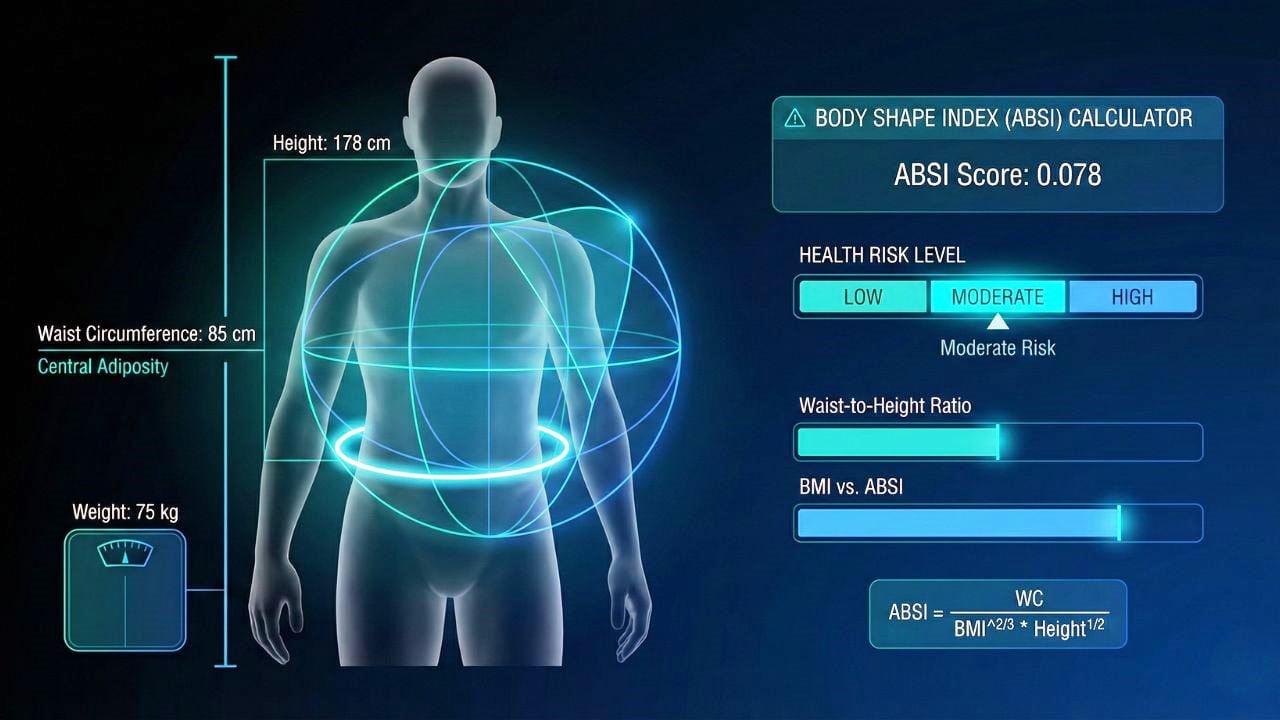
📊 Your ABSI Analysis
💡 Understanding Your Results
- ABSI measures abdominal fat distribution relative to your overall body size
- A lower ABSI indicates less central fat relative to your BMI and height
- The z-score compares you to population averages for your age and gender
- Regular physical activity can help improve body composition over time
- Combine ABSI with other metrics like waist-to-height ratio for a fuller picture
What is ABSI (A Body Shape Index)?
A Body Shape Index (ABSI) is a body composition metric developed by researchers Krakauer and Krakauer in 2012. Unlike BMI, which only considers weight and height, ABSI incorporates waist circumference to assess how fat is distributed around your midsection relative to your overall body size.
The key insight behind ABSI is that two people with identical BMI values can have very different body compositions. One might carry more weight around the abdomen, while another carries it elsewhere. ABSI helps quantify this difference by measuring whether your waist is larger or smaller than expected for someone of your height and BMI.
For a comprehensive approach to body composition, combine ABSI tracking with regular physical activity and strength training.
The ABSI Formula Explained
This calculator uses the original ABSI formula published in the peer-reviewed research:
Where:
- WC = Waist Circumference in meters
- BMI = Body Mass Index (kg/m²)
- Height = Height in meters
The z-score compares your ABSI to age and gender-matched population averages. A z-score of 0 means you’re exactly average, positive values indicate above-average abdominal size relative to body size, and negative values indicate below-average.
Person: Male | 30 years | 170 cm | 70 kg | 80 cm waist
Step 1 – BMI: 70 ÷ (1.70)² = 70 ÷ 2.89 = 24.22
Step 2 – Denominator: 24.22^0.667 × 1.70^0.5 = 8.37 × 1.30 = 10.92
Step 3 – ABSI: 0.80 ÷ 10.92 = 0.0733
Interpretation: This ABSI value (0.0733) is below the typical mean (~0.079) for a 30-year-old male, indicating a favorable waist size relative to body size.
ABSI Z-Score Interpretation
The ABSI z-score tells you how your body shape compares to others of similar age and gender:
| Z-Score Range | Category | Interpretation |
|---|---|---|
| Below -1.0 | Below Average | Less abdominal fat relative to body size |
| -1.0 to +1.0 | Average | Typical abdominal distribution for your profile |
| +1.0 to +2.0 | Above Average | More abdominal fat relative to body size |
| Above +2.0 | High | Significantly more abdominal fat relative to body size |
Remember that ABSI is just one metric. For a complete picture of fitness, consider tracking multiple measurements and focusing on core strengthening exercises and overall activity levels.
Why ABSI Matters Beyond BMI
BMI has long been criticized for its limitations—it doesn’t distinguish between muscle and fat, nor does it account for where fat is stored. ABSI addresses one of these gaps by specifically measuring abdominal fat distribution.
- Accounts for waist size: Two people with BMI 25 can have vastly different waist measurements
- Normalizes for body size: Adjusts expectations based on your height and BMI
- Age and gender specific: Z-scores compare you to appropriate reference groups
- Complements other metrics: Use alongside BMI, waist-to-height ratio, and body fat percentage
For improving body composition, combine regular leg workouts with back exercises for full-body development.
How to Measure Waist Circumference Correctly
Accurate waist measurement is crucial for a reliable ABSI calculation. Follow these steps:
- Stand upright with feet shoulder-width apart
- Locate your navel (belly button) level
- Wrap a flexible tape measure around your waist at navel height
- Keep the tape horizontal and snug but not compressing the skin
- Breathe normally and measure at the end of a normal exhale
- Measure on bare skin or over thin clothing for accuracy
For consistency, measure at the same time of day (morning is ideal) and under similar conditions each time you track your progress.
Comparing Body Composition Metrics
| Metric | What It Measures | Pros | Cons |
|---|---|---|---|
| BMI | Weight relative to height | Simple, widely used | Doesn’t distinguish fat vs muscle |
| ABSI | Waist size relative to BMI & height | Accounts for abdominal fat | Requires waist measurement |
| Waist-to-Height | Waist divided by height | Simple, intuitive | Doesn’t account for overall size |
| Body Fat % | Percentage of body that is fat | Most direct fat measure | Harder to measure accurately |
Learn more about body fat percentage and how it relates to fitness goals at Fit Life Regime.
Frequently Asked Questions
ABSI values typically range from about 0.07 to 0.09. However, the raw ABSI number is less meaningful than the z-score, which compares you to others of your age and gender. A z-score between -1 and +1 is considered average. Lower values (negative z-scores) indicate less abdominal fat relative to your body size, while higher values indicate more.
ABSI and BMI measure different things and are best used together. BMI tells you about overall weight relative to height, while ABSI specifically addresses abdominal fat distribution. Someone with a “normal” BMI could still have an elevated ABSI if they carry more weight around their midsection. For the most complete picture, track both metrics along with waist-to-height ratio.
Monthly measurements are sufficient for tracking changes over time. Body composition changes gradually, so more frequent measurements may show normal day-to-day fluctuations rather than meaningful trends. For best results, measure under consistent conditions—same time of day, similar hydration status, and using the same measurement technique.
Yes, regular exercise—particularly a combination of resistance training and cardiovascular activity—can improve body composition and reduce abdominal fat over time. This would lower your waist circumference relative to your overall body size, potentially improving your ABSI score. However, changes take time; expect to see meaningful differences over months rather than weeks.
The formula’s exponents (2/3 for BMI and 1/2 for height) were derived from large population studies to ensure ABSI is independent of BMI and height. This means your ABSI score reflects your waist size relative to what’s expected for someone of your body size—not just your absolute waist measurement. The mathematical complexity serves a purpose: it isolates the abdominal fat component from overall body size.
References

Manish is a NASM-certified fitness and nutrition coach with over 10 years of experience in weight lifting and fat loss fitness coaching. He specializes in gym-based training and has a lot of knowledge about exercise, lifting technique, biomechanics, and more.
Through “Fit Life Regime,” he generously shares the insights he’s gained over a decade in the field. His goal is to equip others with the knowledge to start their own fitness journey.