
If you’ve built a solid trap training routine around the standard barbell shrug, the behind-the-back version is worth knowing about — but it’s not the upgrade it’s sometimes marketed as.
It’s a narrower, more position-dependent tool: useful for some lifters, unnecessary or even uncomfortable for others. This guide walks through what it actually does to your trapezius muscles, what the research does and doesn’t support, and how to decide whether it belongs in your program.
The behind-the-back barbell shrug is a shrug variation where the bar sits behind your hips instead of in front of your thighs.
You hold it with a pronated (palms-back) grip, arms hanging straight down behind your body, then perform the same scapular-elevation motion as a traditional barbell shrug: shoulders straight up toward your ears, hold briefly, lower under control.
The mechanical difference is real but modest. Because your arms are positioned behind your torso, your shoulder blades start in a slightly more retracted (pulled-back) position than they do in a front shrug, where it’s easy to let the shoulders round forward before you even start the rep.
That’s the genuine benefit of this variation — not that it works “more muscle,” but that the bar position nudges your starting posture into a better place.
The trade-off is that holding a loaded bar behind your body puts your shoulder joint into extension, which most lifters can tolerate fine but some shoulder-sensitive lifters can’t — more on that below.
Know More: Best Upper Trap Exercises For Muscle Mass and Strength
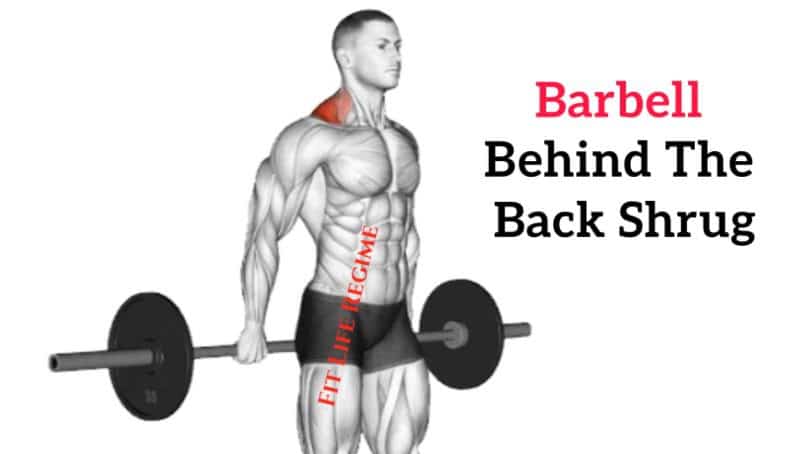
Barbell Behind the Back Shrug Muscles Worked
Behind-the-back barbell shoulder shrugs are a popular exercise for strengthening your upper back, shoulder muscles, neck, and upper arms too.
- The main muscles that barbell shrugs target are the upper traps,
- Other muscles worked are several other upper back muscles, including the middle traps, lower traps, and rhomboids.
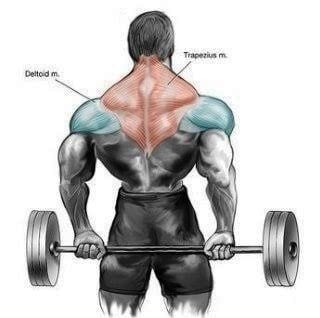
How To Do Behind the Back Shrug
- Stand with feet shoulder-width apart, knees slightly soft, and position the bar on the floor behind your heels.
- Bend at the hips, reach back, and grasp the bar with a pronated (palms-facing-back) grip, hands roughly shoulder-width apart.
- Drive through your legs to stand tall, letting the bar hang at arm’s length behind your glutes. Keep your elbows fully extended throughout, your arms are a hook, not a lever.
- Pull your ribcage down slightly, brace your core, and keep your chest up and spine neutral. Take a breath.
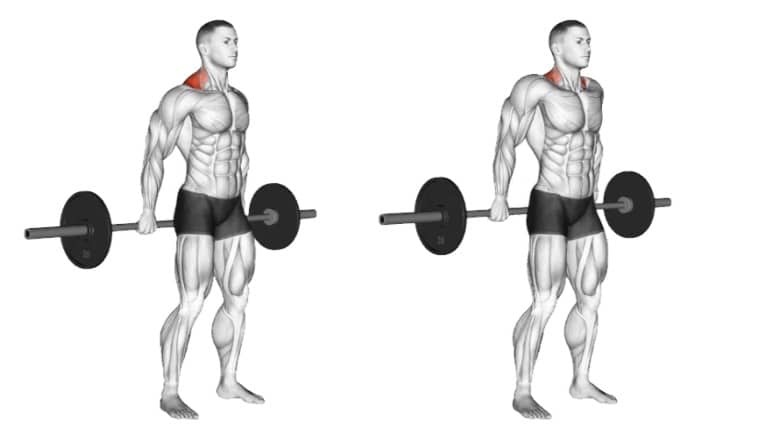
- Drive your shoulders straight up toward your ears, with a slight backward arc rather than a perfectly vertical line, this keeps more of the work on your traps rather than your levator scapulae.
- Hold the top contraction for one full second, squeezing your traps.
- Lower the bar back to the start over 2–3 seconds. Don’t let it drop that’s where the traction-injury risk described above comes in.
- Do 8–10 reps and 3–4 sets for hypertrophy.
Tips and Forms
- Do not roll your shoulders, which can lead to a shoulder injury.
- To avoid putting unnecessary stress on your lower back, please keep your back straight throughout the exercise.
- Don’t hunch Your Shoulders Forward. Focus on keeping your shoulders back and down.
- It’s important to start with a lighter weight and focus on proper form before increasing it. The use of too much weight can result in injury or limit your range of motion.
- Focus on lifting the weight with your traps and not with your biceps.
- Pausing at the top of the barbell shrug makes the exercise more challenging, and you’ll get more out of it.
- Back shrugs are not necessarily bad, but they can be potentially harmful if performed with improper form or excessive weight. It is important to use the correct technique, starting with lighter weights.

Manish is a NASM-certified fitness and nutrition coach with over 10 years of experience in weight lifting and fat loss fitness coaching. He specializes in gym-based training and has a lot of knowledge about exercise, lifting technique, biomechanics, and more.
Through “Fit Life Regime,” he generously shares the insights he’s gained over a decade in the field. His goal is to equip others with the knowledge to start their own fitness journey.