
🚴 Cycling Miles to Steps Calculator
Convert cycling miles to step equivalent based on intensity and speed. Calculate how many steps your bike ride equals using energy expenditure formulas validated by exercise science research.
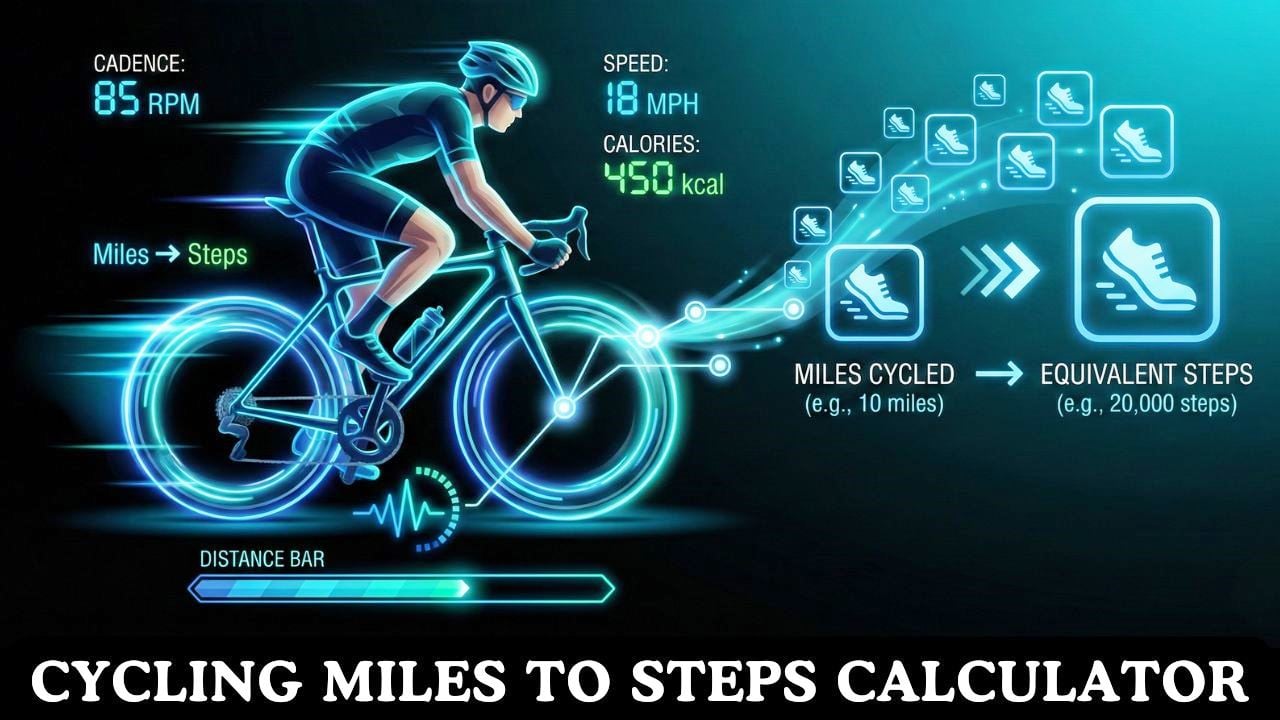
Understanding Cycling to Steps Conversion
Steps = 10 × 880 = 8,800 steps
(Equivalent to ~4.4 miles of walking)
Why Convert Cycling to Steps?
Many fitness trackers and health apps use daily step counts as a standard activity metric. However, cyclists often wonder
how their rides translate to step equivalents. While cycling and walking are different activities biomechanically, they
can be compared through energy expenditure—the amount of calories burned during each activity.
Critical Understanding: Bicycles are highly efficient machines. Due to wheels, gears, and momentum, cycling
1 mile requires only 25-35% of the energy needed to walk 1 mile. This is why the general rule is: 3-4 miles of cycling
equals 1 mile of walking in energy expenditure. A 10-mile moderate bike ride equals approximately 8,800 steps—less than
5 miles of walking—because the bike does much of the mechanical work for you.
Converting cycling to step equivalents allows unified activity tracking across different exercise modes. This is particularly
useful for daily activity goals, fitness app logging, and workplace wellness challenges. Learn more about step tracking with our
Steps Calculator.
Scientific Basis for Conversion
Energy Expenditure Equivalence: Conversion is based on matching the metabolic cost (calories burned) of
cycling to walking. Research shows that energy expenditure, not distance, creates the most accurate activity comparison.
Scientifically Validated Conversion Rates:
• Leisurely cycling (<10 mph): 1 mile ≈ 700 steps
• Moderate cycling (10-12 mph): 1 mile ≈ 880 steps
• Vigorous cycling (12-14 mph): 1 mile ≈ 1,050 steps
• Racing pace (14-16 mph): 1 mile ≈ 1,220 steps
• Very fast (>16 mph): 1 mile ≈ 1,400 steps
These ratios account for cycling’s mechanical efficiency—bicycles use wheels and momentum, requiring 70-80% less energy per mile
than walking. The general rule: 3-4 miles of cycling equals 1 mile of walking in energy expenditure. Higher intensity increases
the conversion factor because wind resistance grows exponentially with speed, requiring substantially more energy per mile at
faster paces. For comprehensive activity tracking, use our
Calories Burned Calculator.
Factors Affecting Conversion Accuracy
Cycling Intensity: The most significant factor. Faster, harder cycling requires more energy per mile, equaling
more steps. Easy spinning at 8 mph is very different from racing at 18 mph in energy cost.
Terrain: Hills dramatically increase energy expenditure. Climbing burns 30-50% more calories than flat riding
at the same speed. Our calculator applies terrain multipliers (flat: 1.0x, rolling hills: 1.15x, hilly: 1.30x) to account for
elevation changes.
Wind Resistance: Headwinds increase effort significantly, while tailwinds reduce it. Wind resistance becomes
the primary resistance factor above 12-15 mph. A strong headwind can double energy expenditure.
Body Weight: Heavier individuals burn more calories for the same activity. A 200-lb person burns ~30% more
calories cycling than a 150-lb person at identical intensity. However, the step equivalent remains similar because both the
cycling calories and walking calories scale proportionally with weight.
Bike Efficiency: Road bikes are more efficient than mountain bikes or cruisers. A mountain bike with knobby tires
on pavement might require 15-20% more energy per mile than a road bike, slightly increasing step equivalents. Tire pressure, bike
fit, and mechanical condition all affect energy required per mile. Track your cycling performance with our
Cycling Power Calculator.

Manish is a NASM-certified fitness and nutrition coach with over 10 years of experience in weight lifting and fat loss fitness coaching. He specializes in gym-based training and has a lot of knowledge about exercise, lifting technique, biomechanics, and more.
Through “Fit Life Regime,” he generously shares the insights he’s gained over a decade in the field. His goal is to equip others with the knowledge to start their own fitness journey.