
Daily Energy Requirements Calculator
Calculate your complete daily calorie needs using scientifically validated formulas for optimal health and fitness goals
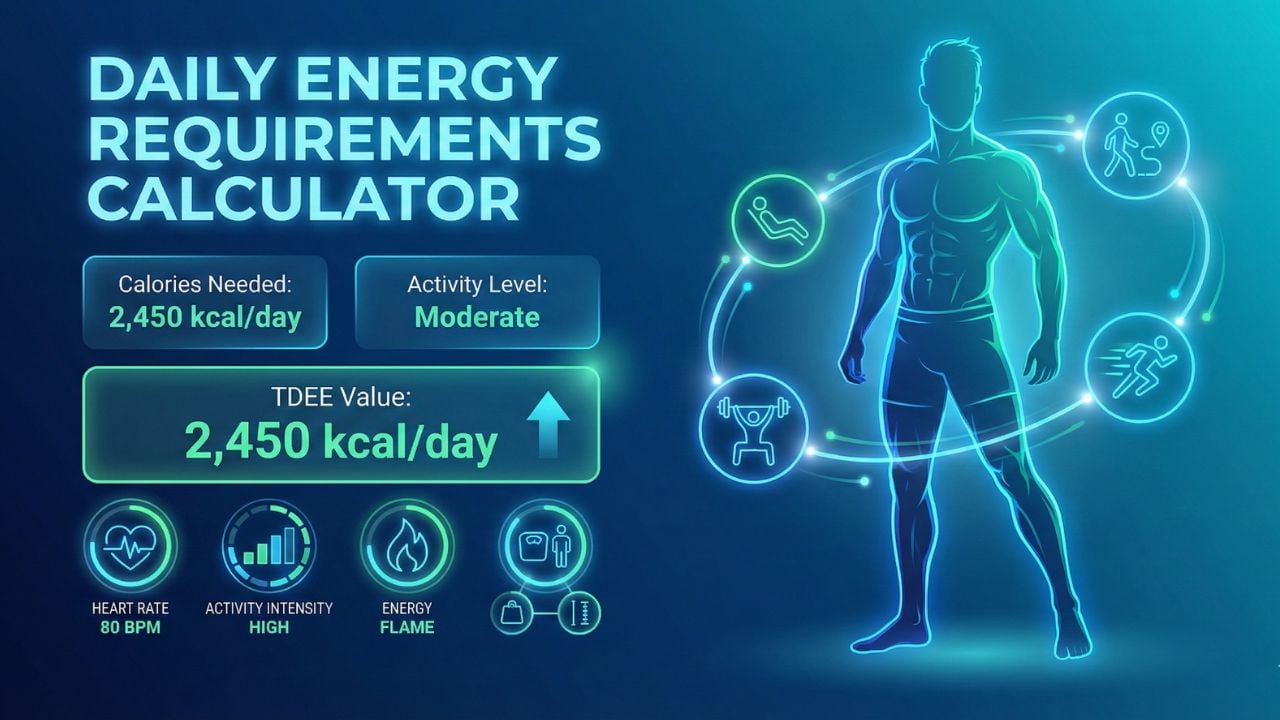
What Are Daily Energy Requirements?
Daily Energy Requirements (DER), also known as Total Daily Energy Expenditure (TDEE), represent the total calories your body needs each day to maintain health and fuel all activities. This includes your Basal Metabolic Rate (the calories burned at rest), physical activity, food digestion, and daily movement.
Unlike simple BMR calculations that only measure resting metabolism, DER provides a complete picture by accounting for all energy your body uses throughout the day. This makes it essential for accurate meal planning, weight management, and optimizing athletic performance.
Components of Daily Energy Requirements
Basal Metabolic Rate (50-70% of DER): The calories burned at complete rest for vital functions like breathing, circulation, and cell production. Your BMR depends on age, gender, body composition, and genetics.
Physical Activity (20-40% of DER): Calories burned during intentional exercise and sports. The higher your training intensity and frequency, the greater this component becomes.
Thermic Effect of Food (8-10% of DER): Energy used to digest, absorb, and process nutrients. Protein has the highest thermic effect (20-30%), followed by carbs (5-10%) and fats (0-3%).
Daily Movement (0-20% of DER): Calories burned during everyday activities like walking, typing, and maintaining posture. This varies significantly between sedentary and active jobs.
DER Calculation Methods
BMR: (10 × 80) + (6.25 × 180) – (5 × 30) + 5 = 1,780 calories
DER: 1,780 × 1.55 = 2,759 calories/day
The Mifflin-St Jeor equation is considered the most accurate for general populations, with ±10% accuracy. Widely used in clinical nutrition and fitness.
Lean Mass: 75 × (1 – 0.15) = 63.75 kg
BMR: 370 + (21.6 × 63.75) = 1,747 calories
DER: 1,747 × 1.55 = 2,708 calories/day
More accurate when body composition is known. Ideal for athletes and those tracking body fat percentage.
Choose the multiplier that best represents your average weekly activity. When in doubt, select the lower level and adjust based on results.
Daily Calorie Needs by Demographics
| Demographics | Sedentary | Lightly Active | Moderately Active | Very Active |
|---|---|---|---|---|
| Male, 20-30, 70kg | 2,100-2,300 cal | 2,400-2,600 cal | 2,700-2,900 cal | 3,000-3,200 cal |
| Female, 20-30, 60kg | 1,600-1,800 cal | 1,850-2,050 cal | 2,100-2,300 cal | 2,350-2,550 cal |
| Male, 30-40, 80kg | 2,200-2,400 cal | 2,500-2,700 cal | 2,800-3,000 cal | 3,100-3,300 cal |
| Female, 30-40, 65kg | 1,650-1,850 cal | 1,900-2,100 cal | 2,150-2,350 cal | 2,400-2,600 cal |
| Male, 40-50, 85kg | 2,250-2,450 cal | 2,550-2,750 cal | 2,850-3,050 cal | 3,150-3,350 cal |
| Female, 40-50, 70kg | 1,700-1,900 cal | 1,950-2,150 cal | 2,200-2,400 cal | 2,450-2,650 cal |
Note: Individual variations of ±300-500 calories are normal due to genetics, muscle mass, and metabolic efficiency. Use these as general guidelines and adjust based on personal results.
Factors Affecting Your Energy Needs
Age and Metabolism
Basal metabolic rate naturally declines by approximately 2-3% per decade after age 30, primarily due to muscle loss and hormonal changes. This means your DER decreases about 50-100 calories per decade unless you maintain muscle mass.
Counter age-related metabolic decline by maintaining an active lifestyle and preserving muscle through regular strength training. Muscle tissue burns more calories at rest than fat tissue.
Body Composition Impact
Your body composition significantly influences DER. Lean muscle burns approximately 6 calories per pound per day at rest, while fat tissue burns only 2 calories per pound per day. Two individuals of the same weight can have vastly different energy requirements based on their muscle-to-fat ratio.
Building and maintaining muscle through comprehensive training programs helps elevate your DER long-term.
Activity Level Assessment
Accurately assessing your activity level is crucial. Most people overestimate their activity, leading to overestimated calorie targets. Be honest about your average weekly activity—a desk job with 3 gym sessions per week typically qualifies as “Lightly Active,” not “Moderately Active.”
Consider both structured exercise and daily movement. Someone with an active job (construction, nursing, serving) burns significantly more calories than someone with a desk job, even if gym time is similar.
Common Questions About DER
How accurate are DER calculators?
DER calculators provide estimates with ±10-15% accuracy for most people. Individual variations exist due to genetics, metabolic efficiency, medications, hormones, and previous dieting history.
Use calculated DER as a starting point, then track your actual weight changes over 2-3 weeks. If results don’t match expectations, adjust intake by 100-200 calories and reassess. Your real-world results are the most accurate measure.
Should I recalculate my DER as weight changes?
Yes, recalculate your DER every 10-15 pounds of weight change. As body weight decreases, so does BMR and DER, since it requires less energy to maintain and move a lighter body. Conversely, gaining weight increases energy requirements.
Also reassess your activity multiplier if training volume or daily activity levels change significantly. New jobs, training frequency changes, or lifestyle shifts all warrant DER recalculation.
What’s the difference between DER, TDEE, and BMR?
BMR (Basal Metabolic Rate) represents calories burned at complete rest for basic functions. TDEE (Total Daily Energy Expenditure) and DER (Daily Energy Requirements) are essentially the same—both represent your complete daily calorie needs.
The terms TDEE and DER are used interchangeably. Both are calculated by multiplying BMR by an activity factor. Our calculator uses validated equations to provide your complete daily energy requirements.
Related Fitness Tools
Complete Your Fitness Planning
Optimize your fitness journey with related tools and guides. Check your body fat percentage to better understand your composition, or use visual body fat assessment for comparison.
For training programs, explore our guides on back development, shoulder training, and arm workouts to complement your nutrition plan.
⚕️ Medical Disclaimer
This Daily Energy Requirements calculator provides estimates based on scientifically validated equations for educational purposes only. Results do not constitute medical advice. Individual energy requirements vary significantly due to genetics, medical conditions, medications, hormones, metabolic efficiency, and dieting history. The calculated DER represents population averages and may not reflect your individual rate. Consult healthcare professionals, registered dietitians, or certified nutritionists before making significant dietary changes, especially if you have pre-existing health conditions, eating disorders, or metabolic disorders. Extreme caloric restriction without medical supervision can lead to nutritional deficiencies, muscle loss, and hormonal disruption. Prioritize long-term health over rapid results.

Manish is a NASM-certified fitness and nutrition coach with over 10 years of experience in weight lifting and fat loss fitness coaching. He specializes in gym-based training and has a lot of knowledge about exercise, lifting technique, biomechanics, and more.
Through “Fit Life Regime,” he generously shares the insights he’s gained over a decade in the field. His goal is to equip others with the knowledge to start their own fitness journey.