
📏 Hand Size to Height Calculator
Estimate your height from hand measurements using forensic anthropometry formulas. Predict height from hand length and span with scientifically validated regression equations.
Understanding Height Estimation from Hand Size
Height = 93.35 + (3.90 × 19) = 93.35 + 74.10 = 167.45 cm (5’6″)
Scientific Basis of Hand-to-Height Estimation
Forensic anthropologists have developed regression equations to estimate height from skeletal measurements, including
hand dimensions. These formulas are based on large population studies showing strong positive correlation (r = 0.75-0.85)
between hand length and overall height. The relationship exists because both dimensions are controlled by similar genetic
and developmental factors during growth.
Height estimation from hand measurements has practical applications in forensic identification, anthropological research,
and ergonomic design. The standard error of ±4-5 cm (1.6-2 inches) makes these formulas useful for general estimation but
not precise enough for individual medical assessment. Gender-specific formulas improve accuracy as males and females have
different average body proportions. Compare your measurements with our
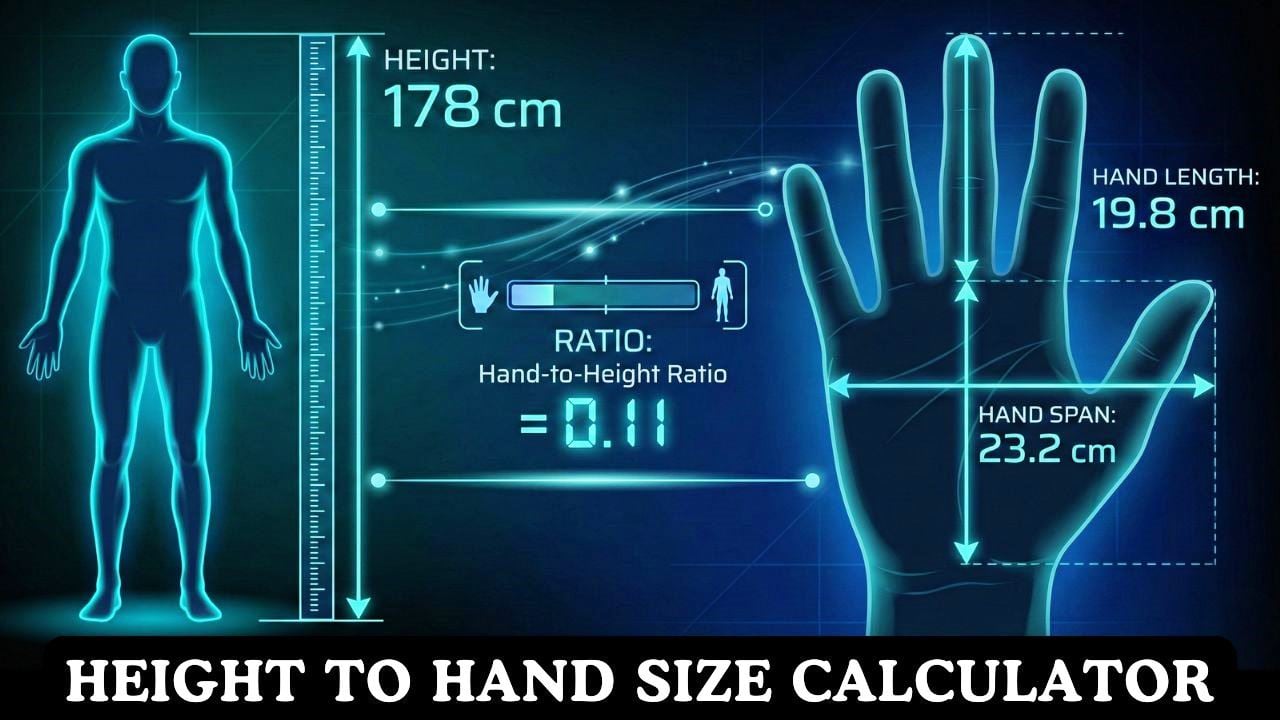
Height to Hand Size Calculator.
How Accurate Are Hand-Based Height Predictions?
Typical Accuracy: ±4-5 cm (1.6-2 inches) standard error
Correlation Strength: r = 0.75-0.85 (strong positive correlation)
Success Rate: ~70% of estimates within ±5 cm of actual height
While hand size provides a reasonable height estimate, individual variation exists due to genetics, ethnicity, and body
proportions. Some people have longer hands relative to their height, while others have shorter hands. Factors affecting
accuracy include measurement precision, age (growth status), ethnicity-specific proportions, and individual genetic variation.
When It’s Most Accurate: Adult populations (growth complete), similar ethnicity to reference population,
accurate hand measurements, average body proportions. When It’s Less Accurate: Children and adolescents
(still growing), mixed ethnic backgrounds, extreme body proportions, measurement errors. Track your body measurements with our
Body Measurement Tracker.
Factors Affecting Height-Hand Relationship
Genetic Influences
Polygenic Inheritance: Both height and hand size are controlled by hundreds of genes, creating complex
inheritance patterns. While generally correlated, specific gene combinations can produce tall individuals with relatively
small hands or vice versa.
Growth Patterns: Different body parts grow at different rates during development. Hands may experience growth
spurts at different times than overall height, creating temporary proportion imbalances that normalize by adulthood. Final adult
proportions reflect the cumulative effect of multiple growth periods.
Ethnic Variation: Different populations show varying average hand-to-height ratios. Asian populations tend to
have slightly shorter hands relative to height, while African populations often have relatively longer extremities. These
differences reflect evolutionary adaptations to different climates and environments. For body composition analysis, use our
Body Fat Calculator.
Environmental & Developmental Factors
Nutrition During Growth: Adequate nutrition during childhood and adolescence affects both height and extremity
development. Malnutrition can stunt overall growth more than hand development, potentially affecting adult proportions. Protein,
calcium, and micronutrients are critical for optimal skeletal development.
Hormonal Influences: Growth hormone, thyroid hormones, and sex hormones (testosterone, estrogen) regulate bone
growth during development. Hormonal imbalances or variations in hormone sensitivity can create proportion differences. Puberty
timing affects final height more than hand size in some individuals.
Health Conditions: Certain medical conditions affect growth patterns. Marfan syndrome causes disproportionately
long limbs and fingers. Achondroplasia affects long bone growth more than hand development. Most people have no such conditions,
but they illustrate how specific factors can uncouple the height-hand relationship.

Manish is a NASM-certified fitness and nutrition coach with over 10 years of experience in weight lifting and fat loss fitness coaching. He specializes in gym-based training and has a lot of knowledge about exercise, lifting technique, biomechanics, and more.
Through “Fit Life Regime,” he generously shares the insights he’s gained over a decade in the field. His goal is to equip others with the knowledge to start their own fitness journey.