
📏 Height to Hand Size Calculator
Calculate expected hand dimensions based on your height using scientifically validated anthropometric formulas. Compare your actual hand size to population averages and discover your hand proportion percentile.
Understanding Height to Hand Size Correlation
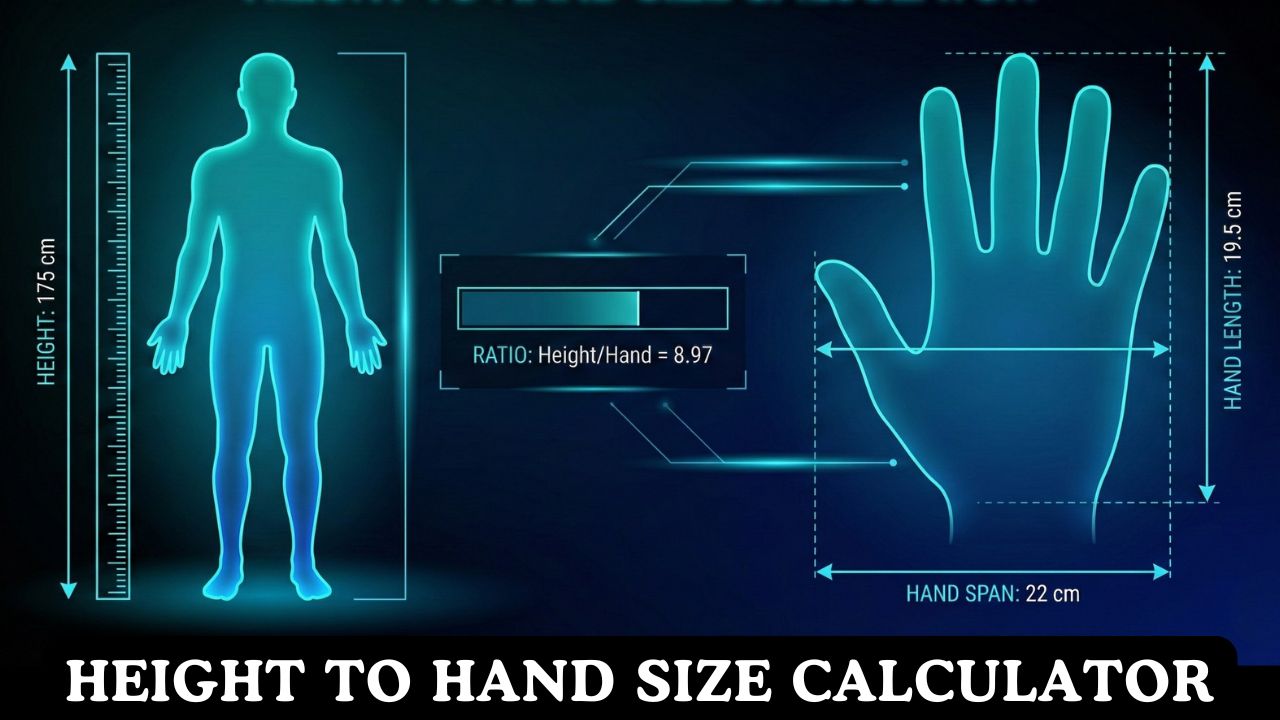
Expected Hand Length = 175 × 0.107 = 18.7 cm (7.4 inches)
Expected Hand Span = 175 × 0.122 = 21.4 cm (8.4 inches)
Scientific Foundation of Hand-Height Relationship
Anthropometric research consistently demonstrates a strong positive correlation (r = 0.80-0.85) between height and hand
dimensions. This relationship exists because both measurements are influenced by similar genetic factors, growth hormones,
and developmental patterns. Hand length typically represents 10.5-11% of total height, while hand span represents 12-13%
of height across diverse populations.
This correlation has practical applications in forensic anthropology (height estimation from skeletal remains), ergonomic
design (equipment sizing), sports performance analysis, and medical assessment. The relationship remains relatively consistent
across different ethnic groups, though minor variations exist. Understanding your hand-to-height ratio helps contextualize
body proportions and identify whether your hands are proportionally larger, smaller, or average for your height. Compare
with our Ape Index Calculator.
How to Measure Your Hands Accurately
Hand Length Measurement Protocol:
1. Positioning: Place your hand flat on a table with palm facing up
2. Starting Point: The prominent wrist crease where hand meets wrist (proximal wrist crease)
3. Ending Point: The tip of your middle finger (longest finger when extended)
4. Tool: Use a rigid ruler for straight-line measurement (not flexible measuring tape)
5. Accuracy: Measure 2-3 times and average the results for precision
Hand Span Measurement Protocol:
1. Positioning: Place hand flat on table with fingers spread to maximum comfortable width
2. Starting Point: The tip of your thumb
3. Ending Point: The tip of your pinky (little finger)
4. Spread: Stretch fingers apart maximally without forcing or causing discomfort
5. Measurement: Measure the straight-line distance between thumb and pinky tips
Important Tips: Measure at consistent times (hands can swell during day), use metric measurements (cm)
for precision, ensure fingers are fully extended but not hyperextended, and maintain consistent positioning across
measurements. Track measurements with our
Body Measurement Tracker.
Gender Differences in Hand Proportions
Male Hand Characteristics:
• Hand Length: Typically 18.5-19.5 cm (7.3-7.7 inches) for average height (175cm/5’9″)
• Hand Span: Typically 21-23 cm (8.3-9.1 inches)
• Hand-to-Height Ratio: ~10.9% for length, ~12.5% for span
• Palm Width: Proportionally wider relative to length
Female Hand Characteristics:
• Hand Length: Typically 17-18 cm (6.7-7.1 inches) for average height (162cm/5’4″)
• Hand Span: Typically 19-21 cm (7.5-8.3 inches)
• Hand-to-Height Ratio: ~10.5% for length, ~11.9% for span
• Palm Width: Proportionally narrower relative to length
These differences reflect sexual dimorphism in skeletal development influenced by hormones (testosterone vs estrogen) during
puberty. Males develop proportionally larger hands relative to height, with greater grip strength despite similar hand-to-height
ratios. However, individual variation within genders exceeds the average difference between genders. For comprehensive body
analysis, use our Body Fat Calculator.
Hand Size and Athletic Performance
Sports Advantages of Larger Hands
Basketball: NBA players average 21.6-22.3cm hand lengths (8.5-8.8 inches), notably above the population average
of 19cm. Larger hands provide superior ball control, easier palming, improved one-handed catches, better rebounding, and
enhanced shooting control. Elite players like Michael Jordan (24.8cm/9.75″) and Kawhi Leonard (24.8cm/9.75″) have exceptionally
large hands that provide significant advantages, though skill development remains paramount.
Rock Climbing: Extended reach allows climbers to skip intermediate holds, reduce dynamic movements, access
diverse grip positions, and increase crimp surface area. Elite climbers often have spans exceeding 22cm, providing significant
advantages on long reaches. However, technique, finger strength, and body positioning matter more than raw hand size.
American Football (Quarterback): NFL combines measure hand span as a key metric. Quarterbacks with 24cm+ spans
(9.5+ inches) show better ball security in adverse weather, improved grip strength, and enhanced throwing control. Successful
QBs range from 22-27cm spans, with larger hands correlating with reduced fumble rates, though proper technique and ball security
fundamentals matter most.
Swimming: Larger hands increase propulsion surface area, improving efficiency per stroke. However, proper technique,
body position, and conditioning provide greater performance benefits. Many Olympic swimmers have average hand sizes. Improve
performance with our VO2 Max Calculator.
Sports Benefits of Smaller/Proportional Hands
Gymnastics: Compact hands provide superior body control, faster rotation speeds, reduced torque requirements,
and easier apparatus grip. Shorter lever arms allow quicker movements and better balance. Elite gymnasts typically have hands
in the average-to-small range for their height, demonstrating this advantage.
Precision Sports: Golf, darts, archery, and shooting sports rely on fine motor control independent of hand size.
Smaller hands often demonstrate excellent precision in delicate movements. Equipment can be customized to fit any hand size,
eliminating size-based disadvantages.
Endurance Running: Running economy, biomechanics, and cardiovascular fitness matter infinitely more than hand
dimensions. Hand size shows no correlation with running performance. Elite marathoners range from very small to very large hands
without performance differences.
Combat Sports: Boxing, MMA, and martial arts value speed, technique, and conditioning over hand size. Many champions
have average or below-average hand dimensions, emphasizing skill development. Hand wrapping and glove selection accommodate all
hand sizes equally. Train with our
HIIT Workout Plan.

Manish is a NASM-certified fitness and nutrition coach with over 10 years of experience in weight lifting and fat loss fitness coaching. He specializes in gym-based training and has a lot of knowledge about exercise, lifting technique, biomechanics, and more.
Through “Fit Life Regime,” he generously shares the insights he’s gained over a decade in the field. His goal is to equip others with the knowledge to start their own fitness journey.