
Karvonen Heart Rate Calculator
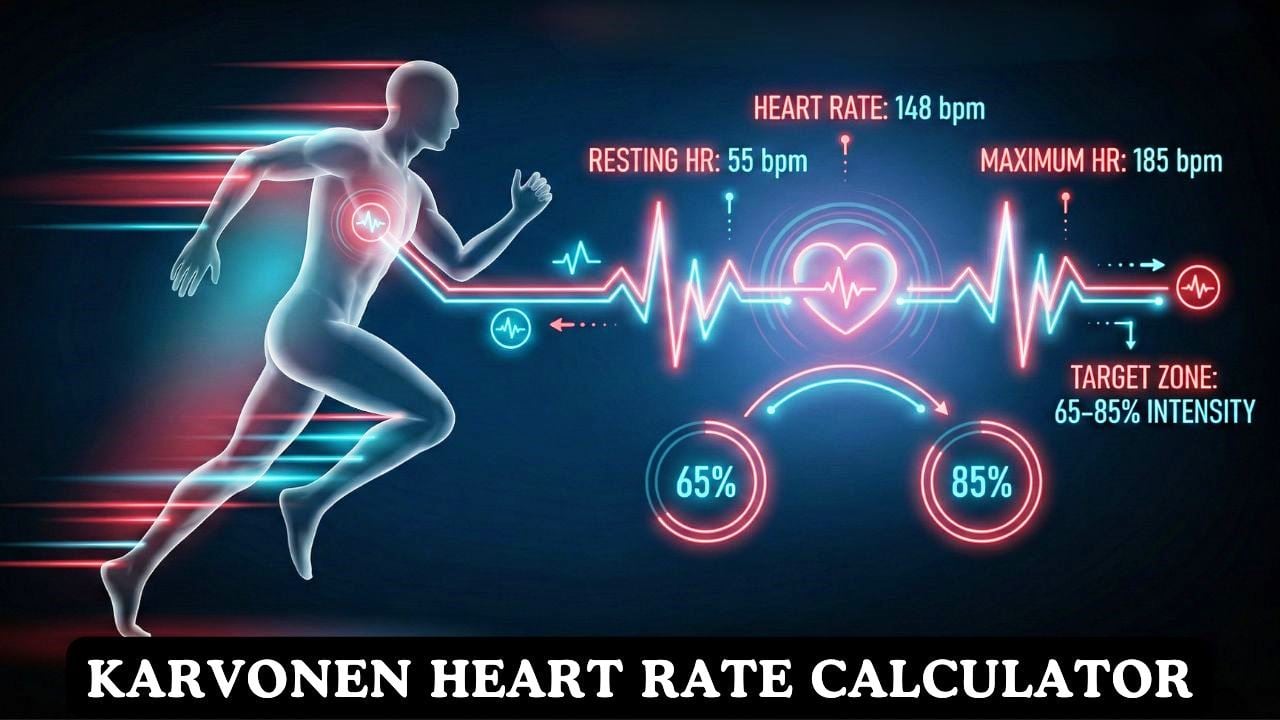
What is the Karvonen Heart Rate Formula?
The Karvonen Formula, developed by Finnish physiologist Martti Karvonen in 1957, is the most accurate method for calculating personalized training heart rate zones. Unlike simple age-based formulas that only use maximum heart rate, the Karvonen method incorporates your resting heart rate to account for individual cardiovascular fitness levels.
This individualized approach makes the Karvonen Formula superior for athletes, fitness enthusiasts, and anyone seeking precise training guidance. A fit person with a resting heart rate of 50 bpm will have different training zones than someone with the same age but a resting heart rate of 75 bpm—the Karvonen Formula accurately reflects this difference.
Target HR = ((Max HR – Resting HR) × %Intensity) + Resting HR
Where Max HR = 220 – Age
Heart Rate Reserve (HRR) = Max HR – Resting HR
Age: 30 years | Resting HR: 60 bpm | Target Intensity: 70%
Step 1: Max HR = 220 – 30 = 190 bpm
Step 2: HR Reserve = 190 – 60 = 130 bpm
Step 3: Target HR = (130 × 0.70) + 60 = 91 + 60 = 151 bpm
Result: Train at 151 bpm for 70% intensity (aerobic zone)
The formula is scientifically validated and widely used by sports physiologists, personal trainers, and medical professionals for cardiovascular training prescription. Research has shown the Karvonen method provides more accurate intensity prescriptions than the simpler percentage of maximum heart rate approach.
Why Heart Rate Reserve Matters
Heart Rate Reserve (HRR) represents your heart’s working capacity—the difference between your maximum and resting heart rates. This metric is crucial because it reflects your cardiovascular fitness and adaptation potential.
Someone with a large heart rate reserve (e.g., max HR 190, resting HR 45 = 145 bpm reserve) typically has excellent cardiovascular fitness. Their heart pumps more blood per beat at rest, requiring fewer beats per minute. Conversely, a smaller reserve indicates room for improvement through consistent aerobic training.
The Karvonen Formula’s use of HRR means your training zones automatically adjust as your fitness improves. As your resting heart rate decreases with training (a sign of improved cardiovascular efficiency), your target training heart rates will appropriately adjust upward within each intensity zone.
The Five Essential Training Zones
Heart rate training zones represent different metabolic states and training adaptations. Understanding these zones helps optimize your workouts for specific goals:
| Zone | % HRR | Primary Fuel | Training Benefit | Duration |
|---|---|---|---|---|
| Recovery (50-60%) | 50-60% | Fat (85%) | Active recovery, blood flow | 20-60 min |
| Fat Burn (60-70%) | 60-70% | Fat (70%) | Aerobic base, fat oxidation | 30-90 min |
| Aerobic (70-80%) | 70-80% | Carbs (55%) | Cardiovascular fitness, endurance | 20-60 min |
| Anaerobic (80-90%) | 80-90% | Carbs (85%) | Lactate threshold, speed | 2-20 min |
| Maximum (90-100%) | 90-100% | Carbs (95%) | Peak power, VO2max | 30 sec – 5 min |
Most athletes should spend approximately 80% of training time in Recovery, Fat Burn, and Aerobic zones (50-80% HRR), with only 20% in higher intensity zones. This 80/20 principle, supported by research on elite endurance athletes, prevents overtraining while building a solid aerobic foundation.
How to Measure Resting Heart Rate Accurately
The Correct Measurement Protocol
Accurate resting heart rate measurement is essential for the Karvonen Formula to work effectively. Your resting heart rate represents your heart’s baseline efficiency and must be measured under specific conditions:
Step-by-Step Measurement:
- Timing: Measure first thing in the morning, immediately upon waking, before getting out of bed
- Position: Remain lying down in a comfortable position for the measurement
- Method: Use two fingers (index and middle) on your radial artery (wrist) or carotid artery (neck), count beats for 60 seconds
- Consistency: Measure at the same time for 3 consecutive days and calculate the average
- Conditions: Ensure adequate sleep (7-8 hours), no alcohol previous night, not sick or stressed
Modern fitness trackers and smartwatches provide continuous resting heart rate monitoring and can automatically detect your lowest heart rate during sleep, offering an even more accurate baseline measurement.
What Your Resting Heart Rate Reveals
Resting heart rate is a powerful indicator of cardiovascular fitness and overall health status:
| Category | Men (bpm) | Women (bpm) | Fitness Level |
|---|---|---|---|
| Athlete | 40-50 | 45-55 | Elite cardiovascular fitness |
| Excellent | 50-60 | 55-65 | Above average fitness |
| Good | 60-70 | 65-75 | Average fitness |
| Fair | 70-80 | 75-85 | Below average fitness |
| Poor | 80+ | 85+ | Significant room for improvement |
As you engage in regular cardiovascular training, your resting heart rate typically decreases by 5-15 beats per minute over several months. This adaptation reflects improved cardiac stroke volume—your heart pumps more blood per beat, requiring fewer beats per minute at rest.
References
- Karvonen, M.J., Kentala, E., & Mustala, O. (1957). “The effects of training on heart rate: a longitudinal study.” Annales Medicinae Experimentalis et Biologiae Fenniae.
- Seiler, S. (2010). “What is best practice for training intensity and duration distribution in endurance athletes?” International Journal of Sports Physiology and Performance.
- Laursen, P.B. & Buchheit, M. (2019). “Science and Application of High-Intensity Interval Training.” Human Kinetics.
- Coggan, A.R. & Allen, H. (2019). “Training and Racing with a Power Meter.” 3rd Edition, VeloPress.

Manish is a NASM-certified fitness and nutrition coach with over 10 years of experience in weight lifting and fat loss fitness coaching. He specializes in gym-based training and has a lot of knowledge about exercise, lifting technique, biomechanics, and more.
Through “Fit Life Regime,” he generously shares the insights he’s gained over a decade in the field. His goal is to equip others with the knowledge to start their own fitness journey.