
🧗 Rock Climbing Calories Burned Calculator
Calculate energy expenditure during rock climbing using scientifically validated MET values based on difficulty and style
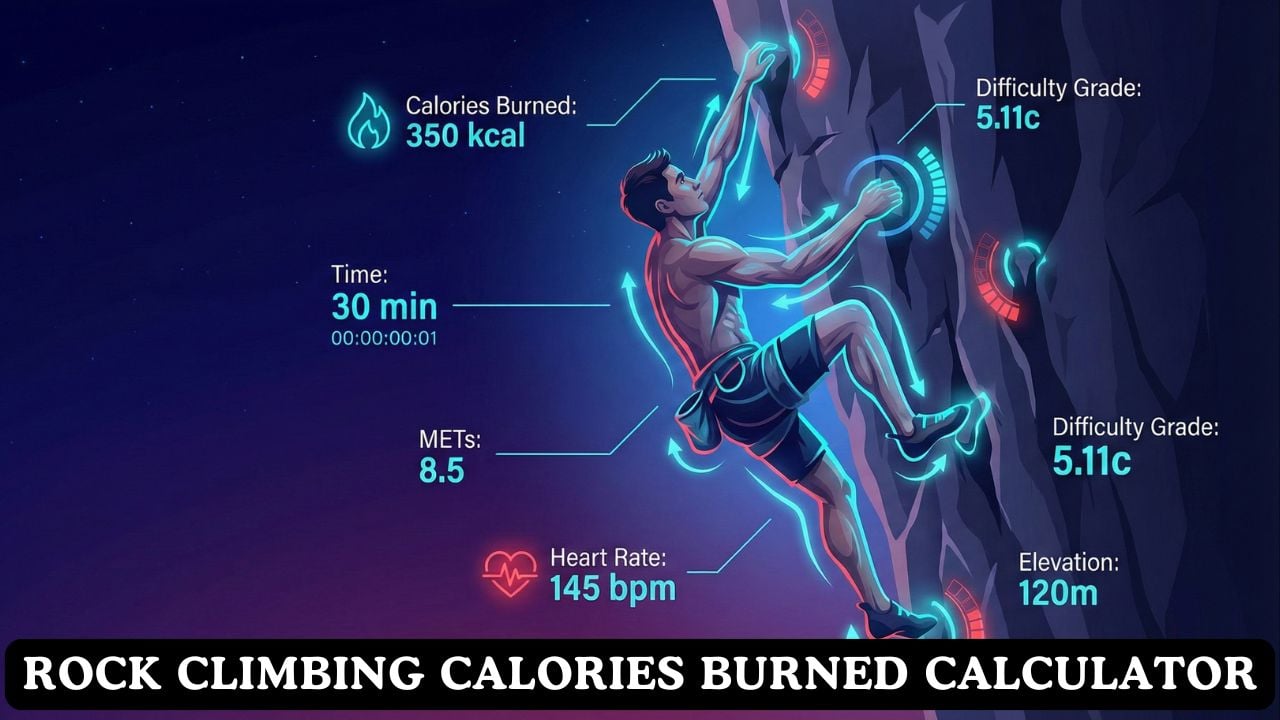
How Many Calories Does Rock Climbing Burn?
Calorie Burn During Rock Climbing: What to Expect
Rock climbing burns approximately 8-12 calories per minute for a 155 lb (70 kg) person at moderate-to-hard difficulty (5.10-5.12 grades), making it one of the most complete full-body workouts available. A typical 60-minute gym climbing session burns 400-600 calories while simultaneously building strength, endurance, flexibility, and mental focus.
Research shows rock climbing provides exceptional fitness benefits: 500-750+ calories per hour depending on difficulty, wall angle, and climbing style. Unlike traditional cardio, climbing engages nearly every major muscle group—fingers, forearms, biceps, shoulders, back, core, legs—creating high metabolic demand through sustained isometric contractions and dynamic movements.
Calories = (MET × 3.5 × Body Weight in kg ÷ 200) × Duration in minutes
Adjusted MET = 8.0 × 0.75 (rest factor) = 6.0 MET effective
Calories = (6.0 × 3.5 × 73 ÷ 200) × 45 = 344 calories burned
Climbing’s unique advantage is simultaneous development of strength, power, endurance, and problem-solving skills. The complex movements require coordination, balance, and spatial awareness impossible to replicate with traditional gym exercises. This mental engagement increases calorie burn through heightened focus and stress hormone release. Learn more about functional fitness benefits.
Calories Burned by Difficulty & Duration
Climbing difficulty (grade) is the primary determinant of calorie burn. Here’s comprehensive data for a 155 lb (70 kg) person across different session lengths:
| Difficulty Level | Grades | MET | 30 Min | 60 Min | 90 Min |
|---|---|---|---|---|---|
| Beginner | 5.6-5.8 / V0-V1 | 5.0 | 154 cal | 307 cal | 461 cal |
| Easy-Moderate | 5.9-5.10a / V2 | 6.5 | 200 cal | 399 cal | 599 cal |
| Moderate | 5.10b-5.11a / V3-V4 | 8.0 | 246 cal | 492 cal | 738 cal |
| Hard | 5.11b-5.12a / V5-V6 | 9.5 | 292 cal | 584 cal | 876 cal |
| Very Hard | 5.12b-5.13a / V7-V9 | 11.0 | 338 cal | 676 cal | 1014 cal |
| Elite | 5.13b+ / V10+ | 12.5 | 384 cal | 769 cal | 1153 cal |
Table Methodology: Values assume 15-20% rest time (typical gym climbing pattern with route reading, belaying, transitions). Use calculator above for custom rest ratios. Elite climbing (5.13+) burns 150% more calories than beginner climbing due to sustained finger strength requirements. A typical intermediate climber (1-3 years) averages 5.10-5.11 grades, burning ~500 calories per hour. Track your progress with our Grip Strength Test.
Calories Burned by Climbing Style
Climbing style significantly affects calorie burn through intensity patterns and rest periods. Here’s a 60-minute comparison for a 155 lb person at moderate difficulty (8.0 base MET):
| Climbing Style | Active Time | Rest Time | Calories/Hour | Key Characteristic |
|---|---|---|---|---|
| Bouldering (Outdoor) | 20-25 min | 35-40 min | 550-650 cal | Max intensity, short bursts |
| Bouldering (Gym) | 25-30 min | 30-35 min | 520-600 cal | High intensity, power moves |
| Sport Climbing (Outdoor) | 30-35 min | 25-30 min | 490-560 cal | Moderate-high sustained effort |
| Sport Climbing (Gym) | 35-40 min | 20-25 min | 460-520 cal | Steady pace, volume focus |
| Top Rope (Gym) | 40-45 min | 15-20 min | 420-480 cal | Continuous, lower intensity |
Style Strategy: Bouldering burns most calories per active minute (12-15 cal/min) but involves significant rest. Top rope provides sustained effort with less rest. Optimal fitness approach: 2× weekly bouldering for power/strength, 1× weekly route climbing for endurance. Design your program with our Climbing Training Guide.
Rock Climbing vs. Other Cardio & Strength Activities
How does rock climbing compare to traditional cardio and strength training for calorie burn? Here’s a 60-minute comparison for a 155 lb person:
| Activity | MET Value | Calories (Hour) | Strength Benefit | Cardio Benefit |
|---|---|---|---|---|
| Running (7 mph) | 11.0 | 676 cal | Low | Excellent |
| Rock Climbing (Hard) | 9.5 | 584 cal | Excellent | Good-Excellent |
| Rock Climbing (Moderate) | 8.0 | 492 cal | Excellent | Good |
| Swimming (Vigorous) | 10.0 | 615 cal | Moderate | Excellent |
| Weight Training (Vigorous) | 6.0 | 369 cal | Excellent | Low |
| Cycling (14-16 mph) | 10.0 | 615 cal | Low-Moderate | Excellent |
Unique Advantages: Rock climbing is the only activity providing excellent strength AND good-to-excellent cardiovascular benefits simultaneously. The combination of sustained isometric holds (forearms, core) and dynamic movements (legs, pulling) creates comprehensive fitness development impossible with single-focus training. Plus mental engagement and problem-solving add cognitive benefits.

Manish is a NASM-certified fitness and nutrition coach with over 10 years of experience in weight lifting and fat loss fitness coaching. He specializes in gym-based training and has a lot of knowledge about exercise, lifting technique, biomechanics, and more.
Through “Fit Life Regime,” he generously shares the insights he’s gained over a decade in the field. His goal is to equip others with the knowledge to start their own fitness journey.