
6 Minute Walk Test Calculator
Evaluate your cardiovascular fitness and functional exercise capacity with clinically validated 6MWT prediction equations
What Is the 6 Minute Walk Test?
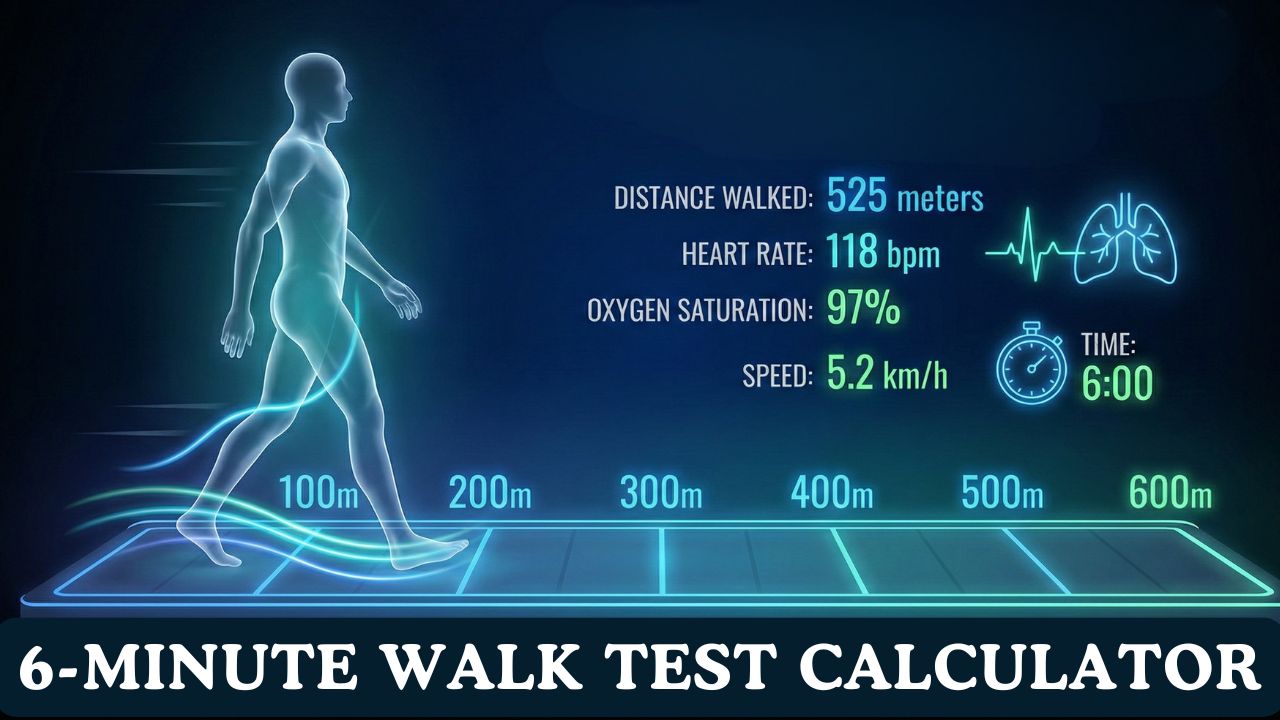
The 6-Minute Walk Test (6MWT) measures the distance you can walk quickly on a flat surface in six minutes. This simple yet powerful assessment evaluates your functional exercise capacity and cardiovascular fitness without expensive equipment or complex procedures.
Healthcare professionals use the 6MWT to assess patients with heart disease, lung conditions, and other chronic illnesses. It provides valuable information about your ability to perform daily activities and helps track fitness improvements over time.
How to Perform the 6 Minute Walk Test
Mark a flat, straight course of at least 30 meters (100 feet) indoors, such as a hallway or corridor. The American Thoracic Society guidelines recommend using cones to mark the turnaround points. Walk back and forth at your own pace for exactly 6 minutes, aiming to cover as much distance as possible. You may slow down or rest against a wall if needed, but continue walking as soon as you’re able.
Avoid talking during the test and walk at a pace you can sustain for the full duration. Wear comfortable walking shoes and use your usual walking aids if necessary. The total distance is measured in meters by counting laps and adding the partial distance. For safety, always perform the test with supervision if you have known cardiovascular or respiratory conditions, or are starting from a sedentary baseline. Consider integrating this assessment with your regular leg training routine.
Prediction Equations and Calculations
Enright & Sherrill Reference Equations
Our calculator uses the validated Enright and Sherrill (1998) reference equations, developed from studying 290 healthy adults aged 40-80 years. Published in the American Journal of Respiratory and Critical Care Medicine, these equations account for age, gender, height, and weight to predict your expected walking distance with approximately 40% variance explanation.
Calculation: (7.57 × 175) – (5.02 × 50) – (1.76 × 80) – 309
Result: 1324.75 – 251 – 140.8 – 309 = 624 meters predicted
Lower Limit: 624 – 153 = 471 meters minimum normal
Interpreting Your Results
Compare your actual distance walked to the predicted value and lower limit of normal (derived from 95% confidence intervals). Walking at or above the lower limit indicates adequate functional capacity for your age and demographics. Distances significantly below this threshold suggest reduced exercise tolerance that may warrant further medical evaluation and assessment.
Results at or above 100% of predicted indicate cardiovascular fitness consistent with or better than the reference population average. Regular aerobic exercise , progressive walking programs, and well-structured strength training can improve your 6MWT performance over 8–12 weeks.
For individuals incorporating resistance training to enhance lower-body strength and walking economy, using accurate loading is essential. Tools like MyBarbellPlates help ensure precise barbell weight calculations, supporting safer and more effective strength progression alongside cardiovascular conditioning.
Related Fitness Assessment Tools
Complete Your Fitness Evaluation
Complement your 6MWT results with comprehensive fitness assessments. Monitor your body composition to understand how weight affects walking performance. Explore back strengthening and chest exercises to build the postural endurance needed for optimal walking mechanics.
This 6 Minute Walk Test calculator provides estimates based on validated reference equations for healthy adults. Results are for educational and informational purposes only and should not replace professional medical assessment or supervised testing.
The 6MWT should be performed under medical supervision if you have known cardiovascular disease, respiratory conditions, or have been sedentary. Consult a physician before performing the test if you experience chest pain, severe shortness of breath, dizziness, or other concerning symptoms with exertion.
Predicted values are based on population averages and may not account for individual variations, ethnic differences, or specific medical conditions. Clinical interpretation requires consideration of symptoms, medical history, and other diagnostic tests. Always seek professional medical advice for health concerns or fitness program planning.

Manish is a NASM-certified fitness and nutrition coach with over 10 years of experience in weight lifting and fat loss fitness coaching. He specializes in gym-based training and has a lot of knowledge about exercise, lifting technique, biomechanics, and more.
Through “Fit Life Regime,” he generously shares the insights he’s gained over a decade in the field. His goal is to equip others with the knowledge to start their own fitness journey.