
🩺 Ankle Brachial Index (ABI) Calculator
Calculate your Ankle Brachial Index to screen for peripheral artery disease (PAD). This non-invasive test compares blood pressure in your ankles and arms to assess cardiovascular health and circulation.
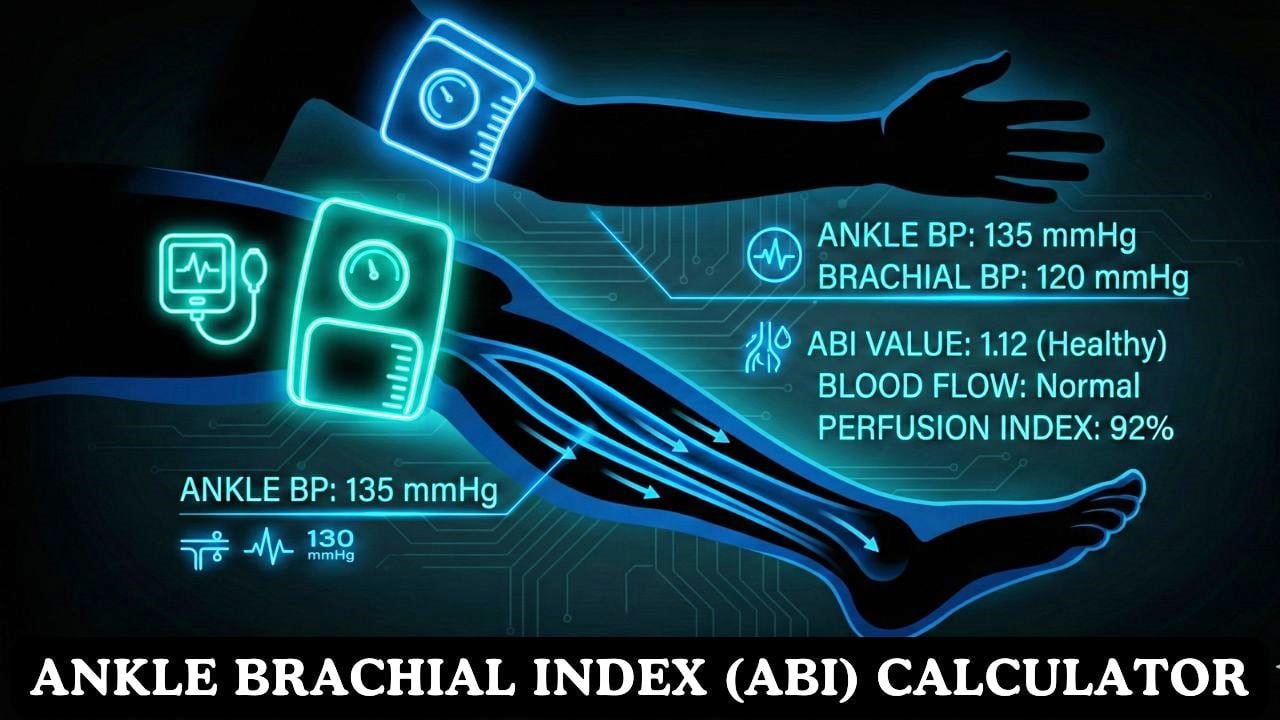
Understanding Ankle Brachial Index (ABI)
ABI = 120 ÷ 140 = 0.86 (indicates PAD)
What is Ankle Brachial Index?
The Ankle Brachial Index (ABI), also called Ankle Brachial Pressure Index (ABPI), is a simple, non-invasive test
that compares blood pressure in your ankles to blood pressure in your arms. This comparison helps detect peripheral
artery disease (PAD)—a condition where narrowed arteries reduce blood flow to your limbs.
In healthy individuals, blood pressure in the ankles is equal to or slightly higher than arm blood pressure, resulting
in an ABI of 1.00-1.30. When arteries become narrowed or blocked, ankle blood pressure drops, resulting in a lower ABI
value. Learn more about cardiovascular health with our Heart Rate Calculator.
Why is ABI Testing Important?
ABI testing is one of the most effective screening tools for PAD, which affects over 200 million people worldwide.
PAD significantly increases risk of heart attack, stroke, and limb complications. Early detection through ABI testing
allows for timely intervention, preventing serious cardiovascular events.
The test is particularly important for individuals over 50, smokers, people with diabetes, those with high blood pressure
or cholesterol, and anyone experiencing leg pain during walking. Regular screening helps identify PAD before symptoms
become severe. Monitor your overall health with our Blood Pressure Calculator.
How is ABI Measured?
Professional Measurement Protocol:
1. Patient Preparation: Rest in supine (lying down) position for 5-10 minutes
2. Arm Pressure: Measure systolic blood pressure in both arms using Doppler ultrasound
3. Ankle Pressure: Measure systolic blood pressure in posterior tibial and dorsalis pedis arteries of both ankles
4. Calculation: Divide highest ankle pressure by highest arm pressure for each leg
5. Interpretation: Lower ABI value used for clinical diagnosis
The test takes 10-15 minutes and is completely painless. Healthcare professionals use specialized Doppler equipment to
detect blood flow and ensure accurate measurements. Track your fitness progress with our
Body Fat Calculator.
ABI Interpretation & Clinical Significance
Normal ABI (1.00 – 1.30)
Meaning: Healthy circulation with no significant arterial narrowing
Significance: Normal blood flow to lower extremities
Action: Maintain healthy lifestyle, regular exercise, balanced diet
A normal ABI indicates your arteries are open and delivering adequate blood flow to your legs. Continue heart-healthy
habits including regular physical activity, nutritious eating, and avoiding tobacco. Consider our
Steps to Miles Calculator
to track your walking progress.
Borderline PAD (0.91 – 0.99)
Meaning: Mild arterial narrowing may be present
Significance: Early warning sign of developing PAD
Action: Medical evaluation, lifestyle changes, repeat testing in 6-12 months
Borderline values suggest early arterial changes. This is the optimal time for aggressive risk factor management through
diet, exercise, smoking cessation, and blood pressure control. Early intervention can prevent progression to significant
PAD. Start your fitness journey with our Walking Calorie Calculator.
Mild PAD (0.71 – 0.90)
Meaning: Mild peripheral artery disease
Significance: Mild arterial narrowing reducing blood flow
Action: Medical evaluation, lifestyle changes, supervised exercise
Mild PAD is highly treatable with conservative measures. Supervised exercise therapy (walking 30-45 minutes, 3-5 times
per week) is the cornerstone of treatment and can significantly improve symptoms and walking distance. Smoking cessation
is the single most important intervention. Antiplatelet medications and statins reduce cardiovascular risk. Most mild PAD
patients respond well to lifestyle modifications without needing invasive procedures. Track your walking progress with our
Steps to Miles Calculator.
Moderate PAD (0.41 – 0.70)
Meaning: Moderate peripheral artery disease
Significance: Significant arterial blockage limiting circulation
Action: Medical treatment required, vascular specialist referral
Moderate PAD requires more intensive medical management. In addition to lifestyle modifications and medications, some
patients may benefit from revascularization procedures (angioplasty, stenting) if symptoms significantly impact quality
of life or if conservative treatment fails. Close monitoring and aggressive risk factor control are essential. Calculate
your health metrics with our BMI Calculator.
Severe PAD (< 0.40)
Meaning: Critical limb ischemia risk
Significance: Severe arterial blockage with limb-threatening reduced blood flow
Action: Emergency vascular evaluation, urgent treatment required
ABI below 0.40 indicates critically compromised circulation requiring immediate medical attention. Risk of tissue damage,
non-healing wounds, and potential limb loss. Urgent vascular specialist consultation and possible surgical intervention
(angioplasty, bypass surgery) may be necessary to restore blood flow and prevent complications.
High ABI (> 1.40)
Meaning: Non-compressible arteries (arterial calcification)
Significance: Stiff arteries prevent accurate compression
Action: Alternative testing required (toe-brachial index)
Abnormally high ABI values don’t indicate superior circulation—instead, they suggest calcified, stiff arteries that
resist compression. Common in diabetes and chronic kidney disease. These patients need alternative diagnostic tests
like toe-brachial index or pulse volume recordings for accurate PAD assessment.

Manish is a NASM-certified fitness and nutrition coach with over 10 years of experience in weight lifting and fat loss fitness coaching. He specializes in gym-based training and has a lot of knowledge about exercise, lifting technique, biomechanics, and more.
Through “Fit Life Regime,” he generously shares the insights he’s gained over a decade in the field. His goal is to equip others with the knowledge to start their own fitness journey.