
🦍 Ape Index Calculator
Calculate your Ape Index (wingspan to height ratio) instantly. Discover if your arm span matches Leonardo da Vinci’s Vitruvian Man ideal of 1.0, or if you have advantages for climbing, basketball, swimming, boxing, and other sports. Get personalized insights based on your body proportions.
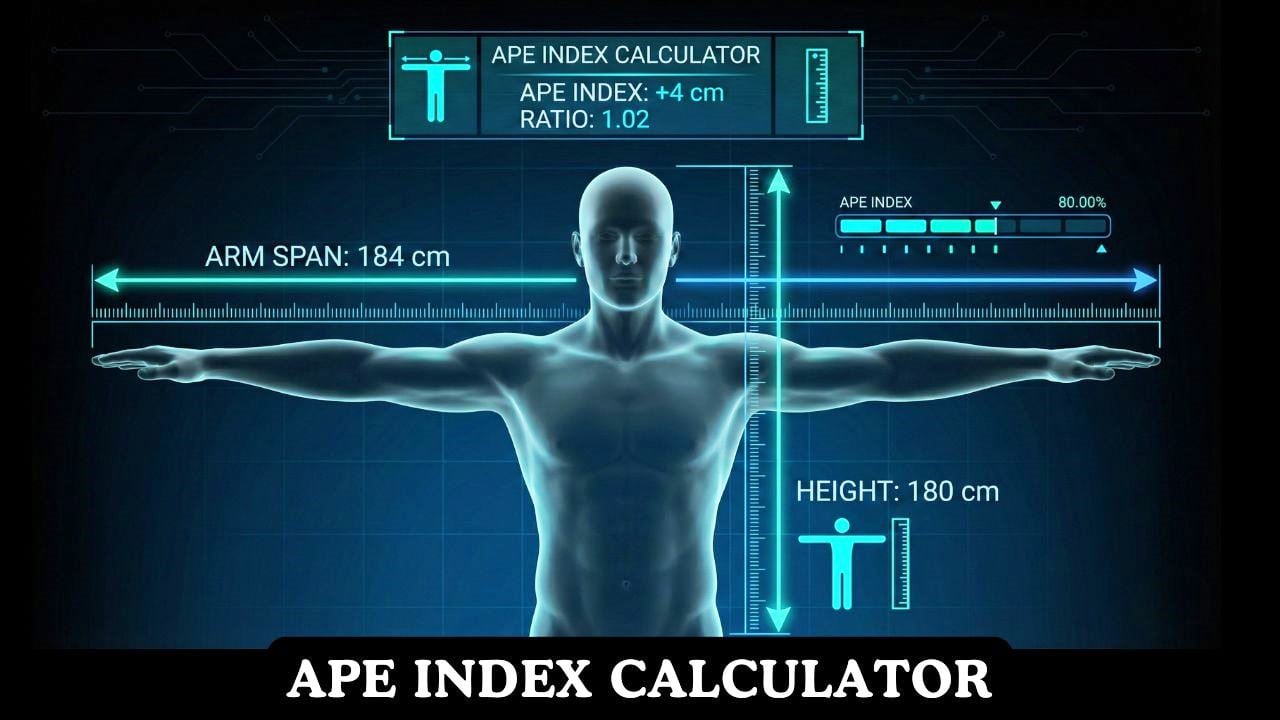
Ape Index: Science & Athletic Performance
The Ape Index, also called the ape ratio or wingspan-to-height ratio, is a body proportion measurement comparing your arm span to your height.
The concept originates from Leonardo da Vinci’s famous Vitruvian Man drawing (circa 1490), which depicted the “perfect” human
with symmetrical proportions where wingspan equals height—an ape index of exactly 1.0.
Two Ways to Calculate Ape Index:
1. Ape Index Ratio (Standard): Ape Index = Wingspan ÷ Height
• Ratio of 1.0 = Perfect Vitruvian proportions (wingspan = height)
• Ratio >1.0 = Positive ape index (longer wingspan)
• Ratio <1.0 = Negative ape index (shorter wingspan)
• Example: 191cm wingspan ÷ 183cm height = 1.044 (Michael Phelps)
2. Ape Index Difference (Alternative): Ape Index = Wingspan – Height
• Result of 0 cm = Neutral (wingspan = height)
• Positive cm = Longer wingspan
• Negative cm = Shorter wingspan
• Example: 191cm – 183cm = +8cm (Michael Phelps)
Scientific research in sports anthropometry
shows that ape index significantly correlates with performance in reach-intensive sports. Most humans have a neutral ape index
(ratio 0.98-1.02), though elite athletes in climbing, basketball, and swimming often exceed 1.05. Track your fitness progress with our
Body Fat Calculator.
Evolutionary Biology of Body Proportions
Evolutionary anthropology research demonstrates that human body proportions, including ape index, vary significantly across populations due to climatic adaptation. Populations from colder climates tend to have shorter limbs relative to height (negative ape index), while those from warmer climates often have longer limbs (positive ape index). This reflects Allen’s Rule, where body extremities adapt to temperature regulation needs. Understanding your body proportions helps optimize training and sport selection. Calculate your BMI and Lean Body Mass for comprehensive body composition analysis.
Athletic Performance Implications
Sports science research shows that ape index significantly impacts performance in multiple sports. Rock climbers benefit from positive ape indices (+5cm to +10cm is common among professionals) as longer reach allows accessing holds more easily. Basketball players with high ape indices can defend, rebound, and shoot more effectively. Swimmers with longer wingspans generate more propulsion per stroke. Conversely, gymnasts often perform better with neutral or slightly negative ape indices due to improved leverage and body control. Plan your training with our Workout Plan Generator.
Measurement Accuracy & Methodology
Anthropometric measurement protocols emphasize the importance of accurate height and wingspan measurement for reliable ape index calculation. Height should be measured barefoot, standing straight against a wall with heels, buttocks, and head touching the surface. Wingspan is measured fingertip to fingertip with arms fully extended horizontally, palms facing forward. Multiple measurements (3-5) should be averaged for accuracy. Measurements are best taken in the morning when spinal compression is minimal. Optimize your body composition with our Macro Calculator.
Ape Index Standards & Population Norms
| Ape Index Category | Range (cm) | Population % | Athletic Advantage | Best Sports |
|---|---|---|---|---|
| Very High Positive | ≥ 1.06 | ~2% | Elite reach advantage | Basketball, Climbing, Boxing |
| High Positive | 1.03 – 1.06 | ~10% | Significant advantage | Swimming, Volleyball, MMA |
| Positive | 1.01 – 1.03 | ~20% | Above average | Most reach sports |
| Neutral (Vitruvian) | 0.99 – 1.01 | ~36% | Balanced (≈1.0) | All sports |
| Slightly Negative | 0.97 – 0.99 | ~15% | Slight leverage | Gymnastics, Powerlifting |
| Negative | 0.94 – 0.97 | ~10% | Leverage advantage | Wrestling, Powerlifting |
| Very Negative | < 0.94 | ~7% | Significant leverage | Sprint, Power sports |
Gender Differences in Ape Index
Male Average: +2.0 to +3.0 cm (wingspan typically longer than height)
Female Average: +1.0 to +2.0 cm (slightly less pronounced than males)
Research shows that males generally have a slightly higher average ape index than females, though significant individual
variation exists within both populations. These differences are attributed to hormonal influences on bone growth and body
proportion development during puberty. Neither gender has inherent advantages or disadvantages; optimal ape index depends
entirely on the specific sport or activity. Calculate your ideal weight with our
Ideal Weight Calculator.
Sport-Specific Ape Index Advantages
🧗 Rock Climbing & Bouldering
Optimal Ape Index: +5cm to +15cm
Why It Matters: Longer reach allows climbers to span greater distances between holds, reducing the need for
dynamic movements and conserving energy. Professional climbers like Adam Ondra (+10cm) and Alex Honnold (+8cm) demonstrate
how positive ape index translates to climbing performance.
Training Focus: Finger strength, shoulder stability, core tension, technique refinement. Even with high ape
index, technical skill and finger strength remain crucial. Explore
pull-up exercises and
grip strengthening
for climbing performance.
🏀 Basketball Performance
Optimal Ape Index: +8cm to +20cm
Why It Matters: Wingspan is often considered more important than height in basketball. Longer arms improve
defensive coverage, rebounding reach, shot blocking, and shooting over defenders. NBA players average +10cm ape index, with
elite defenders often exceeding +15cm.
Performance Benefits: Increased defensive radius, better steal opportunities, improved rebounding position,
enhanced shot contest ability. Kevin Durant’s +17cm ape index exemplifies elite basketball proportions. Calculate calories
burned with our Basketball Calorie Calculator.
🏊 Swimming & Aquatic Sports
Optimal Ape Index: +5cm to +12cm
Why It Matters: Longer wingspan increases stroke length, reducing the number of strokes per lap and improving
efficiency. Each arm stroke covers more distance, translating to faster times. Michael Phelps’s +8cm ape index (191cm wingspan,
183cm height) contributed significantly to his dominance.
Technique Considerations: Longer arms require refined technique to maximize efficiency and avoid shoulder
injuries. Focus on shoulder mobility, rotator cuff strength, and proper stroke mechanics. Track your swimming progress with our
Swimming Calorie Calculator.
🥊 Boxing, MMA & Combat Sports
Optimal Ape Index: +5cm to +15cm
Why It Matters: Longer reach allows fighters to strike opponents while remaining outside their opponent’s
striking range. This “reach advantage” is crucial for offensive and defensive strategy. Jon Jones’s +27cm ape index (215cm
wingspan, 188cm height) provides exceptional advantage.
Strategic Benefits: Control fighting distance, land strikes from safe range, improve defensive positioning,
enhanced clinch control, better grappling leverage. However, technique, speed, and timing remain paramount regardless of reach
advantage. Optimize fitness with our Boxing Calorie Calculator.
🤸 Gymnastics & Acrobatics
Optimal Ape Index: -2cm to +2cm (neutral)
Why It Matters: Gymnastics uniquely benefits from compact, balanced proportions rather than extended limbs.
Neutral or slightly negative ape index provides better leverage for rotations, improved body control, and optimal weight
distribution for balance elements.
Performance Advantages: Faster rotation speed, easier balance maintenance, improved leverage on apparatus,
better spatial awareness. Elite gymnasts often have proportions closer to neutral, facilitating the power and control required
for high-difficulty skills. See bodyweight exercises
for gymnastics-inspired training.
🏐 Volleyball & Net Sports
Optimal Ape Index: +4cm to +10cm
Why It Matters: Longer wingspan increases blocking reach and attacking range. Players can cover more net area
defensively and hit over blocks more effectively. Combined with vertical jump, positive ape index significantly enhances
performance.
Position-Specific Benefits: Middle blockers benefit most from high ape index, while setters benefit less.
Wingspan combined with standing reach determines blocking effectiveness. Calculate your jump performance with our
Vertical Jump Calculator.
Training Considerations by Ape Index
High Positive Ape Index Training (+5cm or more)
Strengths to Develop:
• Maximize reach advantages in chosen sports
• Develop shoulder stability and rotator cuff strength
• Focus on sports utilizing wingspan (climbing, basketball, swimming)
• Train grip strength and forearm endurance
Areas Requiring Extra Attention:
• Shoulder joint stability (longer levers = greater stress)
• Core strength for controlling long limbs
• Flexibility to maintain full range of motion
• Technique refinement to maximize efficiency
Recommended Exercises: Shoulder strengthening,
core exercises,
pull-up variations.
Neutral Ape Index Training (-2cm to +2cm)
Versatility Advantage:
Neutral ape index provides balanced proportions suitable for nearly all sports and activities. No inherent advantages or
disadvantages exist, allowing focus on sport-specific skills and general athleticism.
Training Approach:
• Develop well-rounded fitness across all domains
• Focus on sport-specific technique and conditioning
• Build balanced strength throughout entire body
• Emphasize skills and strategy over physical advantages
Recommended Programs: Personalized workout plans,
CrossFit training,
and calisthenics programs.
Negative Ape Index Training (-5cm or less)
Leverage Advantages:
• Lower center of gravity for improved balance and stability
• Better leverage ratios for powerlifting movements
• Enhanced control in gymnastics and body control sports
• Advantages in wrestling and grappling sports
Optimal Sports Focus:
• Powerlifting: Shorter arms mean shorter range of motion in bench press and deadlift, often allowing heavier
lifts. Use our Bench Press 1RM Calculator
and Deadlift 1RM Calculator.
• Wrestling: Lower center of gravity and improved leverage
• Sprinting: Compact proportions can benefit acceleration
• Gymnastics: Better body control and rotation speed
Training Emphasis: Explosive power development, leverage optimization, technique refinement in chosen sports.
Explore barbell exercises
and compound movements.
Famous Athletes & Their Ape Indices
| Athlete | Sport | Height | Wingspan | Ape Index | Impact |
|---|---|---|---|---|---|
| Michael Phelps | Swimming | 183cm (6’0″) | 191cm (6’3″) | 1.044 (+8cm) | 23 Olympic golds |
| Jon Jones | MMA | 188cm (6’2″) | 215cm (7’1″) | 1.144 (+27cm) | Undefeated champion |
| Kevin Durant | Basketball | 208cm (6’10”) | 225cm (7’5″) | 1.082 (+17cm) | 2× NBA champion |
| Adam Ondra | Climbing | 185cm (6’1″) | 195cm (6’5″) | 1.054 (+10cm) | World’s hardest climbs |
| Muhammad Ali | Boxing | 191cm (6’3″) | 198cm (6’6″) | 1.037 (+7cm) | 3× World champion |
| Michael Jordan | Basketball | 198cm (6’6″) | 211cm (6’11”) | 1.066 (+13cm) | 6× NBA champion |
| Floyd Mayweather | Boxing | 173cm (5’8″) | 183cm (6’0″) | 1.058 (+10cm) | 50-0 Record |
| Shaquille O’Neal | Basketball | 216cm (7’1″) | 231cm (7’7″) | 1.069 (+15cm) | 4× NBA champion |
Measuring Your Ape Index Accurately
How to Measure Height Correctly
Equipment Needed: Wall, tape measure, pen, book or flat object
Step-by-Step Instructions:
If Measuring Alone:
1. Find a wall where you can make a mark
2. Remove shoes and any hair accessories
3. Stand with your back flat against the wall
4. Keep feet together with heels touching the wall
5. Stand straight—do not slouch! Keep your posture natural
6. Look straight ahead (not up or down)
7. Place a book or flat object on top of your head, parallel to the floor
8. Press the object against the wall
9. Mark the wall where the bottom of the object meets it
10. Step away and measure from floor to the mark
Best Practice Tips:
• Measure in the morning for most accurate results (spine less compressed)
• Ensure buttocks, shoulder blades, and back of head all touch the wall
• Take 2-3 measurements and average them
• Height can vary 1-2cm throughout the day due to spinal compression
💡 Pro Tip: Having someone assist you ensures more accurate measurement. Predict future height with our
Ideal Weight Calculator.
How to Measure Wingspan (Arm Span) Correctly
Equipment Needed: Tape measure, helper (highly recommended for accuracy)
💡 Pro Tip: The easiest and most accurate way is to ask somebody for assistance!
Step-by-Step Instructions:
1. Stand up straight with good posture
2. Expand both arms out to the sides, parallel to the floor (make a “T” shape)
3. Keep your arms completely horizontal (not angled up or down)
4. Extend your fingers fully—stretch them out as far as possible
5. Keep palms facing forward
6. Ensure your shoulders are level (not hunched or tilted)
7. Measure the length from fingertip to fingertip
8. Have your helper pull the tape measure taut (but not stretched)
9. Measure from the tip of your middle finger on one hand to the tip of the middle finger on the other hand
10. Take 2-3 measurements and average them
Common Mistakes to Avoid:
❌ Hunching or raising shoulders
❌ Not fully extending fingers
❌ Leaning to one side
❌ Measuring from knuckles instead of fingertips
❌ Letting arms angle up or down instead of staying horizontal
Why Accuracy Matters: Even a 1-2cm error can significantly change your ape index calculation. Take your time
and use a helper for best results. For comprehensive body metrics, check our
Body Surface Area Calculator.

Manish is a NASM-certified fitness and nutrition coach with over 10 years of experience in weight lifting and fat loss fitness coaching. He specializes in gym-based training and has a lot of knowledge about exercise, lifting technique, biomechanics, and more.
Through “Fit Life Regime,” he generously shares the insights he’s gained over a decade in the field. His goal is to equip others with the knowledge to start their own fitness journey.