
✋ Height to Hand Size Calculator
Discover the relationship between your height and hand dimensions. Compare your hand length and span to population averages and see what your hand size reveals about your body proportions.
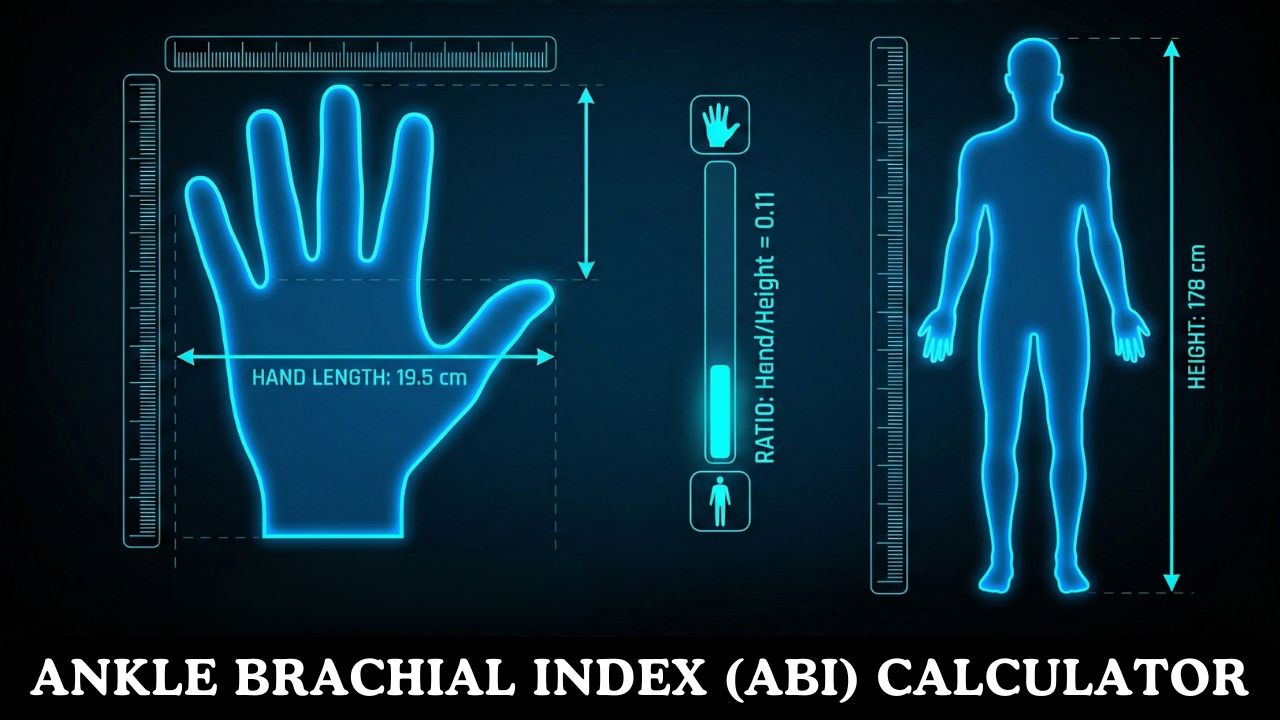
Understanding Height to Hand Size Relationship
Ratio = (19 ÷ 175) × 100 = 10.86% (Average)
Scientific Basis of Height-Hand Correlation
Hand size and height show a strong positive correlation (r = 0.75-0.85) in anthropometric studies. This relationship
exists because both dimensions are influenced by similar genetic and developmental factors during growth. The ratio of
hand length to height typically ranges from 10.5% to 11% in adults, with individual variation influenced by genetics,
ethnicity, and hormonal factors during development.
Forensic anthropologists use hand measurements to estimate height in identification work, with hand length providing
reliable height predictions (standard error ±4-5cm). This correlation forms the basis for understanding body proportions
and has applications in ergonomics, sports performance analysis, and anthropological research. Learn more about body
proportions with our Ape Index Calculator.
How to Measure Your Hands Accurately
Hand Length Measurement:
1. Position: Place your hand flat on a table, palm up, fingers extended
2. Starting Point: The base of your palm at the wrist crease (where hand meets wrist)
3. Ending Point: The tip of your middle finger (longest finger)
4. Measurement: Use a ruler or measuring tape to measure the straight-line distance
5. Record: Measure 2-3 times and use the average for accuracy
Hand Span Measurement:
1. Position: Spread your hand as wide as possible on a flat surface
2. Starting Point: The tip of your thumb
3. Ending Point: The tip of your pinky finger (little finger)
4. Measurement: Measure the maximum stretched distance between tips
5. Accuracy: Repeat measurement and average results
Tips for Accurate Measurement: Measure at the same time of day (hands can swell slightly during the day),
use metric measurements (cm) for precision, and ensure fingers are fully extended. Track your measurements with our
Body Measurement Tracker.
Average Hand Sizes by Gender and Height
Adult Male Averages:
• Hand Length: 18.5-19.5 cm (7.3-7.7 inches)
• Hand Span: 21-23 cm (8.3-9.1 inches)
• Hand-to-Height Ratio: 10.5-11%
• Height Range: 170-180 cm (5’7″-5’11”)
Adult Female Averages:
• Hand Length: 17-18 cm (6.7-7.1 inches)
• Hand Span: 19-21 cm (7.5-8.3 inches)
• Hand-to-Height Ratio: 10.5-11%
• Height Range: 155-165 cm (5’1″-5’5″)
These averages vary by population, with ethnicity playing a significant role. Studies show hand proportions remain
relatively consistent across different heights when expressed as ratios. Individual variation of ±10% from these averages
is completely normal. For complete body composition analysis, use our
Body Fat Calculator.
Hand Size and Athletic Performance
Sports Advantages of Larger Hands
Basketball: Larger hands provide better ball control, improved palming ability, easier one-handed
catches, enhanced rebounding, and superior shooting control.
Rock Climbing: Extended reach allows climbers to skip holds, reduce dynamic movements, improve grip
variety, and increase crimping surface area. Elite climbers often have hand spans exceeding 22cm.
Swimming: Larger hands act as bigger paddles, increasing propulsion with each stroke. Surface area
advantages translate to improved efficiency, though technique remains paramount.
American Football: Quarterbacks with larger hands show better ball security in adverse weather, improved
grip strength, and enhanced throwing control. NFL combine measures hand span as a key metric.
However, hand size alone doesn’t determine athletic success. Strength, coordination, technique, and sport-specific skills
matter far more than raw hand dimensions. Optimize your performance with our
VO2 Max Calculator.
Advantages of Smaller/Proportional Hands
Gymnastics: Compact hands provide better body control, faster rotation speed, improved balance, and
easier apparatus grip. Shorter levers reduce torque requirements for rotational movements.
Precision Sports: Golf, darts, and archery benefit from fine motor control, which isn’t size-dependent.
Smaller hands often demonstrate excellent precision and control in delicate movements.
Endurance Sports: Running, cycling, and swimming rely minimally on hand size. Body proportions matter
more for biomechanical efficiency than absolute hand dimensions.
Combat Sports: Boxing and MMA value hand speed, conditioning, and technique over size. Many successful
fighters have average or smaller hands, emphasizing skill development.
Remember: Hand strength, flexibility, and coordination can be developed regardless of size. Training matters more than
genetic hand dimensions. Build strength with our
Push-Up Variations Guide.

Manish is a NASM-certified fitness and nutrition coach with over 10 years of experience in weight lifting and fat loss fitness coaching. He specializes in gym-based training and has a lot of knowledge about exercise, lifting technique, biomechanics, and more.
Through “Fit Life Regime,” he generously shares the insights he’s gained over a decade in the field. His goal is to equip others with the knowledge to start their own fitness journey.