
💪 Height to Forearm Length Calculator
Estimate your forearm length from your height using anthropometric formulas. Calculate forearm-to-height ratio and body proportion analysis based on scientifically validated skeletal relationships.
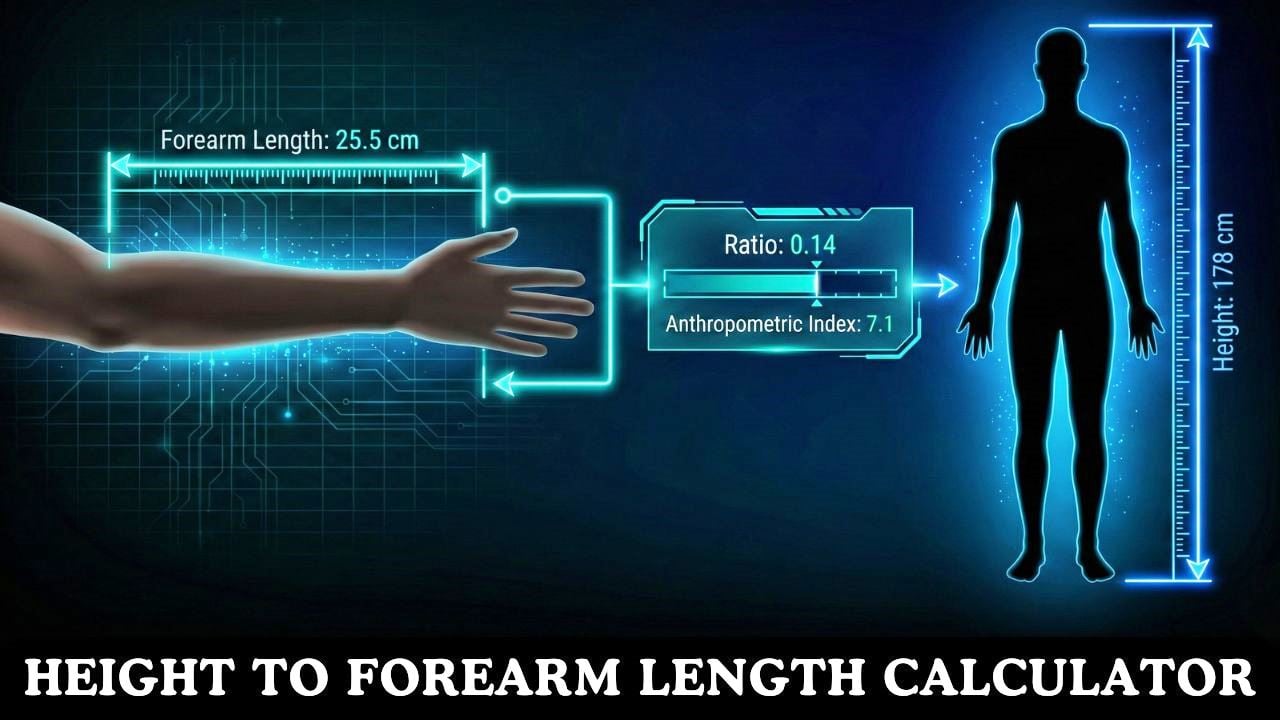
Understanding Height to Forearm Length Relationship
Forearm (cm) = Height (cm) × 0.142 + 1.5 (Females)
Forearm = 175 × 0.146 + 1.2 = 26.75 cm = 10.53 inches
What is the Height-Forearm Relationship?
Forearm length (measured from elbow crease to wrist crease with arm extended) correlates strongly with total body height
through predictable skeletal proportions. The forearm (ulna and radius bones) represents approximately 14.5-16% of total
height in adults, with males averaging slightly higher ratios (~15.3%) compared to females (~15.0%) due to the formula
constants (0.146 coefficient + 1.2 cm constant for males).
This relationship is established during fetal development and remains relatively constant throughout life. Anthropometric
studies use forearm-to-height ratios for forensic height estimation (from skeletal remains), growth assessment (pediatric
development), and ergonomic design (workspace optimization). The correlation coefficient between forearm length and height
is typically r = 0.70-0.80, indicating a strong positive relationship. Explore more body measurements with our
Height to Hand Size Calculator.
Scientific Basis of the Formula
The forearm length formula is derived from linear regression analysis of thousands of anthropometric measurements across
diverse populations. The gender-specific coefficients (0.146 for males, 0.142 for females) represent the proportional
relationship, while the constants (1.2 and 1.5) account for baseline forearm length independent of height.
Why Gender Differences Exist: Males typically have relatively longer forearms compared to females of the
same height due to hormonal influences during puberty. Testosterone promotes differential growth of limb bones, particularly
in the distal segments (forearms and hands). This sexual dimorphism is consistent across populations and emerges during
adolescence.
Accuracy Expectations: Population-based formulas predict individual forearm length within ±10-15% (standard
error ≈ 1.5-2.0 cm). Ethnic variation exists—some Asian populations show slightly shorter forearms relative to height, while
some African populations show slightly longer proportions. Individual skeletal proportions are ultimately determined by genetics,
prenatal environment, and childhood nutrition. Calculate your overall proportions with our
Body Proportions Calculator.
Frequently Asked Questions
How accurate is the height-to-forearm calculator?
The calculator provides estimates accurate within ±10-15% for most individuals, with typical error of 1.5-2.0 cm. Accuracy depends on how well your skeletal proportions match population averages. The formula is based on regression analysis of large anthropometric datasets and works well for typical proportions. However, individual genetics, ethnicity, and skeletal variations cause deviations. For medical, forensic, or precise applications, direct measurement is necessary. For general interest and approximate predictions, calculator estimates are reliable.
Can I use forearm length to estimate my height?
Yes, the relationship works bidirectionally. Forensic anthropologists use forearm bone length (ulna) to estimate height from skeletal remains. The regression equation is: Height (cm) ≈ (Forearm length × 6.85) + 60 (approximately, varies by gender and population). Standard error is ±3-5 cm when using forearm alone. Combining multiple bone measurements (forearm + hand + foot + tibia) improves accuracy to ±2-3 cm. Gender and ancestry must be known for optimal accuracy, as these factors affect regression constants.
Does forearm length affect grip strength?
Forearm length has a complex relationship with grip strength. Longer forearms increase the moment arm for grip muscles, requiring
greater muscle force to generate equivalent grip pressure. However, this doesn’t necessarily mean weaker grip—muscle size, fiber
type, and tendon insertion points matter more than bone length.
Research shows grip strength correlates more strongly with forearm circumference (muscle cross-sectional area) than forearm length.
A person with short, muscular forearms typically has stronger absolute grip than someone with long, thin forearms. For grip endurance
(climbing, hanging), longer forearms may provide slight advantages through improved leverage in certain positions. Focus on training
rather than anatomy for grip development.
Why do males have longer forearms than females?
Sexual dimorphism in forearm proportions emerges during puberty due to differential hormone effects. Testosterone promotes relatively
greater growth in distal limb segments (forearms, hands, feet) compared to proximal segments and trunk. This is reflected in the
gender-specific formula coefficients: males use 0.146 while females use 0.142. When accounting for the constant offset, males
typically measure ~15.3% while females measure ~15.0% of height in forearm length—a small but consistent difference.
Evolutionary hypotheses suggest this dimorphism relates to throwing ability and tool use, where longer forearms provide biomechanical
advantages. However, the difference is modest (3-4%) and substantial overlap exists between male and female distributions. Individual
variation within each gender far exceeds the average difference between genders. Ethnicity and genetics create more variation than
gender alone.

Manish is a NASM-certified fitness and nutrition coach with over 10 years of experience in weight lifting and fat loss fitness coaching. He specializes in gym-based training and has a lot of knowledge about exercise, lifting technique, biomechanics, and more.
Through “Fit Life Regime,” he generously shares the insights he’s gained over a decade in the field. His goal is to equip others with the knowledge to start their own fitness journey.