
⌚ Height to Wrist Circumference Calculator
Estimate your wrist circumference from your height using anthropometric formulas. Determine your body frame size (small/medium/large) and skeletal structure based on scientifically validated proportional relationships.
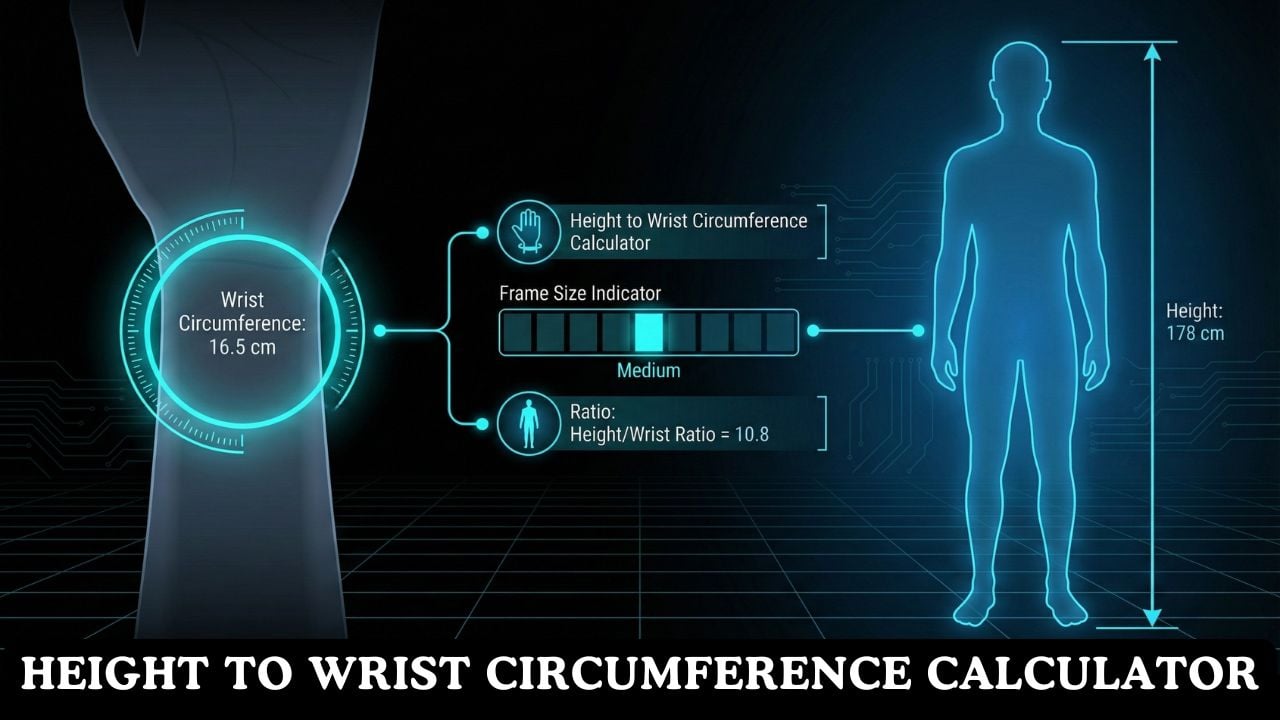
Understanding Height to Wrist Circumference Relationship
Female: Wrist (cm) = Height (cm) × 0.089 + 0.2
Wrist = 175 × 0.096 + 0.3 = 17.1 cm = 6.73 inches
Ratio: 17.1 ÷ 175 = 9.77% (Medium Frame)
What is Wrist Circumference?
Wrist circumference is measured around the narrowest point of the wrist, just above the wrist bone (distal to the ulnar and radial
styloid processes). This measurement correlates moderately with total body height (r = 0.5-0.6) and serves as a primary indicator
of skeletal frame size—the underlying bone structure independent of muscle mass or body fat.
Important Distinction: Wrist circumference (around the wrist) typically represents 9-11% of total height,
with males averaging ~9.8% and females ~9.3%. This is different from wrist breadth (diameter across), which is ~3-3.5% of
height. Our calculator measures circumference because it’s more practical for home measurement and watch sizing. Males average
slightly higher ratios due to sexual dimorphism in skeletal proportions. Unlike measurements that include soft tissue (bicep, thigh),
the wrist provides a relatively pure assessment of bone structure with minimal muscle or fat overlay. Calculate your complete
body proportions with our
Body Proportions Calculator.
Frame Size Classification
Body frame size is determined by the wrist circumference-to-height ratio, classifying individuals into small, medium, or large frame
categories. This classification predicts ideal weight ranges, muscle-building potential, and metabolic characteristics.
Frame Size Thresholds (Wrist Circumference-to-Height Ratio):
Males:
• Small Frame: <9.5% (wrist <16.6 cm at 175cm height)
• Medium Frame: 9.5-10.5% (wrist 16.6-18.4 cm)
• Large Frame: >10.5% (wrist >18.4 cm)
Females:
• Small Frame: <9.0% (wrist <14.9 cm at 165cm height)
• Medium Frame: 9.0-10.0% (wrist 14.9-16.5 cm)
• Large Frame: >10.0% (wrist >16.5 cm)
Note: These thresholds are for wrist circumference (measurement around the wrist), not wrist breadth
(diameter across). Traditional frame size assessments used calipers to measure breadth (~3% of height), but circumference is more
practical for home measurement and correlates strongly with skeletal frame.
Frame size is genetically determined and cannot be changed through diet or exercise—it’s your skeletal blueprint. However,
understanding your frame helps set realistic weight goals and training expectations. Small frames typically have lower ideal
weights and may build muscle more slowly. Large frames can support more total mass and often build muscle more easily.
Determine your ideal weight with our
Ideal Weight Calculator.
Scientific Basis & Accuracy
The wrist-height formula is derived from anthropometric regression studies analyzing thousands of individuals. The correlation
coefficient (r = 0.5-0.6) indicates moderate predictive power—weaker than forearm-height (r = 0.7-0.8) but sufficient for frame
size classification and watch sizing recommendations.
Circumference vs. Breadth: Traditional anthropometry measured wrist breadth (side-to-side bone width using
calipers) which averages 3-3.5% of height. Our calculator measures wrist circumference (around the wrist with tape) which
averages 9-11% of height. Circumference is more practical for home measurement and has the same frame size correlation as breadth
(r ≈ 0.5-0.6 with body frame). The ratio of circumference to breadth is roughly 3:1 (circumference ≈ π × diameter, but wrists aren’t
perfect circles).
Why Wrist Size Matters: Wrist circumference reflects skeletal robustness and bone mineral density. Larger wrists
indicate thicker, denser bones throughout the skeleton, not just at the wrist. This correlates with higher bone mineral content,
greater muscle attachment surface area, and typically higher strength potential. Conversely, smaller wrists indicate lighter skeletal
structure, which correlates with lower body weight requirements and often better relative strength-to-weight ratios.
Accuracy Limitations: Prediction error is ±10-15% (±1.5-2.5 cm) for individuals due to genetic variability in
skeletal proportions. Some people have disproportionately thick or thin wrists relative to their height. Ethnicity creates variation—
some East Asian populations average slightly smaller wrists, while some African populations average slightly larger wrists for the same
height. For precise frame assessment, measure your actual wrist circumference. Assess your bone health with our
Bone Density Calculator.
Practical Applications & Implications
Ideal Weight & Frame Size
Frame size significantly affects ideal weight recommendations. Standard BMI calculations ignore skeletal structure, potentially
misclassifying large-framed individuals as overweight or small-framed individuals as underweight. Frame-adjusted weight ranges
provide more accurate targets.
Frame Adjustments to Ideal Weight:
• Small Frame: -10% from medium frame ideal
• Medium Frame: Standard ideal weight formula
• Large Frame: +10% from medium frame ideal
Example (Male, 175cm):
• Small Frame: 63-68 kg (138-150 lbs)
• Medium Frame: 70-76 kg (154-167 lbs)
• Large Frame: 77-83 kg (170-183 lbs)
These ranges reflect skeletal capacity. Large-framed individuals attempting to reach small-frame weights may lose excessive muscle
mass and bone density. Small-framed individuals carrying large-frame weights likely have excess body fat. Focus on body composition
(fat vs. muscle) rather than scale weight alone. Calculate your body fat percentage with our
Body Fat Calculator.
Watch & Bracelet Sizing
Wrist circumference directly determines proper watch, fitness tracker, and bracelet sizing. Ill-fitting watches are uncomfortable
and may provide inaccurate biometric readings (heart rate monitors require proper contact).
Watch Size Guidelines:
• <15 cm wrist: 32-38mm case diameter, XS/S bands
• 15-16.5 cm: 38-40mm case, S/M bands
• 16.5-18 cm: 40-44mm case, M/L bands
• 18-19.5 cm: 44-48mm case, L/XL bands
• >19.5 cm: 48mm+ case, XL+ bands
Measurement for Watches: Measure at the narrowest point above the wrist bone where you’d wear a watch. Add 1-2 cm
to your measurement for comfortable watch fit (you should fit one finger between band and wrist). For fitness trackers requiring
accurate heart rate, fit should be snug but not constricting. Many fitness trackers offer adjustable or interchangeable bands—
verify your wrist circumference before purchasing. Track your fitness metrics with our
Fitness Tracker Calculator.
Frame Size & Muscle Building
Skeletal frame size significantly impacts muscle-building potential and realistic physique expectations. Bone dimensions determine
muscle attachment surface area and mechanical leverage—fundamental factors in strength and size development.
Small Frame Characteristics:
• Lower maximum muscle mass potential (smaller attachment points)
• Better relative strength-to-weight ratio (lighter to move)
• Excel in: Endurance sports, gymnastics, rock climbing
• Challenge: Building significant muscle mass requires more effort
• Advantage: Lower caloric requirements, faster recovery
Large Frame Characteristics:
• Higher maximum muscle mass potential (larger attachment points)
• Better absolute strength (more total mass supportable)
• Excel in: Powerlifting, strongman, football, rugby
• Challenge: Maintaining low body fat percentage
• Advantage: Easier muscle gain, higher metabolism
Medium Frame: Balanced characteristics without specific advantages or disadvantages. Versatile for most sports and
training goals. Represents ~50-60% of the population. Optimize your muscle building with our
Muscle Gain Calculator.
Frequently Asked Questions
How do I measure my wrist circumference accurately?
Use a flexible measuring tape to measure around the narrowest point of your wrist, just above the prominent wrist bone
(about 2-3 cm above the hand). Wrap the tape completely around your wrist. Measure with hand relaxed (not flexed), typically on your
dominant wrist. The tape should be snug but not compressing tissue. Take 2-3 measurements and average them for accuracy.
Expected Values: Adult males typically measure 16-19 cm circumference, adult females 14-17 cm. If your measurement
is significantly outside this range, double-check your technique. For watch sizing, measure where you’d actually wear the watch
(slightly higher on the wrist than the narrowest point). Professional anthropometrists traditionally use calipers to measure wrist
breadth (side-to-side bone width, 5-7 cm typical) rather than circumference for frame size assessment, but circumference
correlates equally well and is more practical for home measurement.
Can I change my frame size?
No, frame size is determined by bone structure (genetics) and cannot be significantly changed through diet, exercise, or training. Your wrist bones are fixed dimensions established during growth and development (growth plates fuse around age 18-25). Weight training can increase forearm muscle mass, which may add 0.5-1.0 cm to circumference measurement, but this doesn’t change underlying bone structure. Some pathological conditions (acromegaly, gigantism) can cause bone growth in adults, but these are medical abnormalities. Accept your frame size and work within it—small frames can be strong and muscular (Bruce Lee had small wrists), large frames don’t need to carry excess fat. Focus on optimizing body composition for YOUR frame rather than trying to match someone else’s proportions.
Why do males have larger wrists than females?
Sexual dimorphism in skeletal proportions emerges during puberty due to testosterone’s effects on bone growth. Testosterone promotes
greater periosteal bone deposition (outward bone growth), particularly in appendicular skeleton (limbs). Males average 15-20% larger
wrist circumferences than females of equivalent height. For example, at 170 cm height, males average ~16.6 cm wrist while females
average ~14.3 cm—a 16% difference.
This difference serves no clear evolutionary function—it’s likely a byproduct of overall skeletal robustness differences related to
upper body strength dimorphism. The male coefficient (0.096) is ~8% higher than the female coefficient (0.089), reflecting this
consistent skeletal difference across populations and ethnic groups. This explains why males generally have higher wrist-to-height
ratios (~9.8%) compared to females (~9.3%) for the same frame category.
Is wrist size related to grip strength?
Wrist circumference correlates weakly-to-moderately with grip strength (r ≈ 0.3-0.5). Larger wrists indicate larger bones, which often
correlate with larger forearm muscles and more muscle attachment surface area. However, muscle size, neural efficiency, and training
matter far more than bone size for actual strength performance.
Example: A trained climber with 16 cm wrists (small frame) may have 60+ kg grip strength, while an untrained person
with 19 cm wrists (large frame) may only have 40 kg. Wrist size provides potential, but training realizes it. That said, wrist size
does affect injury resistance—thicker bones are harder to fracture, and larger wrists typically handle heavier loads better over time.
For grip strength development, focus on progressive training (farmer’s walks, dead hangs, pinch grip work) rather than worrying about
genetic wrist size. Track your grip development with our
Grip Strength Standards.

Manish is a NASM-certified fitness and nutrition coach with over 10 years of experience in weight lifting and fat loss fitness coaching. He specializes in gym-based training and has a lot of knowledge about exercise, lifting technique, biomechanics, and more.
Through “Fit Life Regime,” he generously shares the insights he’s gained over a decade in the field. His goal is to equip others with the knowledge to start their own fitness journey.