
🏒 Hockey Calories Burned Calculator
Calculate energy expenditure for ice hockey, field hockey, and street hockey using scientifically validated MET values
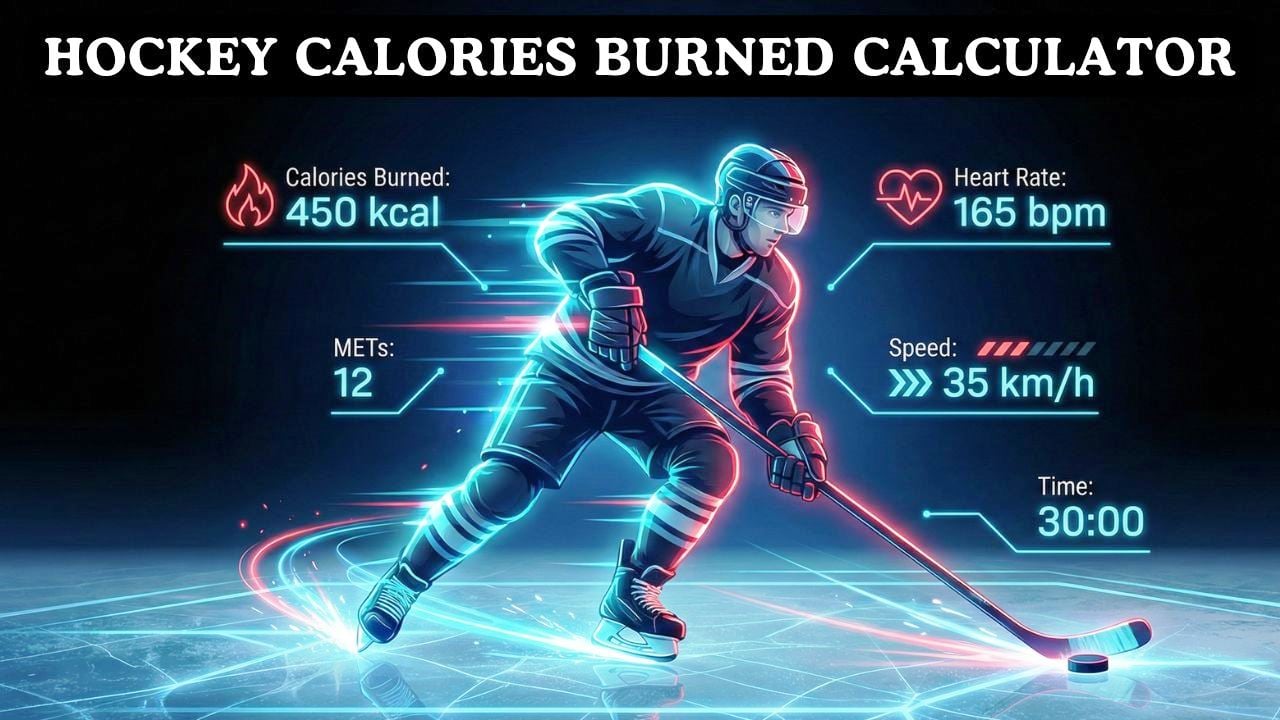
How Many Calories Does Hockey Burn?
Hockey burns between 400-900 calories per hour, making it one of the highest calorie-burning sports. A typical ice hockey game burns approximately 600-800 calories per hour for most players, with competitive play reaching up to 900 calories. This makes hockey comparable to high-intensity running or cycling for cardiovascular fitness.
Research shows that a 160 lb (73 kg) player burns approximately 610 calories per hour during general ice hockey play, and up to 1,089 calories during a 90-minute competitive game. The exact amount depends on your position, intensity, and body weight.
Calories Burned by Duration (160 lb / 73 kg player)
| Duration | Recreational | General Ice Hockey | Field Hockey | Competitive Ice | Power Skating |
|---|---|---|---|---|---|
| 15 Minutes | 113 cal | 153 cal | 149 cal | 191 cal | 229 cal |
| 30 Minutes | 226 cal | 305 cal | 298 cal | 382 cal | 458 cal |
| 45 Minutes | 339 cal | 458 cal | 447 cal | 573 cal | 687 cal |
| 60 Minutes | 452 cal | 610 cal | 596 cal | 763 cal | 916 cal |
| 90 Minutes | 678 cal | 915 cal | 894 cal | 1,145 cal | 1,374 cal |
| 120 Minutes | 904 cal | 1,220 cal | 1,192 cal | 1,526 cal | 1,832 cal |
Note: Based on MET values of 6.0 (recreational), 8.0 (general ice), 7.8 (field), 10.0 (competitive ice), and 12.0 (power skating). Most games involve 60-90 minutes of total playing time including breaks.
Calories Burned by Body Weight (60-Minute Game)
| Body Weight | Street Hockey | General Ice | Field Hockey | Competitive Ice |
|---|---|---|---|---|
| 130 lbs (59 kg) | 324 cal | 432 cal | 422 cal | 540 cal |
| 150 lbs (68 kg) | 374 cal | 499 cal | 487 cal | 623 cal |
| 160 lbs (73 kg) | 399 cal | 532 cal | 519 cal | 665 cal |
| 170 lbs (77 kg) | 424 cal | 565 cal | 551 cal | 706 cal |
| 180 lbs (82 kg) | 449 cal | 598 cal | 584 cal | 748 cal |
| 200 lbs (91 kg) | 499 cal | 665 cal | 649 cal | 831 cal |
| 220 lbs (100 kg) | 549 cal | 732 cal | 714 cal | 915 cal |
Research-backed: A 155 lb person burns approximately 563 calories per hour during ice hockey. Heavier players burn proportionally more—a 220 lb player burns about 70% more calories than a 130 lb player during the same game.
Calories = (MET × 3.5 × Body Weight in kg ÷ 200) × Duration in minutes
Calories = (10.0 × 3.5 × 73 ÷ 200) × 60
Calories = (12.775) × 60 = 767 calories burned
Hockey’s high calorie burn results from continuous skating, quick directional changes, full-body muscle engagement, and anaerobic bursts of maximum effort. This combination makes hockey an exceptional cardiovascular and strength workout.
Hockey Types & MET Values Breakdown
Different hockey variations and activities burn calories at varying rates. Here’s a comprehensive breakdown:
| Hockey Type/Activity | MET Value | Intensity | Cal/Hour (155 lb) | Description |
|---|---|---|---|---|
| Power Skating Drills | 12.0 | Maximum | 844 cal | Sprint intervals, explosive starts, max speed training |
| Ice Hockey – Competitive | 10.0 | Very High | 704 cal | Game play, full effort, body contact, continuous action |
| Scrimmage/Practice | 9.0 | High | 633 cal | Practice games, drills, moderate intensity |
| Ice Hockey – General | 8.0 | High | 563 cal | Recreational play, regular breaks, moderate pace |
| Field Hockey | 7.8 | High | 549 cal | Running-based, continuous movement, stick work |
| Street/Floor Hockey | 6.0 | Moderate | 422 cal | No skates, reduced speed, but active gameplay |
| Recreational Skating | 5.0 | Moderate | 352 cal | Casual skating, no game play or drills |
| Goalie Training | 4.0 | Light-Moderate | 281 cal | Positional drills, save practice, less movement |
Key Insight: Competitive ice hockey burns as many calories as running at 7-8 mph, making it one of the most effective full-body workouts. Power skating drills provide even higher calorie burn for short-duration, high-intensity training.
Calories Burned by Playing Position
Position significantly impacts calorie expenditure through different activity patterns and ice time. Here’s what research shows for a 60-minute game:
| Position | Ice Time | Activity Pattern | Calories (150 lb) | Calories (180 lb) |
|---|---|---|---|---|
| Center (Forward) | 15-20 min | High-intensity shifts, max effort | 600-900 cal | 720-1,080 cal |
| Winger (Forward) | 15-18 min | Moderate-high intensity, zone coverage | 550-850 cal | 660-1,020 cal |
| Defenseman | 18-25 min | Sustained moderate intensity, longer shifts | 500-800 cal | 600-960 cal |
| Goalie | 60 min | Positional, explosive saves, limited skating | 350-500 cal | 420-600 cal |
Important: Forwards typically burn 10-30% more calories than defensemen and 40-60% more than goalies due to higher activity levels and explosive movements. Ice time varies by league and playing style—these estimates reflect typical competitive play.
Game vs. Practice: Calorie Burn Comparison
The intensity difference between practice and game situations significantly affects calorie expenditure:
| Activity Type | MET Value | Intensity Level | Calories (60 min, 160 lb) |
|---|---|---|---|
| Championship/Tournament | 11.0+ | Maximum | 775-850 cal |
| Playoff/Important Game | 10.5 | Very High | 740 cal |
| Regular Season Game | 10.0 | High | 704 cal |
| Scrimmage/Practice Game | 9.0 | Moderate-High | 633 cal |
| Skills Practice | 7.0 | Moderate | 493 cal |
| Light Practice/Scrimmage | 6.0 | Light-Moderate | 422 cal |
Key Finding: Competitive games burn 10-20% more calories than practice due to heightened intensity, continuous play, and emotional arousal. Championship situations can increase calorie burn by an additional 10-15% as players sustain maximum effort.

Manish is a NASM-certified fitness and nutrition coach with over 10 years of experience in weight lifting and fat loss fitness coaching. He specializes in gym-based training and has a lot of knowledge about exercise, lifting technique, biomechanics, and more.
Through “Fit Life Regime,” he generously shares the insights he’s gained over a decade in the field. His goal is to equip others with the knowledge to start their own fitness journey.