
Ideal Arm Size Calculator
What Is Ideal Arm Size?
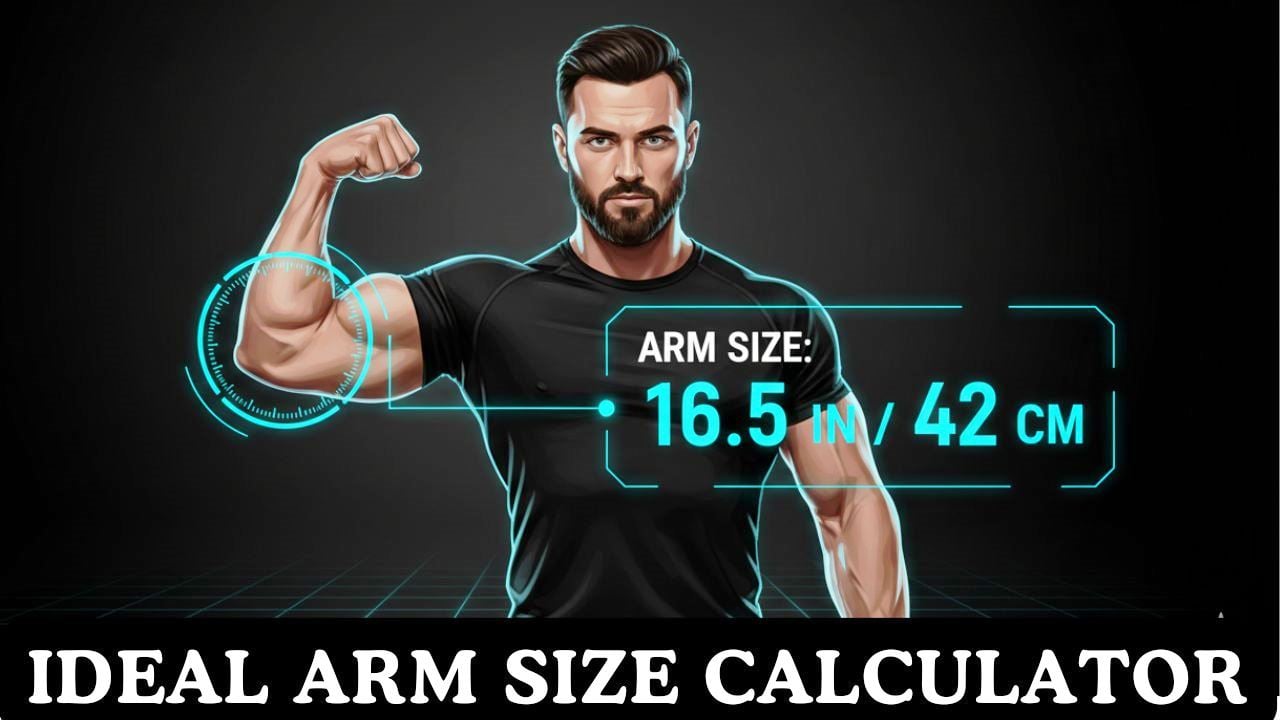
Ideal arm size refers to bicep and forearm measurements that create balanced, proportional upper body development. Unlike arbitrary numbers, ideal arm measurements are relative to your skeletal structure (wrist circumference), height, body frame, and fitness objectives. This personalized approach ensures realistic, achievable targets.
The concept gained prominence through bodybuilder Steve Reeves in the 1940s, who demonstrated that aesthetic proportions follow mathematical ratios based on bone structure. Modern exercise science combines his wrist-based formula with height-proportional methods and the golden ratio (1:0.806) for bicep-to-forearm balance.
For comprehensive arm training programs, see our bicep exercises guide and complete arm workouts.
Calculation Methods & Formulas
Ideal Bicep = Wrist Circumference × 2.5
Ideal Forearm = Ideal Bicep × 0.806
Bicep Calculation:
17.5 × 2.5 = 43.75 cm (17.2 inches)
Forearm Calculation:
43.75 × 0.806 = 35.3 cm (13.9 inches)
Result: Ideal bicep = 43.75 cm, ideal forearm = 35.3 cm
Ideal Bicep = Height × 0.20
Ideal Forearm = Ideal Bicep × 0.806
Bicep Calculation:
175 × 0.20 = 35 cm (13.8 inches)
Forearm Calculation:
35 × 0.806 = 28.2 cm (11.1 inches)
Result: Ideal bicep = 35 cm, ideal forearm = 28.2 cm
1. Calculate average of Methods 1 & 2
2. Apply body type multiplier (0.94-1.06)
3. Apply goal multiplier (0.95-1.05)
4. Calculate forearm (Bicep × 0.806)
Method 2 Result: 35 cm
Average: (43.75 + 35) / 2 = 39.4 cm
Body Type (Mesomorph): 39.4 × 1.0 = 39.4 cm
Goal (Aesthetics): 39.4 × 1.0 = 39.4 cm
Final Ideal Bicep: 39.4 cm (15.5 inches)
Final Ideal Forearm: 39.4 × 0.806 = 31.8 cm (12.5 inches)
Body Types & Arm Development
| Body Type | Characteristics | Multiplier | Training Approach |
|---|---|---|---|
| Ectomorph | Lean, narrow frame, small wrists | 0.94 | Higher volume (15-20 sets/week), calorie surplus required |
| Mesomorph | Athletic, medium frame, builds muscle easily | 1.0 | Balanced approach (12-16 sets/week), progressive overload |
| Endomorph | Stocky, thick wrists, stores fat easily | 1.06 | Moderate volume (12-15 sets/week), focus on definition |
How to Measure Arms Correctly
Bicep Measurement Technique
Step 1: Bend arm to 90° angle at elbow
Step 2: Flex bicep as hard as possible
Step 3: Wrap tape at peak (thickest point)
Step 4: Keep tape snug but not tight, level with floor
Step 5: Record at peak flex
Step 6: Measure both arms, use larger measurement
Common mistakes: measuring relaxed (underestimates), tape not at peak, pulling too tight, or inconsistent location. For proper warm-up before measuring, see our muscle recovery guide.
Forearm Measurement Technique
Step 1: Extend arm fully or slight bend
Step 2: Make tight fist or flex forearm
Step 3: Measure at widest point (2-3 inches below elbow)
Step 4: Keep tape level and snug
Step 5: Record at peak flex
Learn proper forearm training techniques to develop balanced arms.
Average Arm Sizes by Training Level
| Training Level | Average Bicep Size | Description |
|---|---|---|
| Untrained | 30-33 cm (12-13 in) | Average adult with no resistance training |
| Beginner (6-12 months) | 33-36 cm (13-14 in) | Consistent training, basic development |
| Intermediate (1-3 years) | 36-40 cm (14-16 in) | Solid foundation, noticeable development |
| Advanced (3-5 years) | 40-45 cm (16-18 in) | Significant mass, approaching genetic limits |
| Elite Natural (5+ years) | 45-48 cm (18-19 in) | Near maximum, rare naturally |

Manish is a NASM-certified fitness and nutrition coach with over 10 years of experience in weight lifting and fat loss fitness coaching. He specializes in gym-based training and has a lot of knowledge about exercise, lifting technique, biomechanics, and more.
Through “Fit Life Regime,” he generously shares the insights he’s gained over a decade in the field. His goal is to equip others with the knowledge to start their own fitness journey.