This is an arm workout covers both sides of the upper arm: 10 biceps exercises, 10 triceps exercises, and two weekly routines (beginner and intermediate) built from them. Each exercise has a short how-to and a link to its full guide.
If you only want the plan, jump to the routines. The short version: train your arms two days a week, do about 8 to 12 hard sets for the front of the arm and the same for the back, and add weight slowly.
The reasons are in the routine section, with the research that supports each choice. If you also want to match your calories to your goal, use the TDEE calculator.

- Arm Muscles
- Biceps Exercises for Bigger Arms
- 1. Barbell Curl
- 2. Preacher Curl
- 3. Hammer Curl
- 4. Incline Dumbbell Curl
- 5. Chin-Up
- 6. Zottman Curl
- 7. Cable Curl
- 8. One-Arm High Cable Curl
- 9. Barbell Spider Curl
- 10. Barbell Reverse Curl
- Triceps Exercises for Bigger Arms
- 1. Cable Overhead Triceps Extension
- 2. Two-Arm Overhead Dumbbell Extension
- 3. Triceps Pushdown
- 4. Rope Pushdown
- 5. Cable One-Arm Reverse-Grip Pushdown
- 6. Lying Triceps Extension (Skull Crusher)
- 7. Close-Grip Bench Press
- 8. Parallel Bar Triceps Dip
- 9. Diamond Push-Up
- 10. Dumbbell Triceps Kickback
- Video: Biceps and Triceps Exercises
- Arm Workout Routines for Men
- What the Research Says About Sets, Reps and Frequency
- Beginner Arm Workout (2 Days per Week)
- Intermediate Arm Workout (2 Days per Week)
- How to Progress
- Frequently Asked Questions
- How many days a week should I train arms?
- Should I train biceps and triceps on the same day?
- Are bigger arms mostly about the triceps?
- What rep range builds the most muscle?
- References
Arm Muscles
The upper arm has two sides. The front (anterior) compartment holds three muscles: the biceps brachii, the brachialis and the coracobrachialis. The back (posterior) compartment holds one: the triceps brachii. StatPearls describes this layout, and a second StatPearls chapter covers each muscle.
- Biceps brachii has two heads and crosses both the shoulder and the elbow. It bends the elbow and is also the forearm’s most powerful supinator (it turns the palm up) when the elbow is bent. (StatPearls)
- Brachialis sits under the biceps and bends the elbow in every forearm position. It is described as the strongest elbow flexor when the forearm is not supinated. (StatPearls)
- Brachioradialis is a forearm muscle on the thumb side. It helps bend the elbow whether the palm faces up, in or down, which is why it shows up in curl exercises. (StatPearls) More in the brachioradialis guide.
- Triceps brachii has three heads (long, lateral and medial). All three extend the elbow, and the long head also crosses the shoulder. (StatPearls)


You will often read that the triceps makes up about two-thirds of the upper arm. We could not trace that figure to a source, so it is not repeated here.
What the anatomy sources do show is that the triceps is the only muscle on the back of the arm and a large one, so it deserves as much attention as the biceps.
Biceps Exercises for Bigger Arms
The list covers straight-bar curls, grip changes (hammer, Zottman, reverse), angle changes (incline, preacher, spider), cable options, and one pull (the chin-up).
1. Barbell Curl
The barbell curl is the standard biceps lift. It works the biceps and brachialis, and your forearms hold the bar. It usually lets you use a heavier load than most curl variations.
In an EMG test of 12 people, straight-bar and EZ-bar curls kept the biceps more active than dumbbell curls, most clearly in the lowering phase.
The two bars differed little, so pick the one that is comfortable on your wrists. See the full guide on barbell curls.

How to do it
- Stand holding a barbell with an underhand grip, hands about shoulder-width apart.
- Keep your elbows by your sides and your upper arms still.
- Curl the bar toward your shoulders until your biceps are fully shortened.
- Lower the bar under control until your arms are straight.
Tips
- Pause briefly at the top instead of swinging the bar up.
- Let the movement happen at the elbow. If your shoulders and back are helping, the weight is too heavy.
2. Preacher Curl
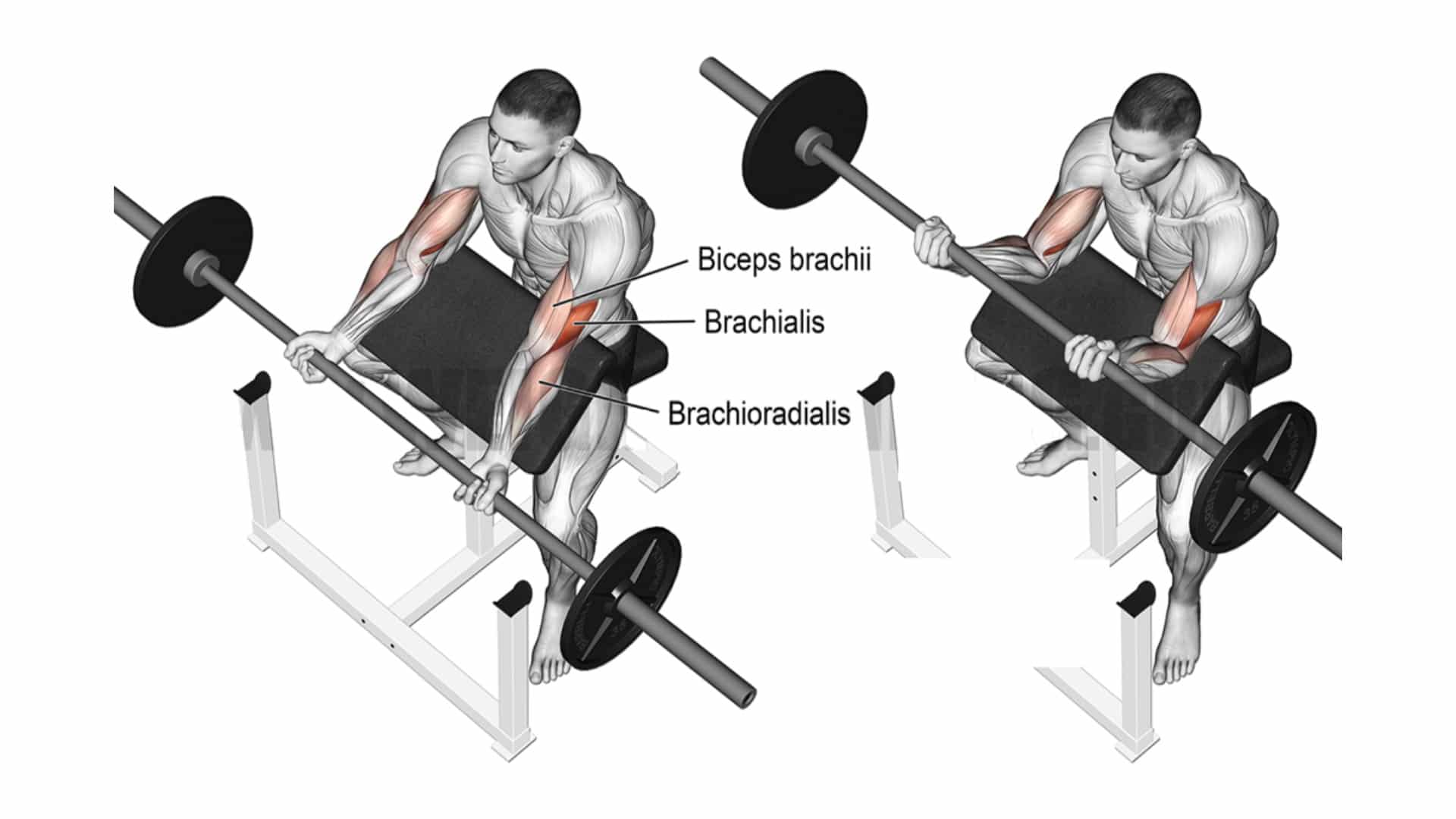
The preacher pad holds your upper arms in front of your body, which makes cheating hard. In a 12-week trial of 21 untrained adults, researchers compared preacher and incline dumbbell curls (5 sets of 10, twice a week).
Preacher curls grew the brachialis and brachioradialis more, while incline curls grew the biceps more, and total elbow flexor growth was not different.
A separate 8-week trial in 63 young women found more distal (near the elbow) growth after preacher curls than after incline curls. See preacher curl variations.
How to do it
- Sit with your chest against the pad and your upper arms flat on it, palms facing up.
- Lower the weight until your arms are almost straight.
- Curl until the bar or dumbbells reach shoulder height.
- Lower slowly rather than dropping the weight.
Tips
- Keep your upper arms on the pad for the whole set.
- Stop just short of locking out at the bottom if the front of the elbow feels strained.
3. Hammer Curl
The hammer curl uses a neutral grip, palms facing each other. It is usually described as an exercise for the brachialis and brachioradialis. The evidence is thin: in a small EMG test of 10 bodybuilders, biceps activity during the lifting phase was about 12 percentage points lower with a palms-in grip than with a palms-up grip, and brachioradialis activity was about 6 points lower.
The brachialis was not measured, so the usual explanation (it works harder when the palm is not facing up) rests on anatomy, not on that test. Treat it as a useful variation, not a replacement for the standard curl.
Compare the grips in curl vs hammer curl vs reverse curl or try the cable hammer curl.

How to do it
- Hold a dumbbell in each hand with your palms facing your thighs.
- Keep your elbows by your sides and your upper arms still.
- Curl the dumbbells toward your shoulders without turning your wrists.
- Lower them slowly to the start.
Tips
- Do not lean back or swing the weights.
- Stay in control as you lower the weight. The lowering phase is part of the set.
4. Incline Dumbbell Curl
Sitting back on an incline bench puts your shoulders behind your body, so the biceps starts more stretched. In the 12-week trial above, incline curls grew the biceps brachii more than preacher curls (+22.1% vs +18.9%). The participants were untrained, so results may differ for experienced lifters.
An older EMG test of 22 people found that incline and standard dumbbell curls kept the biceps long head working through the whole range, while the preacher curl did so only over a short part of it. See the full incline dumbbell curl guide.

How to do it
- Set an incline bench to about 45 degrees and sit back with your feet flat on the floor.
- Let your arms hang straight down with your palms facing forward.
- Curl both dumbbells up toward your shoulders without moving your upper arms forward.
- Lower slowly until your arms are straight again.
Tips
- Keep your head and back against the bench.
- Use a full range, because the stretched bottom position is the point of this exercise.
5. Chin-Up
The chin-up is a back exercise that also loads the biceps hard. In an EMG test of 25 adults across three pull-up variations, the latissimus dorsi had the highest activity (117 to 130% of a maximal contraction), with the biceps brachii at 78 to 96%.
The biceps and pectoralis major were more active in the chin-up than in the pull-up. So it is not a biceps-only move, but it is a useful compound option for the arms. See pull-up and chin-up muscles worked.

How to do it
- Hang from a bar with an underhand grip, hands about shoulder-width apart.
- Brace your core and keep your body in a straight line.
- Pull until your chin is above the bar.
- Lower yourself under control until your arms are nearly straight.
Tips
- Do full reps instead of chasing numbers with half reps.
- If you cannot do one yet, use an assisted chin-up machine or a band, or lower yourself slowly from the top.
6. Zottman Curl
The Zottman curl combines two curls in one rep: you lift with a palms-up grip and lower with a palms-down grip.
It is a technique drill as much as a strength move, so start with lighter dumbbells than you would use for a standard curl while you learn the wrist rotation. See Zottman curl form and variations.

How to do it
- Hold a dumbbell in each hand at your sides, palms facing forward.
- Curl both dumbbells up to your shoulders.
- At the top, rotate your wrists so your palms face down.
- Lower the dumbbells slowly with the overhand grip.
- At the bottom, rotate your palms back to face forward and repeat.
Tips
- Rotate your wrists smoothly at the top and bottom instead of jerking them.
- You can lift with both arms together or alternate arms.
7. Cable Curl
The cable curl is easy to learn and works well for beginners. Free-weight curls are hardest in the middle of the lift and easier at the very bottom, because gravity pulls straight down.
A cable at a low pulley pulls at an angle, so there is usually some tension at the bottom of the rep.
We did not find growth research comparing cable and dumbbell curls, so pick the one you can load steadily and enjoy. See also the biceps cable workout.

How to do it
- Attach a straight bar to the low pulley and grip it with your palms up, hands shoulder-width apart.
- Stand tall with your elbows by your sides.
- Curl the bar toward your shoulders by bending your elbows.
- Lower it slowly until your arms are straight.
Tips
- Keep your elbows against your sides so the shoulders do not take over.
- Lower the weight slowly. Do not let the stack drop back.
8. One-Arm High Cable Curl
In the high cable curl your arm is raised to about shoulder height and you curl the handle toward your head.
It works as a finisher because you can train one arm at a time and match both sides. There is no research showing it builds more muscle than other curls, but it is an easy way to add volume once the main lifts are done.

How to do it
- Stand sideways to a high pulley and take the handle in the hand closest to the machine, arm out to the side at about shoulder height.
- Curl the handle toward your head by bending your elbow, keeping your upper arm in place.
- Pause for a second at the top and squeeze.
- Straighten your arm slowly, then finish your reps and switch sides.
Tips
- Keep your elbow level with your shoulder instead of letting it drop.
- Match the number of reps on both arms.
9. Barbell Spider Curl
For the spider curl you lie chest-down on an incline bench with your arms hanging in front of you.
That means your upper arms stay in front of your torso, like the preacher curl, which limits how much momentum you can use. See spider curls.

How to do it
- Set an incline bench to about 45 degrees and lie with your chest against the pad, feet on the floor.
- Let your arms hang straight down holding a barbell with an underhand grip.
- Curl the bar toward your shoulders.
- Pause, then lower the bar slowly until your elbows are straight.
Tips
- Use a lighter load than your standing barbell curl.
- Keep your chest on the pad so your upper arms stay vertical.
10. Barbell Reverse Curl
The reverse curl uses an overhand grip. It is usually recommended for the brachialis and forearms, but that rests on anatomy, not measurement.
In the EMG test of bodybuilders mentioned under hammer curls, the overhand grip gave about 19 percentage points less biceps activity and about 5 points less brachioradialis activity than the palms-up grip, and the brachialis was not measured.
Use it as a variation, with a bar lighter than your normal curl. See reverse curl muscles worked and variations.

How to do it
- Hold a barbell with an overhand grip, hands about shoulder-width apart.
- Keep your elbows by your sides.
- Curl the bar to shoulder level by bending your elbows.
- Lower it slowly until your arms are straight.
Tips
- Keep your wrists straight rather than letting them bend back.
- Do not lean back to get the bar up.
Triceps Exercises for Bigger Arms
The triceps has three heads, and the long head crosses the shoulder joint. That detail matters for exercise choice. In a 12-week trial of 21 adults, researchers had each person train one arm with cable elbow extensions overhead and the other with the arm by the side. The overhead arm grew more: whole triceps +19.9% vs +13.9%, and the long head +28.5% vs +19.6%, even though lighter loads were used. So the list starts with overhead movements.
1. Cable Overhead Triceps Extension
This is the closest everyday version of the movement used in the overhead-versus-neutral trial above. Because your arms are overhead, the long head starts stretched. See the full guide on the overhead cable triceps extension.

How to do it
- Attach a rope to the low pulley and face away from the machine.
- Hold the rope in both hands with your palms facing each other and bring your hands above and behind your head.
- Keep your upper arms close to your head and extend your elbows until your arms are straight above you.
- Return slowly until your triceps are stretched.
Tips
- Keep your ribs down and your core braced so your lower back does not arch.
- Use a weight you can control through the whole range.
2. Two-Arm Overhead Dumbbell Extension
This is the dumbbell version of an overhead extension, so the long head is stretched here too. The research above used cables, so we cannot say the dumbbell version gives the same result, but the arm position is the same.
See seated triceps extension and overhead extension variations.

How to do it
- Sit on a bench with back support and hold one dumbbell with both hands, resting on the underside of the top plate.
- Raise it overhead with your arms straight.
- Lower the dumbbell behind your head by bending your elbows only.
- Extend your elbows to return to the top.
Tips
- Keep your upper arms close to your head and your neck neutral.
- Start with a light dumbbell until the stretched position at the bottom feels comfortable.
3. Triceps Pushdown
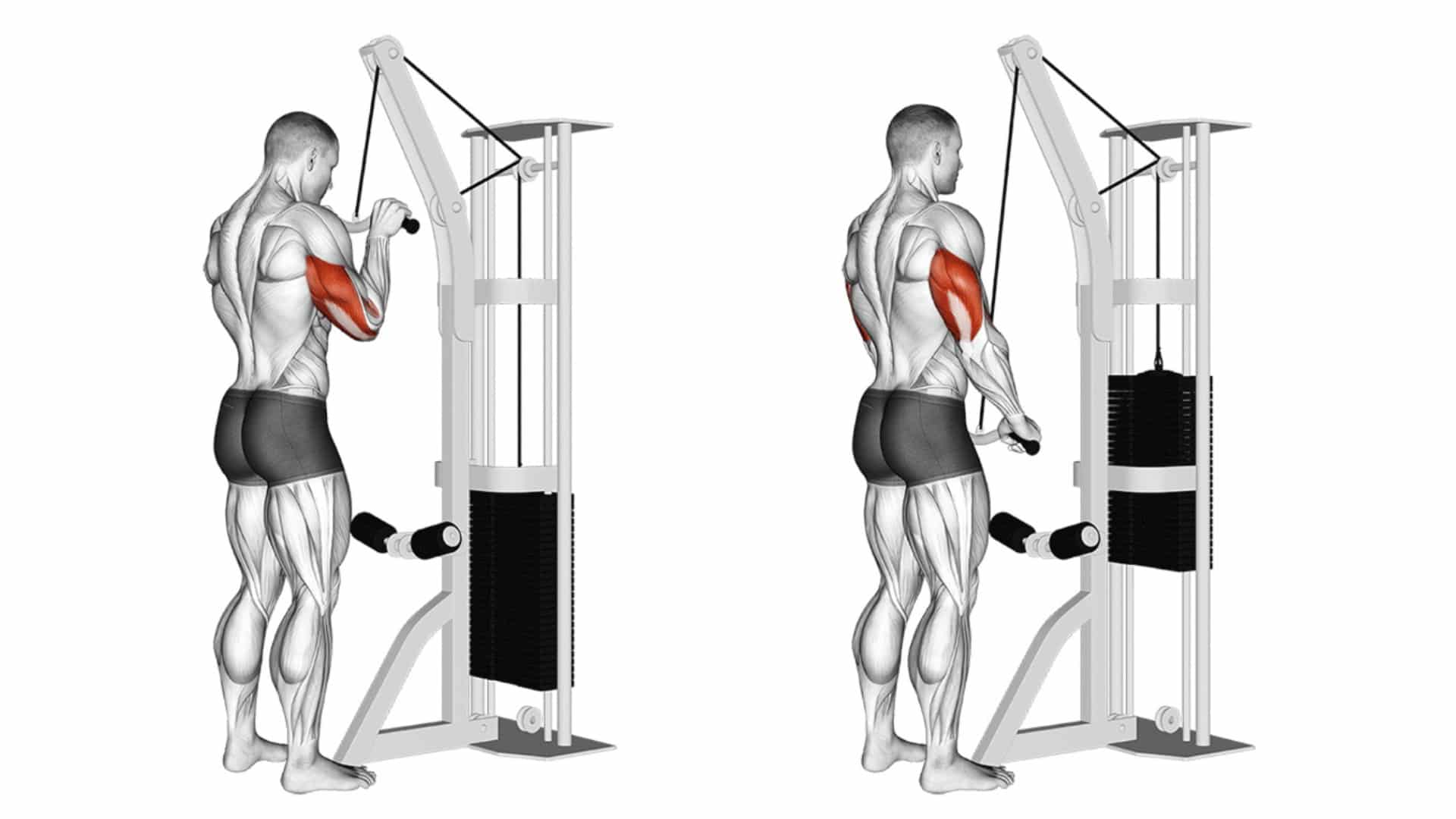
The triceps pushdown is simple and the cable stack lets you add weight in small steps. A straight bar, V-bar or EZ bar all work, so use the attachment that is comfortable on your wrists.
In a small EMG test of pushdowns with different handle types, triceps activity did not differ between handles, though forearm muscle activity did. See the full triceps pushdown guide.
How to do it
- Stand facing a high pulley with a short straight bar and your hands about shoulder-width apart, palms down.
- Bend your knees slightly and keep your elbows tight against your sides.
- Extend your elbows until your arms are straight.
- Pause briefly, then let the bar rise slowly.
Tips
- Keep your elbows still and do the work with your triceps, not your shoulders.
- Stand upright instead of leaning over the bar.
4. Rope Pushdown
The rope lets your hands rotate and move apart at the bottom, which some lifters find easier on the wrists and elbows than a straight bar. See pushdown variations for more options.

How to do it
- Face a high pulley with a rope attachment, feet shoulder-width apart.
- Grip the ends of the rope with your palms facing in and your elbows by your waist.
- Push down until your arms are straight, spreading the ends of the rope slightly at the bottom.
- Return slowly to the start.
Tips
- Keep your elbows by your sides throughout.
- Pause at the bottom and squeeze your triceps.
5. Cable One-Arm Reverse-Grip Pushdown
The one-arm version lets you work each arm separately and check that the weaker arm is keeping up. The underhand grip feels different from a standard pushdown, but we did not find research showing it shifts work to a particular head.

How to do it
- Attach a single handle to a high pulley and grip it with your palm facing up.
- Keep your elbow against your side and press the handle down until your arm is straight.
- Pause, then let the handle rise slowly until your forearm is about parallel to the floor.
- Finish your reps, then switch arms.
Tips
- Keep your upper arm still. Only your forearm should move.
- Do not use your free hand to help once you are past the first few reps.
6. Lying Triceps Extension (Skull Crusher)
In the lying triceps extension you lower the weight toward your head and extend your elbows to bring it back up. It can be done with a barbell, EZ bar or dumbbells.
See the full guide on the lying triceps extension.

How to do it
- Lie on a flat bench with your feet on the floor and hold the weight over your chest with your arms straight.
- Keeping your upper arms still, bend your elbows to lower the weight toward your forehead.
- Extend your elbows to push the weight back up.
Tips
- Keep the movement at your elbows and your upper arms still.
- Go slowly and use a weight you can control. Switch to dumbbells or an EZ bar if a straight bar bothers your wrists.
7. Close-Grip Bench Press
The close-grip bench press is a compound lift that works the triceps along with the chest and front shoulders. It lets you use heavy loads. See close-grip bench press form and muscles worked.

How to do it
- Lie flat on a bench with your feet on the floor.
- Grip the bar with your hands about shoulder-width apart.
- Unrack the bar and lower it to your lower chest with your elbows fairly close to your body.
- Press the bar back up until your arms are straight.
Tips
- Keep your hands about shoulder-width apart. A very narrow grip can bother the wrists.
- Use a spotter when you are lifting heavy.
8. Parallel Bar Triceps Dip
The dip works the triceps and chest, and it is a bodyweight option that is easy to make harder with added weight. In an EMG test of 13 experienced men, the bar dip produced higher peak triceps activity than the bench dip, and the bench dip needed more shoulder extension, which the authors flagged for anyone with shoulder pain. See tricep dips and variations.

How to do it
- Support yourself on parallel bars with your arms straight and your body upright.
- Lower yourself by bending your elbows, keeping them close to your sides, until your upper arms are about parallel to the floor.
- Press through your hands to straighten your arms.
Tips
- If the front of your shoulder hurts at the bottom, reduce the depth.
- Use an assisted dip machine or a band if you cannot do bodyweight reps yet.
9. Diamond Push-Up
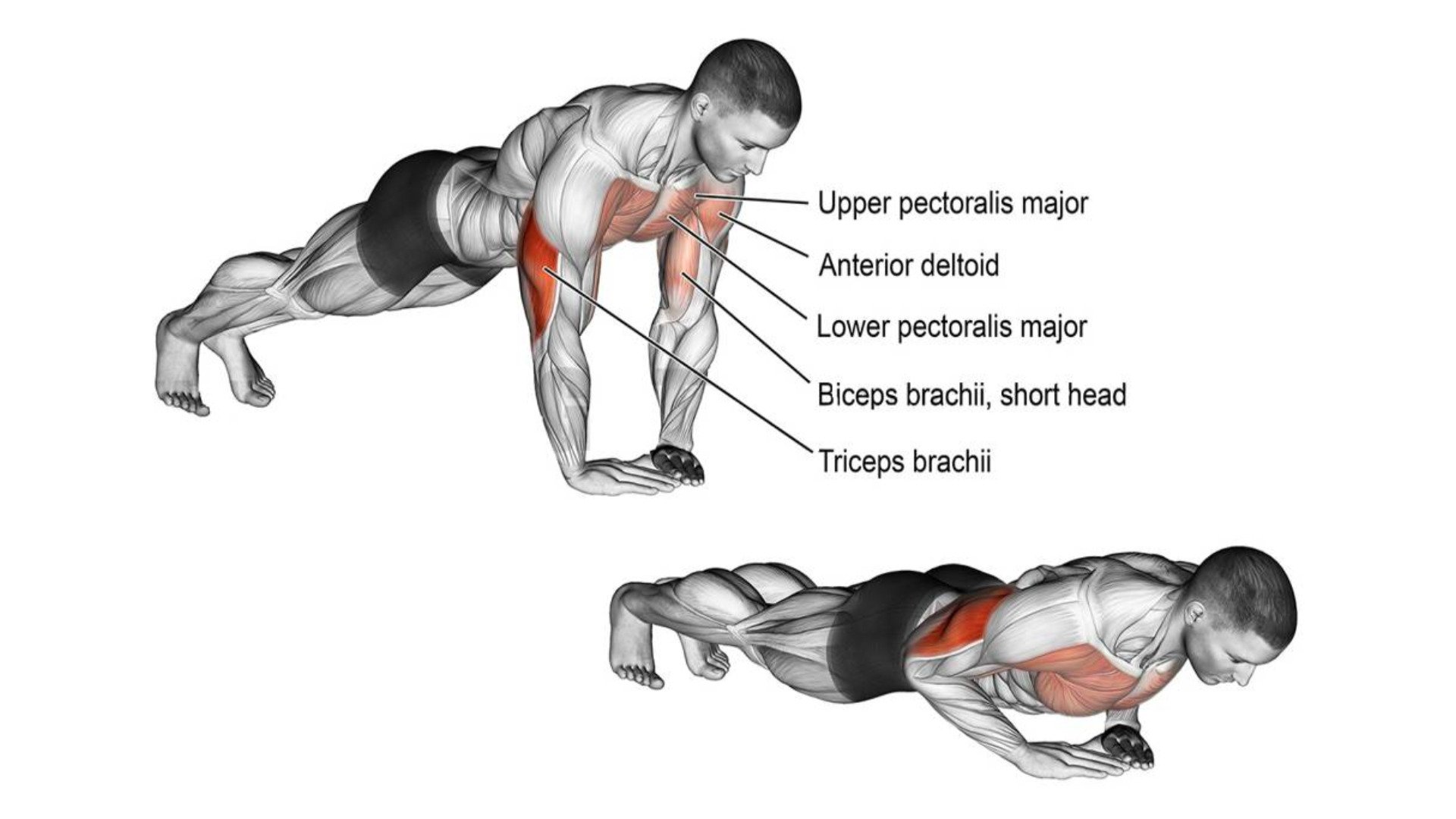
Diamond push-ups are a push-up with your hands close together, forming a diamond under your chest. They need no equipment, so they work at home. See diamond push-ups.
How to do it
- Start in a plank with your hands together under your chest, thumbs and index fingers forming a diamond.
- Keep your body in a straight line from head to heels.
- Lower your chest toward your hands, keeping your elbows from flaring out too wide.
- Push back up until your arms are straight.
Tips
- Do them from your knees to make them easier.
- Stop a little before your chest touches your hands if your wrists or elbows complain.
10. Dumbbell Triceps Kickback
The kickback is an isolation exercise, so it works the triceps without the chest or shoulders doing much. The weight needed is small, so do not expect to load it heavy. See dumbbell triceps kickbacks.

How to do it
- Place your right knee and right hand on a flat bench so your torso is roughly parallel to the floor.
- Hold a dumbbell in your left hand with your upper arm tight against your side and parallel to the floor.
- Extend your elbow until your arm is straight behind you.
- Pause for a second, then lower slowly. Finish your reps, then switch sides.
Tips
- Keep your upper arm still and move only your forearm.
- Use a light weight and a slow tempo.
Video: Biceps and Triceps Exercises
Arm Workout Routines for Men
These two routines use the exercises above. They are examples built from the research below, not formulas proven to be the single best option.
What the Research Says About Sets, Reps and Frequency
- Weekly sets: A meta-analysis of 15 studies found a graded relationship between weekly sets and muscle growth: on average, more sets per muscle meant more growth. Each extra weekly set was linked to about 0.37% more gain. (Schoenfeld 2017)
- Reps and load: Across 21 trials with sets taken to failure, muscle growth was similar with lighter and heavier loads. Heavier loads were better for 1RM strength. (Schoenfeld 2017) That is why 8 to 12 reps is a practical middle ground, not a rule.
- Frequency: A meta-analysis of 25 studies found that, when weekly volume was the same, training a muscle more often did not meaningfully change growth. (Schoenfeld 2019) Two arm sessions a week is a convenient choice, not a requirement.
- Rest between sets: About 1 to 2 minutes works for most arm exercises. This is a practical guideline and not drawn from the research above.
Keep in mind that chin-ups, rows, bench press and dips already work your arms. If you train those hard, you may not need as many direct arm sets.
Beginner Arm Workout (2 Days per Week)
Do the same workout twice a week, for example Monday and Thursday. This gives about 8 weekly sets for the front of the upper arm and 8 for the back. Choose a weight that lets you finish each set in the 8 to 12 range with the last two reps hard.
| Exercise | Sets | Reps |
|---|---|---|
| Barbell curl or dumbbell curl | 2 | 8-12 |
| Hammer curl | 2 | 8-12 |
| Seated overhead dumbbell extension | 2 | 8-12 |
| Triceps pushdown | 2 | 8-12 |
Intermediate Arm Workout (2 Days per Week)
Two different sessions a week, giving about 12 weekly sets for the front of the arm and 12 for the back. Day A uses incline curls and Day B uses preacher curls, because the 12-week trial above found each one grew different elbow flexors a little more. Each day includes an overhead triceps extension.
| Day | Exercise | Sets | Reps |
|---|---|---|---|
| A | Incline dumbbell curl | 3 | 8-12 |
| A | Hammer curl | 3 | 8-12 |
| A | Cable overhead triceps extension | 3 | 8-12 |
| A | Close-grip bench press | 3 | 6-10 |
| B | Preacher curl | 3 | 8-12 |
| B | Barbell reverse curl | 3 | 10-12 |
| B | Seated overhead dumbbell extension | 3 | 8-12 |
| B | Rope pushdown | 3 | 10-12 |
How to Progress
- When you can finish every set at the top of the rep range with good form, add a small amount of weight and work back up from the bottom of the range.
- Add sets slowly. The meta-analysis shows more sets tends to mean more growth on average, but it cannot tell you how much your elbows and recovery will tolerate.
- If you want recovery guidance, try the muscle recovery calculator.
Frequently Asked Questions
How many days a week should I train arms?
Two days a week is a practical default. A meta-analysis of 25 studies found no meaningful difference in muscle growth between lower and higher training frequencies when weekly volume was matched, so one long session or three shorter ones can also work. Pick the schedule you can stick to.
Should I train biceps and triceps on the same day?
Either works. A 2025 narrative review of supersets, which included alternating opposing muscles such as biceps and triceps, found that muscle growth was generally similar to doing straight sets, while the session took less time.
The studies in that review varied a lot, so treat it as a tentative answer. If your arms are too tired to keep good form on the second muscle, split them across days and keep the weekly sets the same. (Mang 2025)
Are bigger arms mostly about the triceps?
You will often hear that the triceps is two-thirds of the upper arm. We could not trace that figure to a source. What the anatomy sources do show is that the back of the arm holds only the triceps while the front holds three muscles (biceps, brachialis and coracobrachialis). Train both sides.
What rep range builds the most muscle?
Across 21 trials where sets were taken to failure, lighter and heavier loads built muscle about equally, while heavier loads gave greater gains in maximal strength. A range of 8 to 12 reps is a practical choice, but lighter sets of 15 to 20 or heavier sets of 5 to 8 can also build muscle when the sets are hard, as they were in the studies (taken to failure).
References
- Kobayashi Y, Maeo S, et al. Exercise-specific preferential hypertrophy of individual elbow flexor muscles after incline versus preacher dumbbell curl training. J Sports Sci. 2026;44(23):3288-3301. PubMed
- Kassiano W, Costa B, et al. Distinct muscle growth and strength adaptations after preacher and incline biceps curls. Int J Sports Med. 2025;46(5):334-343. PubMed
- Maeo S, Wu Y, et al. Triceps brachii hypertrophy is substantially greater after elbow extension training performed in the overhead versus neutral arm position. Eur J Sport Sci. 2023;23(7):1240-1250. PubMed
- Pedrosa GF, Simoes MG, et al. Training in the initial range of motion promotes greater muscle adaptations than at final in the arm curl. Sports (Basel). 2023;11(2):39. PubMed
- Youdas JW, Amundson CL, et al. Surface electromyographic activation patterns and elbow joint motion during a pull-up, chin-up, or Perfect-Pullup rotational exercise. J Strength Cond Res. 2010;24(12):3404-3414. PubMed
- Coratella G, Tornatore G, et al. Biceps brachii and brachioradialis excitation in biceps curl exercise: different handgrips, different synergy. Sports (Basel). 2023;11(3):64. PubMed
- Schoenfeld BJ, Grgic J, Ogborn D, Krieger JW. Strength and hypertrophy adaptations between low- vs. high-load resistance training: a systematic review and meta-analysis. J Strength Cond Res. 2017;31(12):3508-3523. PubMed
- Schoenfeld BJ, Ogborn D, Krieger JW. Dose-response relationship between weekly resistance training volume and increases in muscle mass: a systematic review and meta-analysis. J Sports Sci. 2017;35(11):1073-1082. PubMed
- Schoenfeld BJ, Grgic J, Krieger J. How many times per week should a muscle be trained to maximize muscle hypertrophy? J Sports Sci. 2019;37(11):1286-1295. PubMed
- Marcolin G, Panizzolo FA, et al. Differences in electromyographic activity of biceps brachii and brachioradialis while performing three variants of curl. PeerJ. 2018;6:e5165. PubMed
- Oliveira LF, Matta TT, et al. Effect of the shoulder position on the biceps brachii EMG in different dumbbell curls. J Sports Sci Med. 2009;8(1):24-29. PubMed
- Rendos NK, Heredia Vargas HM, et al. Differences in muscle activity during cable resistance training are influenced by variations in handle types. J Strength Cond Res. 2016;30(7):2001-2009. PubMed
- McKenzie A, Crowley-McHattan Z, et al. Bench, bar, and ring dips: do kinematics and muscle activity differ? Int J Environ Res Public Health. 2022;19(20):13211. PubMed
- Mang ZA, Beam JR, Kravitz L. The acute and chronic effects of superset resistance training versus traditional resistance training: a narrative review. J Strength Cond Res. 2025;39(11):1216-1234. PubMed
- Haugen ME, Varvik FT, et al. Effect of free-weight vs. machine-based strength training on maximal strength, hypertrophy and jump performance: a systematic review and meta-analysis. BMC Sports Sci Med Rehabil. 2023;15(1):103. PubMed
- Tiwana MS, Charlick M, Varacallo MA. Anatomy, shoulder and upper limb, biceps muscle. StatPearls. NCBI Bookshelf
- Tiwana MS, Sinkler MA, Bordoni B. Anatomy, shoulder and upper limb, triceps muscle. StatPearls. NCBI Bookshelf
- Lung BE, Ekblad J, Bisogno M. Anatomy, shoulder and upper limb, forearm brachioradialis muscle. StatPearls. NCBI Bookshelf
- Anatomy, shoulder and upper limb, brachialis muscle. StatPearls. NCBI Bookshelf
- Anatomy, shoulder and upper limb, arm muscles. StatPearls. NCBI Bookshelf
- Anatomy, shoulder and upper limb, arm structure and function. StatPearls. NCBI Bookshelf

Manish is a NASM-certified fitness and nutrition coach with over 10 years of experience in weight lifting and fat loss fitness coaching. He specializes in gym-based training and has a lot of knowledge about exercise, lifting technique, biomechanics, and more.
Through “Fit Life Regime,” he generously shares the insights he’s gained over a decade in the field. His goal is to equip others with the knowledge to start their own fitness journey.