
💪 Lat Pulldown Calories Burned Calculator
Calculate energy expenditure during lat pulldown training using scientifically validated MET values and exercise physiology
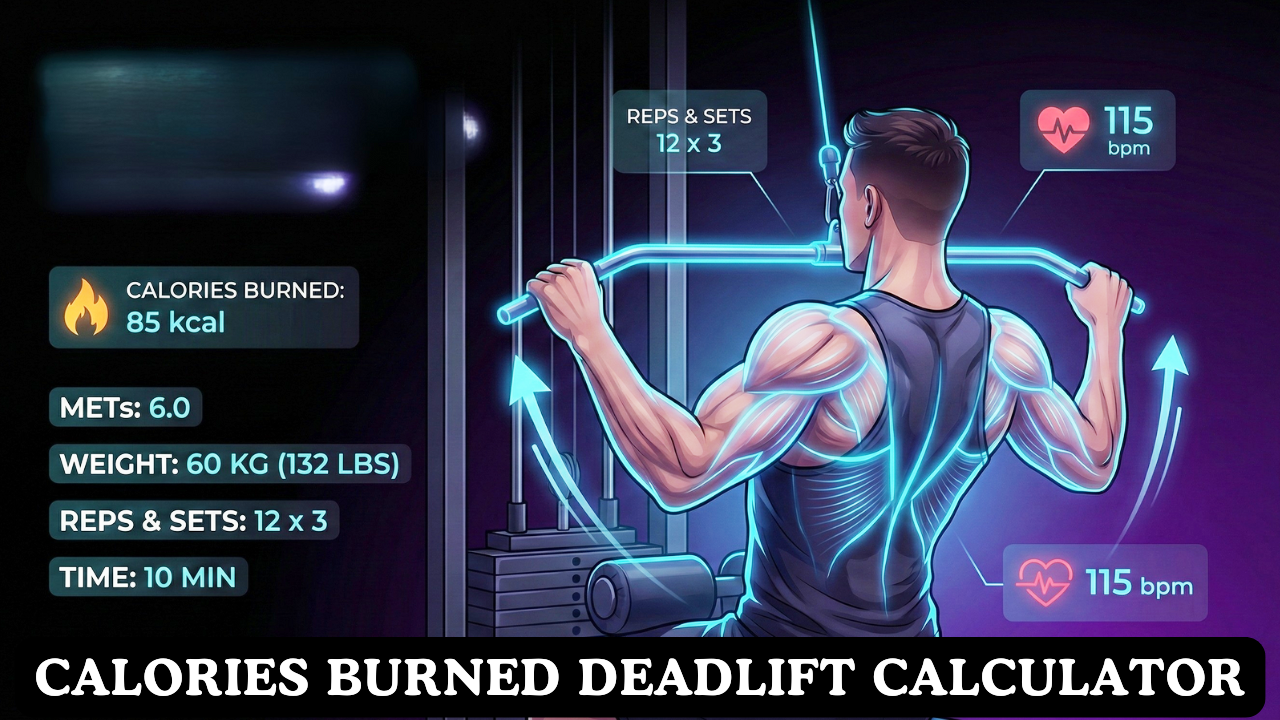
How Many Calories Do Lat Pulldowns Burn?
Calorie Burn During Lat Pulldown Training: What to Expect
Lat pulldowns burn approximately 150-220 calories per 30-minute session for a 155 lb (70 kg) person performing standard strength training (5.0-6.0 MET), making them a moderate-calorie upper body exercise. A typical lat pulldown workout burns 5-7 calories per minute during active work, with circuit-style training burning up to 9 calories per minute when accounting for post-exercise oxygen consumption (EPOC).
As an isolation exercise targeting the latissimus dorsi (lats), rhomboids, and biceps, lat pulldowns burn fewer calories than compound movements like deadlifts or squats because they engage less total muscle mass. However, they remain excellent for back development and upper body conditioning when combined with a comprehensive training program.
Calories = (MET × 3.5 × Body Weight in kg ÷ 200) × Duration in minutes
Calories = (5.5 × 3.5 × 73 ÷ 200) × 30
Calories = (7.01) × 30 = 210 calories burned
EPOC Effect: Unlike heavy compound lifts, lat pulldowns create modest EPOC (Excess Post-Exercise Oxygen Consumption), burning an additional 5-8% of workout calories over the next 12-24 hours. A 210-calorie session may burn 221-227 total calories with EPOC. Combine lat pulldowns with compound movements for maximum calorie expenditure.
Calories Burned by Training Duration & Body Weight
Body weight significantly impacts calorie expenditure. Here's comprehensive data for lat pulldowns at 5.5 MET (standard upper body training intensity):
| Body Weight | 15 Minutes | 30 Minutes | 45 Minutes | 60 Minutes |
|---|---|---|---|---|
| 130 lbs (59 kg) | 85 cal | 170 cal | 255 cal | 340 cal |
| 150 lbs (68 kg) | 98 cal | 196 cal | 294 cal | 392 cal |
| 160 lbs (73 kg) | 105 cal | 210 cal | 315 cal | 420 cal |
| 180 lbs (82 kg) | 118 cal | 236 cal | 353 cal | 471 cal |
| 200 lbs (91 kg) | 131 cal | 262 cal | 393 cal | 524 cal |
| 220 lbs (100 kg) | 144 cal | 288 cal | 431 cal | 575 cal |
Key Insight: Heavier individuals burn 69% more calories—a 220 lb person burns 575 calories per hour vs 340 calories for a 130 lb person during identical workouts. These values represent workout calories at 5.5 MET; add 5-8% for EPOC effect with vigorous training.
Calories Burned by Training Style & Intensity
Training approach dramatically affects energy expenditure. Here's how different styles compare for a 160 lb (73 kg) person during 30 minutes:
| Training Style | MET Value | Description | Calories (30 min) |
|---|---|---|---|
| Circuit/Superset Training | 7.5 | 30-45 sec rest, continuous work | 287 cal |
| Volume/Hypertrophy Training | 6.0 | 60-90 sec rest, 8-12 reps | 229 cal |
| Standard Strength Training | 5.5 | 90-120 sec rest, moderate volume | 210 cal |
| Heavy Strength (Low Reps) | 5.0 | 2-3 min rest, 3-6 reps | 191 cal |
| Light/Technique Work | 4.0 | 50-60% effort, form practice | 153 cal |
Training Insight: Circuit-style lat pulldowns burn 50% more calories than heavy strength training due to minimal rest and continuous metabolic demand. However, combining both approaches optimizes muscle development. Track your back strength with our Pull-Up Strength Calculator.
Grip Variations & Calorie Impact
Different grip positions slightly affect calorie expenditure by altering muscle recruitment patterns and range of motion:
| Grip Type | Primary Muscles | Relative Difficulty | Calories (40 reps, 160 lb) |
|---|---|---|---|
| Wide Pronated (Overhand) | Upper lats, teres major | Moderate-High | 28-30 cal |
| Underhand/Supinated | Lower lats, biceps | Moderate | 27-29 cal |
| Medium/Shoulder-Width | Mid lats, rhomboids | Moderate | 26-28 cal |
| Close Grip | Lower lats, mid-back | Moderate-Low | 25-27 cal |
| Neutral/Parallel | Mid lats, balanced | Low-Moderate | 25-26 cal |
Grip Strategy: Wide overhand grip provides maximum lat activation and slightly higher calorie burn due to longer range of motion and recruitment of upper back stabilizers. Vary grips for complete back development. Learn proper form with our Back Training Guide.
Lat Pulldowns for Back Development & Fat Loss
While lat pulldowns burn fewer calories than compound movements, they provide unique benefits for balanced physique development and functional upper body strength:
1. Targeted Back Development:
Lat pulldowns isolate the latissimus dorsi—the largest upper body muscle—allowing focused development without fatigue from supporting muscles. This isolation is impossible with compound pulls like deadlifts or rows. Lat development creates the V-taper physique and improves shoulder stability for pressing movements.
2. Progressive Overload Capacity:
Machine-based lat pulldowns allow precise weight adjustments (2.5-5 kg increments) for systematic progression. Unlike pull-ups where progression requires adding external weight or reps, lat pulldowns let you gradually increase resistance while maintaining form. This makes them ideal for beginners building toward pull-ups.
3. Unilateral Training Option:
Single-arm variations correct left-right imbalances common in back development. This prevents dominant-side compensation seen in bilateral movements and improves core anti-rotation strength. Combine with our Muscle Imbalance Assessment.

Manish is a NASM-certified fitness and nutrition coach with over 10 years of experience in weight lifting and fat loss fitness coaching. He specializes in gym-based training and has a lot of knowledge about exercise, lifting technique, biomechanics, and more.
Through “Fit Life Regime,” he generously shares the insights he’s gained over a decade in the field. His goal is to equip others with the knowledge to start their own fitness journey.