
Leg Raises Calories Burned Calculator
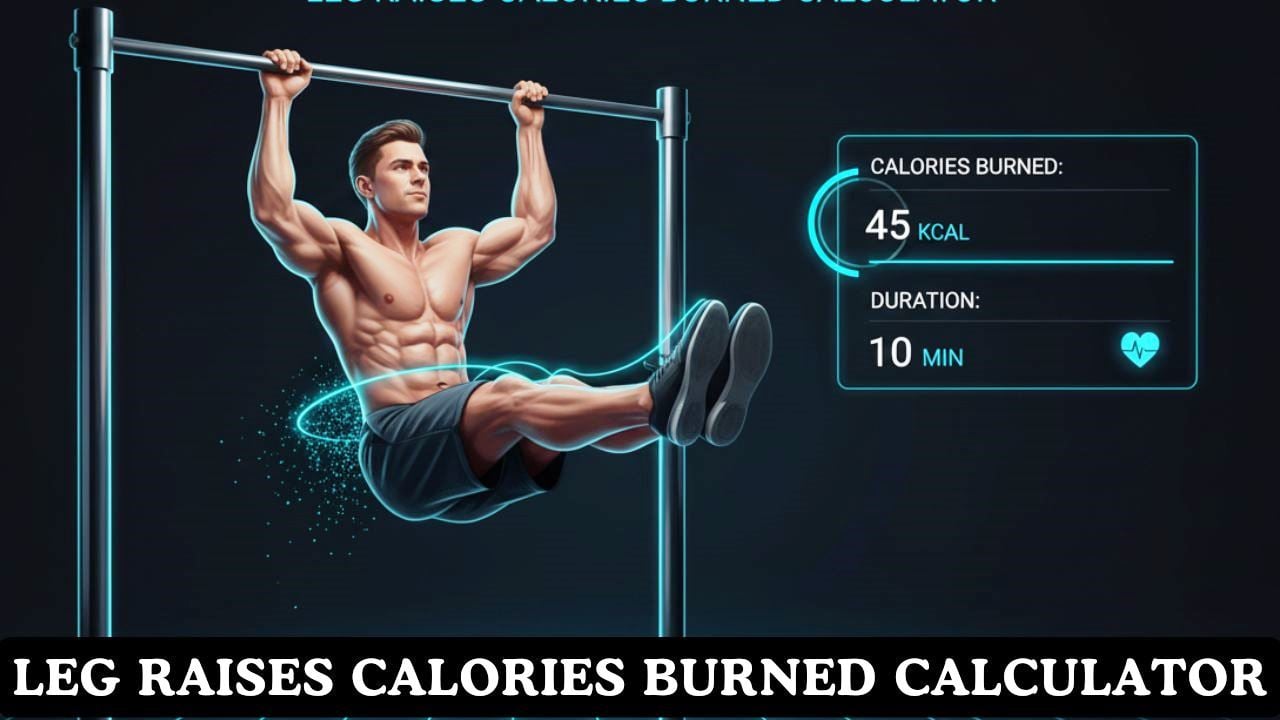
How Many Calories Do Leg Raises Burn?
Leg raises burn 206-551 calories per hour, depending on variation, intensity, and body weight. Basic lying leg raises burn 206-279 cal/hour for a 59-70kg person, captain’s chair and incline variations burn 331-368 cal/hour, while advanced hanging variations like toes to bar can burn up to 551 cal/hour. Leg raises are one of the most effective lower abdominal exercises with multiple intensity levels.
Leg raises specifically target your lower rectus abdominis and hip flexors through leg elevation movements. Unlike crunches that lift your upper body, leg raises challenge your core by lifting the weight of your legs against gravity. Different variations range from beginner-friendly lying leg raises to elite-level hanging toes to bar and windshield wipers.
Research published in PubMed
demonstrates that leg raise variations effectively activate lower abdominal muscles and improve core strength.
Our calculator includes 9 different leg raise variations with validated MET values from the Compendium of Physical Activities. Choose from basic, advanced, and elite options. Compare with our crunches calculator for complete core training.
Science of Leg Raise Calorie Burn
Leg raises burn calories through sustained isometric core contraction combined with dynamic leg movement. Your abdominals must contract continuously to stabilize your pelvis while your hip flexors lift your legs against gravity.
This dual demand creates significant metabolic activity, especially in advanced variations like hanging leg raises where your entire body weight is supported.
Clinical studies in strength research
confirm that leg raise variations effectively develop lower core strength and muscular endurance.
The calorie burn increases dramatically with hanging variations because you must also engage your lats, grip, and shoulder stabilizers to maintain body position. Hanging straight leg raises and toes to bar movements can burn 2-3 times more calories than lying leg raises due to the full-body engagement required.
Our calculator uses MET values ranging from 2.8 (bent knee lying raises) to 7.5 (hanging toes to bar) from the Compendium of Physical Activities. Explore lower abs exercises for comprehensive core development.
Leg Raise Calorie Formula & Methodology
📐 Scientific Calorie Calculation
Calories = (Time × MET × 3.5 × Weight) ÷ 200
Understanding Each Component:
- Time: Duration of leg raise workout in minutes
- MET: Metabolic Equivalent specific to variation (2.8-7.5)
- 3.5: Oxygen consumption constant (ml/kg/min)
- Weight: Your body weight in kilograms
- 200: Conversion factor for kilocalories
📊 Practical Example:
Scenario: 70 kg person, 10 minutes, captain’s chair leg raises (5.0 METs)
Calculation: (10 × 5.0 × 3.5 × 70) ÷ 200 = 61.25 ≈ 61 calories
Result: This person burns approximately 61 calories in 10 minutes of captain’s chair leg raises, or about 368 calories per hour.
Types of Leg Raise Exercises & Variations
💪 Basic Leg Raise Variations
Lying Bent Knee Raises (2.8 METs): The most accessible variation for beginners. Lie on your back, keep knees bent, and lift them toward your chest. Burns approximately 206 cal/hour for a 70kg person and teaches proper pelvic stabilization. Perfect for building foundational lower ab strength with reduced hip flexor strain.
Lying Straight Leg Raises (3.8 METs): Progress to straight legs for increased difficulty. Keep legs straight and lift them to 90 degrees, then lower with control. Burns approximately 279 calories per hour for a 70kg person. Significantly more challenging than bent knee raises and essential for developing lower ab strength.
Floor Flutter Kicks (3.8 METs): Rapid alternating leg movements maintaining constant tension. Keep legs straight and flutter them 6-12 inches off the ground. Burns approximately 279 cal/hour with the added benefit of cardiovascular conditioning. Excellent for building muscular endurance in your lower abs.
🔥 Advanced Leg Raise Variations
Incline Bench Leg Raises (4.5 METs): Perform on a decline bench to increase range of motion and difficulty. The incline adds gravity resistance and burns approximately 331 cal/hour for a 70kg person. Excellent progression before attempting hanging variations. Enhances both strength and control.
Captain’s Chair Leg Raises (5.0 METs): One of the most effective ab exercises according to ACE Fitness research. Support yourself on padded arms and lift knees (or straight legs) toward chest. Burns approximately 368 cal/hour and provides excellent lower ab isolation with back support.
Hanging Knee Raises (5.5 METs): Hang from a pull-up bar and bring knees to chest. This advanced variation burns approximately 405 cal/hour for a 70kg person and develops grip strength alongside core power. Engages the entire anterior chain and builds functional strength.
⚡ Elite Leg Raise Variations
Hanging Straight Leg Raises (6.5 METs): The elite progression requiring exceptional core and grip strength. Hang from a bar and raise straight legs to 90 degrees. Burns approximately 478 cal/hour for a 70kg person. Demands significant lat engagement to prevent swinging and full-body stabilization.
Hanging Toes to Bar (7.5 METs): The ultimate lower ab challenge! Touch your toes to the pull-up bar through explosive core contraction. Burns approximately 551 cal/hour for a 70kg person and requires elite-level core strength, shoulder mobility, and grip endurance. Popular in CrossFit and advanced calisthenics training.
Windshield Wipers (7.5 METs): Hang from a bar with legs raised to 90 degrees, then rotate legs side to side like windshield wipers. Burns approximately 551 cal/hour for a 70kg person. This elite movement challenges obliques and core rotational strength. Explore more pull-up bar ab exercises for variety.
Leg Raise Intensity MET Values & Performance
| Exercise Type | MET Value | Pace (reps/min) | Calories/Hour (70kg) | Best For |
|---|---|---|---|---|
| Lying Bent Knee | 2.8 | 12 | 206 cal/hr | Beginners |
| Lying Straight Leg | 3.8 | 10 | 279 cal/hr | General fitness |
| Floor Flutter Kicks | 3.8 | 20 | 279 cal/hr | Endurance |
| Incline Bench | 4.5 | 10 | 331 cal/hr | Progressive training |
| Captain’s Chair | 5.0 | 10 | 368 cal/hr | Lower ab isolation |
| Hanging Knee Raises | 5.5 | 8 | 405 cal/hr | Advanced strength |
| Hanging Straight Leg | 6.5 | 8 | 478 cal/hr | Elite core power |
| Toes to Bar | 7.5 | 6 | 551 cal/hr | CrossFit/Elite training |
| Windshield Wipers | 7.5 | 3 | 551 cal/hr | Oblique/rotational power |
Note: MET values based on the Compendium of Physical Activities. Calories calculated for 70 kg (154 lb) person. Actual burn varies with form, range of motion, grip strength, and rest periods. Hanging variations require significantly more energy due to full-body engagement and stabilization demands.
Leg Raise Calories by Duration
⏱️ Time-Based Calorie Estimates
Duration significantly impacts total calorie burn. These estimates use lying straight leg raises (3.8 METs) for reliable fitness planning. Balance core training with our BMR calculator and TDEE calculator for complete energy management.
| Time | 130 lb (59 kg) | 150 lb (68 kg) | 175 lb (79 kg) | 200 lb (91 kg) | 225 lb (102 kg) | 250 lb (113 kg) |
|---|---|---|---|---|---|---|
| 5 mins | 20 cal | 22 cal | 26 cal | 30 cal | 34 cal | 37 cal |
| 10 mins | 39 cal | 45 cal | 52 cal | 60 cal | 67 cal | 75 cal |
| 15 mins | 59 cal | 68 cal | 79 cal | 90 cal | 101 cal | 112 cal |
| 20 mins | 78 cal | 90 cal | 105 cal | 120 cal | 135 cal | 150 cal |
| 30 mins | 117 cal | 135 cal | 157 cal | 180 cal | 203 cal | 225 cal |
| 60 mins | 235 cal | 271 cal | 315 cal | 360 cal | 405 cal | 449 cal |
Note: Values based on lying straight leg raises (3.8 METs). Bent knee raises burn 26% less, while hanging toes to bar burns 97% more. Form quality, grip fatigue, and rest periods significantly affect actual calorie burn in hanging variations.
Maximize Your Leg Raise Effectiveness
💪 Techniques to Increase Benefits
Master the Progression: Start with bent knee raises, progress to straight leg raises, then advance to incline and captain’s chair variations before attempting hanging exercises. Rushing to hanging variations without proper core strength can lead to poor form and potential injury. Build a solid foundation first.
Control Pelvic Tilt: Press your lower back into the floor during lying variations and avoid arching. For hanging variations, think “pull your pelvis toward your ribcage” rather than just lifting legs. This posterior pelvic tilt ensures your abs do the work, not just hip flexors. Proper engagement increases effectiveness by 40-50%.
Build Grip Strength: Hanging variations are limited by grip strength. Incorporate grip strengthening exercises and dead hangs to build endurance. Use lifting straps initially if needed, but work toward unassisted hanging. Combine with pull-up training for comprehensive upper body development. Support recovery with our protein calculator.
Leg Raise Calorie Burn FAQs
❓ How accurate is this leg raise calculator?
Our calculator uses the scientifically validated formula: Calories = (Time × MET × 3.5 × Weight) ÷ 200, with MET values from the Compendium of Physical Activities. This provides accuracy within 10-15%, comparable to laboratory measurements for abdominal exercises.
💪 How many calories does 50 leg raises burn?
50 lying straight leg raises burn approximately 23 calories for a 70 kg person. At 10 reps/min, 50 leg raises take about 5 minutes and burn roughly 23 calories (3.8 METs). Hanging straight leg raises (6.5 METs) would burn approximately 50 calories for the same 50 reps due to higher intensity and full-body engagement requiring 6.25 minutes at 8 reps/min.
🏋️ Are leg raises or crunches better for calories?
Advanced leg raises (hanging variations) burn significantly more calories than crunches due to full-body engagement. Hanging toes to bar (7.5 METs, 551 cal/hour) burns nearly double moderate crunches (3.8 METs, 279 cal/hour). However, basic lying leg raises and crunches burn similar calories at comparable intensities.
🔥 Which leg raise variation burns the most calories?
Hanging toes to bar and windshield wipers burn the most calories at 7.5 METs (551 cal/hour for a 70kg person). These elite movements require exceptional core strength, grip endurance, and shoulder stability. For most people, captain’s chair leg raises offer the best balance of effectiveness and accessibility, burning 368 cal/hour with back support.
⚡ Can leg raises reduce belly fat?
Leg raises burn 206-551 cal/hour depending on variation, but don’t spot-reduce belly fat. However, they build strong lower abs and hip flexors which improve core stability and athletic performance. For fat loss, combine leg raises with cardio, full-body strength training, and proper nutrition. Hanging variations burn significantly more calories. Use our weight loss calculator for personalized goals.
🎯 How do I progress to hanging leg raises?
Progress systematically: Master lying straight leg raises (50+ reps), advance to incline bench leg raises, then captain’s chair leg raises. Build grip strength with dead hangs (30+ seconds). Start with hanging knee raises before attempting straight leg raises. This progression typically takes 2-4 months of consistent training. Learn proper technique with our pull-up bar ab workout guide.
Core Exercise & Safety Disclaimer
This tool is for educational and informational purposes only. Consult healthcare professionals, certified personal trainers, or physical therapists before attempting advanced hanging leg raises, especially if you have shoulder, lower back, or hip conditions.

Manish is a NASM-certified fitness and nutrition coach with over 10 years of experience in weight lifting and fat loss fitness coaching. He specializes in gym-based training and has a lot of knowledge about exercise, lifting technique, biomechanics, and more.
Through “Fit Life Regime,” he generously shares the insights he’s gained over a decade in the field. His goal is to equip others with the knowledge to start their own fitness journey.