
Spinning Calories Calculator
Calculate your calorie burn during indoor cycling and spin classes using research-backed MET values
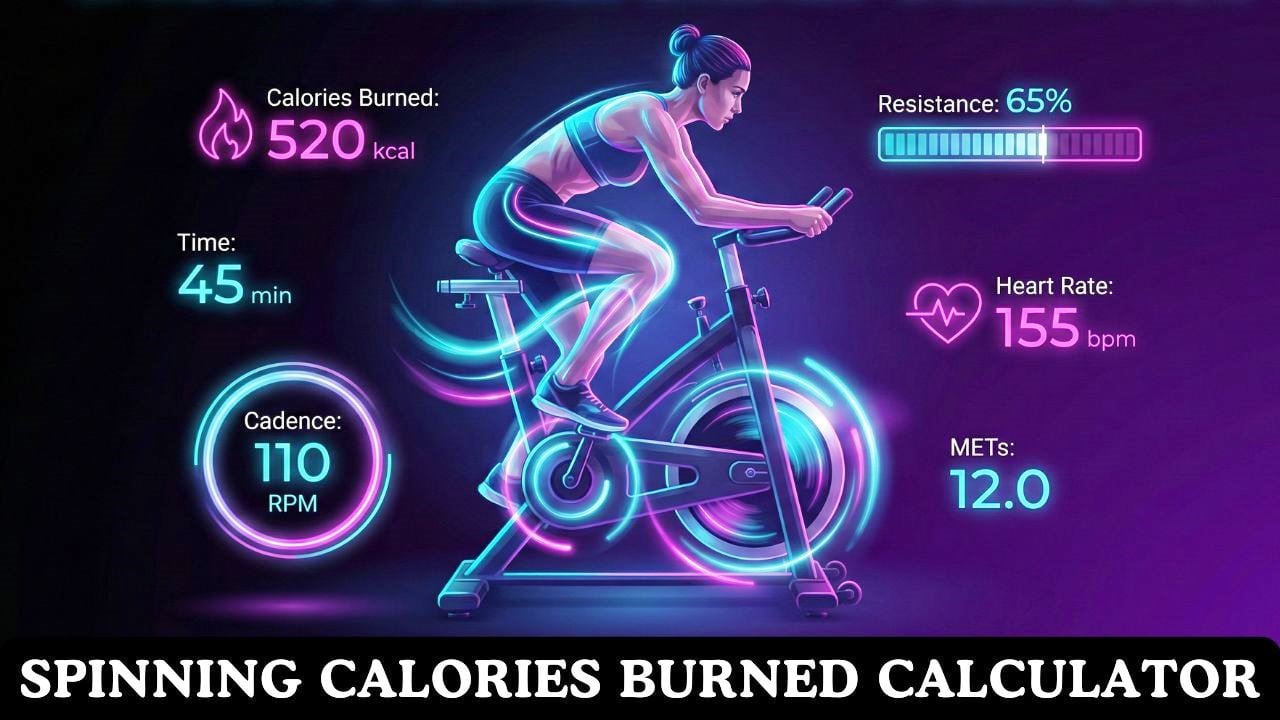
🔥 Your Spinning Results
💡 Spinning Performance Tips
- Maintain proper bike setup with correct saddle height for efficient power transfer
- Keep your core engaged throughout the ride to support your lower back
- Vary your cadence between 60-100 RPM for different training benefits
- Stay hydrated – aim for 500-750ml of water per hour of spinning
- Use resistance progressively to build strength without compromising form
How Many Calories Does Spinning Burn?
Spinning burns between 250 to 1,000+ calories per hour, depending on your body weight, intensity level, and power output. A 70 kg (154 lbs) person typically burns around 500 calories in a 45-minute spin class at moderate intensity. Higher power outputs (200+ watts) can burn over 700 calories in the same timeframe.
Indoor cycling is one of the most efficient cardiovascular workouts available. Research published in the Journal of Sports Science & Medicine shows that spinning provides an excellent combination of calorie expenditure and lower-body muscle engagement while being low-impact on joints.
The Spinning Calorie Burn Formula
This calculator uses the scientifically validated MET (Metabolic Equivalent of Task) method from the 2011 Compendium of Physical Activities:
Person: 70 kg | Intensity: Spin Class (8.5 MET) | Duration: 45 minutes
Calculation: 8.5 × 3.5 × 70 ÷ 200 × 45 = 468 calories
The MET value represents energy expenditure relative to rest. A MET of 8.5 means you’re burning 8.5 times more calories than at rest. Learn more about effective fitness and exercise benefits at Fit Life Regime.
Spinning Intensity Levels & MET Values
The table below shows calorie burn estimates for different spinning intensities based on a 70 kg (154 lbs) person for one hour:
| Intensity Level | Power Output | MET | Calories/Hour (70 kg) |
|---|---|---|---|
| Very Light | 30-50 watts | 3.5 | 257 |
| Light to Moderate | 51-89 watts | 4.8 | 353 |
| Moderate to Vigorous | 90-100 watts | 6.8 | 500 |
| General Spinning | Variable | 7.0 | 515 |
| Spin Class (RPM) | Variable | 8.5 | 625 |
| Vigorous | 101-160 watts | 8.8 | 647 |
| High Intensity | 161-200 watts | 11.0 | 809 |
| Very High Intensity | 201-270 watts | 14.0 | 1,029 |
Power output is a more accurate measure of effort than heart rate alone. Modern spin bikes with power meters allow you to track watts in real-time for precise training.
Key Factors Affecting Calorie Burn
- Body Weight: Heavier individuals burn more calories due to greater energy requirements
- Power Output (Watts): Higher resistance and faster cadence increase wattage and calorie burn
- Workout Duration: Longer sessions naturally burn more total calories
- Fitness Level: Well-trained cyclists are more efficient but can sustain higher intensities
- Cadence (RPM): Optimal cadence range of 80-100 RPM maximizes cardiovascular benefits
- Resistance Level: Higher resistance builds leg strength and increases energy expenditure
Spinning vs Other Cardio Exercises
How does spinning compare to other popular cardio workouts? Here’s a comparison for a 70 kg person exercising for 45 minutes:
| Activity | MET | Calories (45 min) |
|---|---|---|
| Spinning (Spin Class) | 8.5 | 468 |
| Running (6 mph) | 9.8 | 540 |
| Swimming (moderate) | 7.0 | 386 |
| Rowing Machine | 7.0 | 386 |
| Elliptical Trainer | 5.0 | 276 |
| Walking (3.5 mph) | 3.5 | 193 |
For those interested in building leg strength and power, spinning offers an excellent complement to resistance training.
Frequently Asked Questions
Yes, spinning is highly effective for weight loss. A 45-minute spin class can burn 400-600 calories depending on intensity. Combined with proper nutrition, regular spinning sessions create the calorie deficit needed for sustainable weight management. The workout also builds lean muscle, which increases your resting metabolism.
Built-in calorie counters on spin bikes can vary in accuracy by 20-30%. Bikes with power meters tend to be more accurate since they measure actual work output. Our calculator uses scientifically validated MET values that account for body weight and intensity, providing estimates within 10-15% of actual expenditure.
The optimal cadence depends on your goals. For endurance and cardiovascular training, aim for 80-100 RPM. For strength and power, lower cadences of 60-80 RPM with higher resistance are effective. Sprint intervals may reach 100-120 RPM briefly. Avoid spinning faster than 120 RPM as it becomes inefficient and increases joint stress.
Target watts depend on fitness level and goals. Beginners might average 50-100 watts, intermediate cyclists 100-180 watts, and advanced riders 180-250+ watts. A good benchmark is 2-3 watts per kilogram of body weight for sustained efforts. For a 70 kg person, that’s 140-210 watts during steady-state cycling.
Spinning is generally considered low-impact and easier on joints than running. However, proper bike setup is essential. An incorrect saddle height can strain the knees. Ensure your knee has a slight bend (25-35 degrees) at the bottom of the pedal stroke. If you experience discomfort, reduce resistance and consult a fitness professional for bike fitting.

Manish is a NASM-certified fitness and nutrition coach with over 10 years of experience in weight lifting and fat loss fitness coaching. He specializes in gym-based training and has a lot of knowledge about exercise, lifting technique, biomechanics, and more.
Through “Fit Life Regime,” he generously shares the insights he’s gained over a decade in the field. His goal is to equip others with the knowledge to start their own fitness journey.