
💪 Training Intensity Calculator
Master your training with scientifically validated intensity calculations: Heart Rate Zones, 1RM Percentages, and RPE Scale
Rate of Perceived Exertion (RPE) Scale
RPE measures training intensity based on how hard you feel you’re working. Use this scale for both strength and cardio training when precise measurements aren’t available.
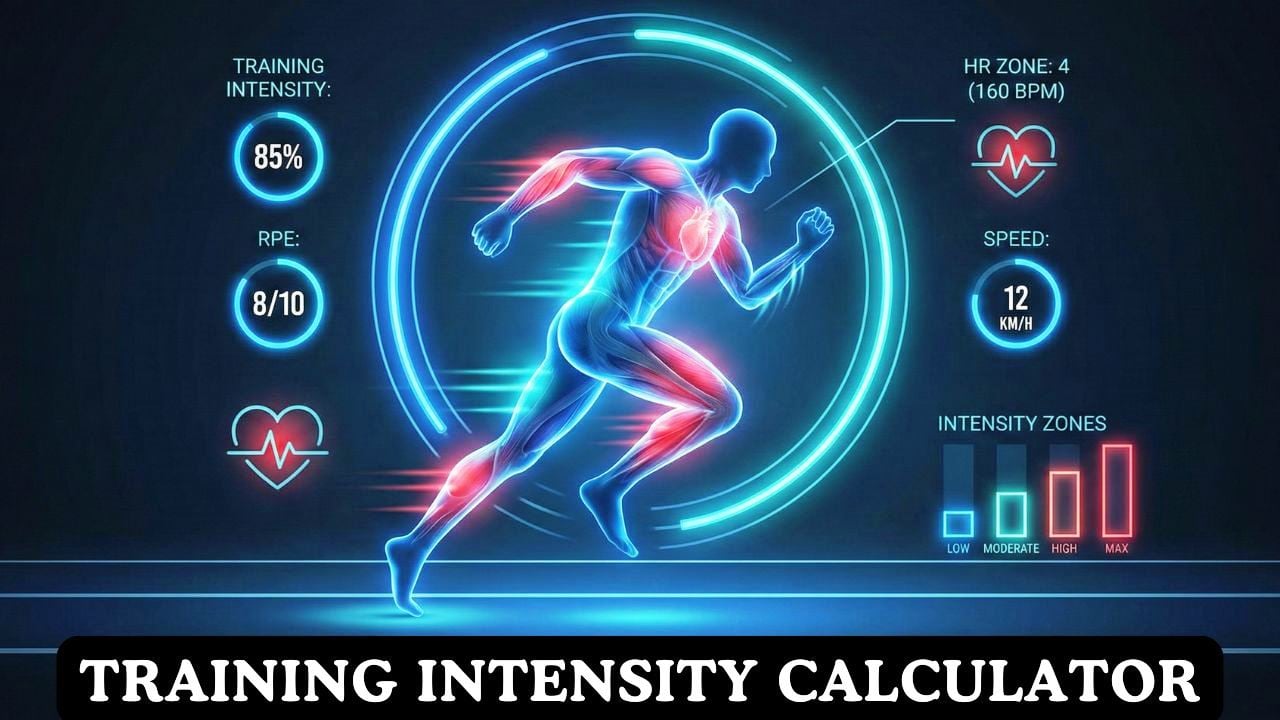
Why Training Intensity Matters
Training intensity determines the physiological adaptations your body makes from exercise. Whether your goal is building strength, improving endurance, or enhancing performance, proper intensity management is the key to consistent progress while avoiding overtraining.
This calculator provides three scientifically validated methods to measure and optimize training intensity: heart rate zones for cardiovascular training, 1RM percentages for strength work, and the RPE scale for subjective effort monitoring. Each method serves specific training contexts and goals.
Target HR = ((Max HR – Resting HR) × Intensity%) + Resting HR
Max HR = 220 – Age
Max HR = 220 – 30 = 190 BPM
HR Reserve = 190 – 60 = 130 BPM
Zone Range = (130 × 0.70) + 60 to (130 × 0.80) + 60 = 151-164 BPM
Heart Rate Training Zones Explained
Heart rate zones divide your cardiovascular capacity into distinct training intensities, each producing specific adaptations:
- Zone 1 – Recovery (50-60% MHR): Active recovery, promotes blood flow without stress. Perfect for rest days or warm-ups.
- Zone 2 – Aerobic (60-70% MHR): Fat burning zone, builds aerobic base. Sustainable for hours, foundational for endurance.
- Zone 3 – Tempo (70-80% MHR): Improves aerobic efficiency and endurance. Challenging but controlled pace.
- Zone 4 – Threshold (80-90% MHR): Lactate threshold training, increases sustainable pace at high intensity. Race pace work.
- Zone 5 – VO2 Max (90-100% MHR): Maximum aerobic capacity. Short intervals, HIIT, maximum effort training.
The Karvonen formula (Heart Rate Reserve method) provides more accurate zones than simple percentage of max HR, especially for trained athletes. Learn more about cardiovascular training benefits.
1RM Percentages for Strength Training
Your 1-Rep Max (1RM) is the maximum weight you can lift for one complete repetition. Training at specific percentages of your 1RM produces targeted strength adaptations:
1RM = Weight ÷ (1.0278 – (0.0278 × Reps))
1RM = 80 ÷ (1.0278 – (0.0278 × 5))
1RM = 80 ÷ 0.889 = 90 kg (198 lbs)
| Intensity | % of 1RM | Rep Range | Primary Adaptation |
|---|---|---|---|
| Maximum Strength | 90-100% | 1-4 reps | Neural adaptation, max force production |
| Strength Development | 80-90% | 4-8 reps | Strength with some size gains |
| Hypertrophy | 70-80% | 8-12 reps | Muscle growth, metabolic stress |
| Muscular Endurance | 60-70% | 12-20 reps | Endurance, work capacity |
Combine strength training with proper recovery strategies for optimal results.
Applying Training Intensity Principles
Rate of Perceived Exertion (RPE) Scale
RPE provides a subjective measure of training intensity based on how hard you feel you’re working. This method is valuable when heart rate monitors or 1RM data aren’t available, and it accounts for daily variations in performance.
The modern RPE scale (1-10) was adapted from the original Borg Scale for practical training application. Research shows strong correlation between RPE and physiological intensity markers, making it a valid tool for regulating training load.
Key RPE Anchor Points:
- RPE 6-7: Sustainable training pace, can maintain conversation with some difficulty
- RPE 8: Very hard effort, 2 reps in reserve (RIR), short sentences only
- RPE 9: Near maximum, 1 rep in reserve, single words only
- RPE 10: Absolute maximum, complete failure or sprint finish
RPE works for both strength training (measured as reps in reserve) and cardio (measured by breathing difficulty and sustainability). It’s particularly useful for compound movements where multiple muscle groups make exact intensity harder to quantify.
Periodization and Intensity Cycling
Effective training programs cycle intensity to maximize adaptations while managing fatigue. Understanding how to structure intensity variations is key to long-term progress.
Weekly Intensity Distribution (80/20 Rule):
- 80% Low Intensity: Zone 1-2 for cardio, 60-70% 1RM for strength. Builds base, promotes recovery
- 20% High Intensity: Zone 4-5 for cardio, 85-95% 1RM for strength. Drives peak adaptations
- Minimal Medium Intensity: Zone 3 and 75-80% 1RM create fatigue without sufficient stimulus
Block Periodization Phases:
- Accumulation (3-4 weeks): Higher volume, moderate intensity (70-80% 1RM, Zone 2-3)
- Intensification (2-3 weeks): Lower volume, high intensity (85-95% 1RM, Zone 4-5)
- Realization (1-2 weeks): Peak intensity with reduced volume, testing maximal capacity
- Deload (1 week): Reduced volume and intensity (60-70% 1RM, Zone 1-2) for recovery
This structured approach prevents overtraining while ensuring progressive overload. Explore foundational exercises to build your training base.
Common Training Intensity Questions
Q: How accurate is the 220-age formula for maximum heart rate?
The 220-age formula has a standard deviation of ±10-12 BPM, meaning individual max HR can vary significantly. It’s adequate for general training but not precise. For better accuracy, perform a proper max HR test under professional supervision, or use the Karvonen formula with resting heart rate, which accounts for individual fitness levels.
Q: Should I train to failure or use RPE?
Training to complete failure (RPE 10) has limited applications and high fatigue cost. Most training should occur at RPE 7-9 (1-3 reps in reserve). Reserve training to failure for specific scenarios: final set of isolation exercises, deload testing, or competition. Chronic failure training increases injury risk and impairs recovery without proportional gains.
Q: How often should I test my 1RM?
Test 1RM every 8-12 weeks for major lifts. Frequent max testing (monthly or more) creates unnecessary fatigue and injury risk. Instead, use estimated 1RM from submaximal sets (3-5 reps at RPE 8-9) to track progress. Reserve true 1RM tests for meet preparation or program transitions.
Q: Can I use heart rate zones for strength training?
Heart rate zones are less useful for traditional strength training due to intermittent work:rest ratios and the delayed heart rate response to resistance exercise. However, HR monitoring works well for circuit training, CrossFit-style workouts, or high-rep strength endurance work. For pure strength training, rely on 1RM percentages and RPE instead.
Q: What intensity is best for fat loss?
While Zone 2 (60-70% MHR) has the highest percentage of calories from fat, total calorie burn matters more for fat loss. High-intensity training (Zone 4-5) burns more total calories and creates EPOC (afterburn effect). Optimal approach: 80% low-intensity steady state (Zone 2) for sustainability, 20% high-intensity intervals (Zone 4-5) for metabolic boost. Combine with proper nutrition and resistance training for body composition changes.

Manish is a NASM-certified fitness and nutrition coach with over 10 years of experience in weight lifting and fat loss fitness coaching. He specializes in gym-based training and has a lot of knowledge about exercise, lifting technique, biomechanics, and more.
Through “Fit Life Regime,” he generously shares the insights he’s gained over a decade in the field. His goal is to equip others with the knowledge to start their own fitness journey.