
Assault Bike Calories Burned Calculator
Calculate energy expenditure for air bike workouts using validated MET values
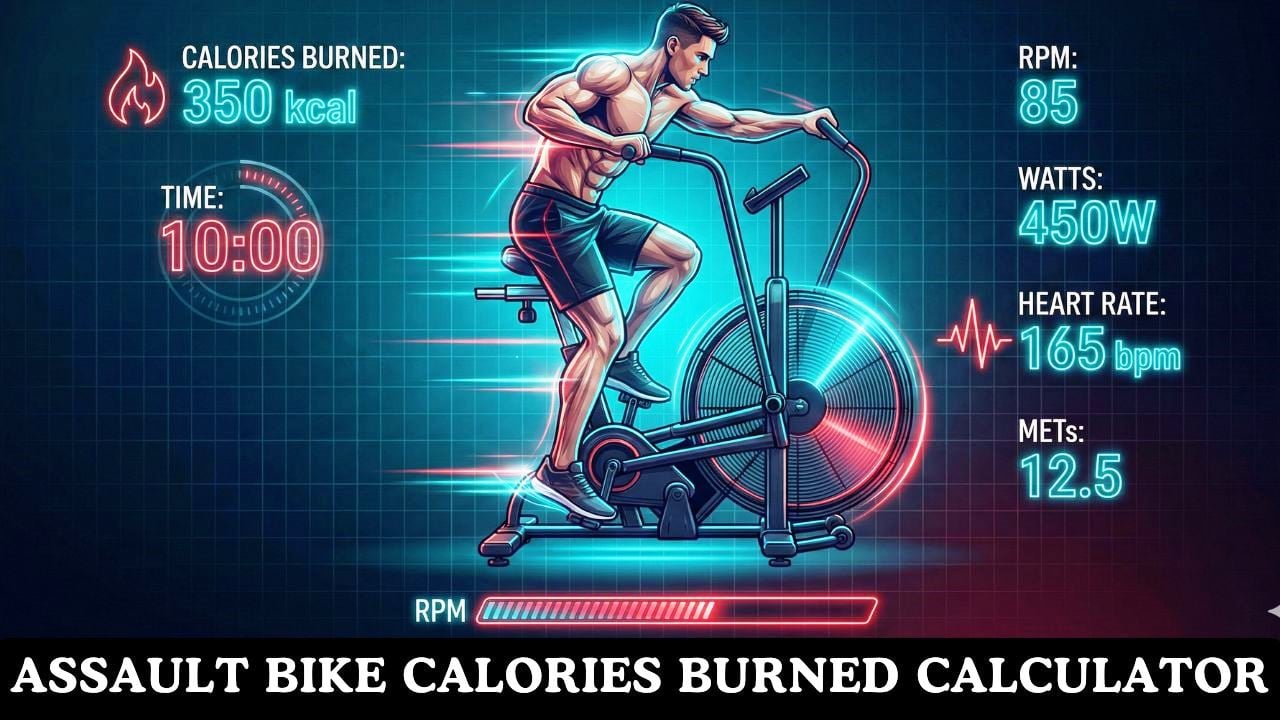
How Many Calories Does the Assault Bike Burn?
The assault bike burns between 400-1000+ calories per hour depending on workout intensity, your body weight, and training style. A 20-minute moderate-intensity session typically burns 180-280 calories for most adults. At maximum effort, the assault bike ranks among the highest calorie-burning cardio machines, capable of burning 15-20 calories per minute during all-out sprints.
What makes the assault bike exceptional for calorie burning is its unique air resistance system. Unlike traditional bikes, the fan creates resistance that increases with your effort—push harder and the resistance grows proportionally. This self-regulating mechanism ensures you’re always working at your chosen intensity level.
Primary factors affecting calorie burn:
- Body weight: Heavier individuals burn more calories at the same intensity
- Intensity level: Maximum effort burns 2-2.5x more than light effort
- Duration: Longer sessions accumulate more total calories
- Workout style: HIIT protocols maximize metabolic effect
- Full-body engagement: Using arms and legs simultaneously increases burn by 20-30%
The Science Behind Air Bike Calorie Calculation
This calculator uses the MET (Metabolic Equivalent of Task) system, the gold standard for measuring exercise energy expenditure. MET values represent how many times more energy an activity burns compared to sitting at rest.
Calories/min = 8.8 × 3.5 × 75 ÷ 200 = 11.6 calories/minute
Total = 11.6 × 20 = 231 calories
The calculator applies additional multipliers for workout style, fitness level, and environment to provide personalized estimates that reflect real-world training conditions.
Assault Bike Intensity Levels and MET Values
Understanding intensity levels helps you choose the right workout for your goals. The assault bike’s MET values range from 5.5 for light warm-up pace to 16.0 for elite-level competition efforts, based on the Compendium of Physical Activities and air bike research.
| Intensity Level | MET Value | Calories/Hour (70kg) | Best For |
|---|---|---|---|
| Light Effort | 5.5 METs | ~404 cal | Warm-up, recovery |
| Moderate Effort | 7.0 METs | ~515 cal | Aerobic base building |
| Vigorous Effort | 8.8 METs | ~647 cal | Cardiovascular fitness |
| High Effort | 11.0 METs | ~808 cal | HIIT intervals |
| Maximum Effort | 14.0 METs | ~1,029 cal | Sprint training |
| Elite Effort | 16.0 METs | ~1,176 cal | Competition prep |
Note: These values represent sustained effort. Most HIIT workouts alternate between high and low intensities, resulting in average calorie burns between the listed values.
How Assault Bike Compares to Other Cardio Equipment
The assault bike consistently ranks among the highest calorie-burning cardio machines due to its full-body engagement. Here’s how it compares to popular alternatives for a 70kg person:
- Assault Bike (vigorous): 600-800 calories/hour – Full-body, self-regulating resistance
- Rowing Machine: 500-700 calories/hour – Full-body, adjustable resistance
- Running (8 mph): 600-750 calories/hour – Lower body dominant, high impact
- Stationary Bike: 400-550 calories/hour – Lower body only, fixed resistance
- Elliptical: 400-600 calories/hour – Full-body, low impact
The assault bike’s advantage lies in engaging approximately 80% of your muscles simultaneously, including legs, core, and upper body. This comprehensive muscle recruitment drives higher metabolic demand than leg-only cardio options.
Frequently Asked Questions
Why does assault bike feel harder than other cardio?
The assault bike engages both upper and lower body simultaneously, recruiting significantly more muscle mass than leg-only exercises. This full-body demand creates higher cardiovascular stress and metabolic load. Additionally, the air resistance increases progressively with effort—the faster you pedal, the more resistance you encounter—making high-intensity efforts particularly challenging.
How accurate are assault bike calorie displays?
Built-in calorie displays on assault bikes use algorithms based on power output and standardized body weight assumptions. They can overestimate by 15-30% for lighter individuals and underestimate for heavier users. This calculator provides more personalized estimates by incorporating your actual body weight and multiple training factors.
Is assault bike good for weight loss?
Yes, the assault bike is highly effective for weight management when combined with proper nutrition. Its high calorie burn rate, low joint impact, and EPOC (excess post-exercise oxygen consumption) effect make it excellent for creating calorie deficits. A 30-minute high-intensity session can burn 300-450 calories and elevate metabolism for hours afterward.
How often should I use the assault bike?
Training frequency depends on intensity and your overall program. For high-intensity sessions, 2-4 times per week with adequate recovery is typical. Low-to-moderate intensity sessions can be performed more frequently, even daily, as active recovery. Listen to your body and ensure proper recovery between intense workouts.
Should I use arms only, legs only, or both?
Using both arms and legs simultaneously maximizes calorie burn (20-30% more than legs alone) and develops full-body conditioning. However, isolating arms or legs can be useful for specific training goals, active recovery, or when one area is fatigued. Most effective workouts emphasize coordinated full-body movement.

Manish is a NASM-certified fitness and nutrition coach with over 10 years of experience in weight lifting and fat loss fitness coaching. He specializes in gym-based training and has a lot of knowledge about exercise, lifting technique, biomechanics, and more.
Through “Fit Life Regime,” he generously shares the insights he’s gained over a decade in the field. His goal is to equip others with the knowledge to start their own fitness journey.